
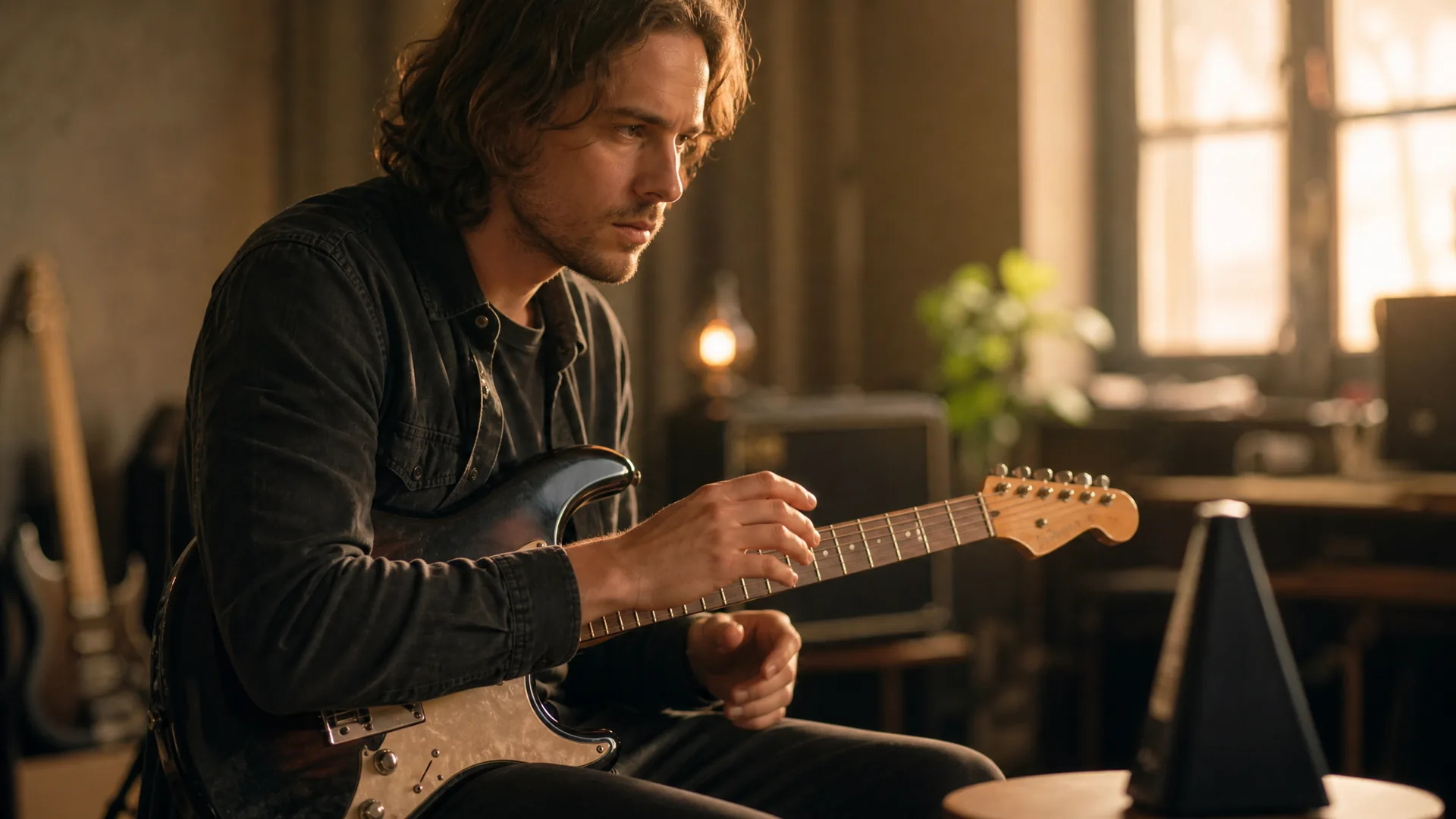
You can run scales at full speed. You can nail the fingering on every chord. You can play the right notes in the right order, and still sound like a machine. That gap, between technical execution and actual music, is where most guitarists spend their entire lives without ever crossing. Learning how to play guitar with feel is about understanding what music is for.
Most Guitarists Never Learn What Guitar Feel Actually Is
Technique is a tool. Feel is a purpose. Confusing them is the single most common reason capable players plateau and stay there.
Guitar feel and emotion can be learned like any other skill. Feel is intentional musical communication, knowing what you want to say before you play a single note. It is the difference between executing a phrase and meaning it.
Adam Levine spent 50 years teaching guitarists at every level, from beginners to students who went on to perform with Michael Jackson, George Benson, Celine Dion, and Norah Jones. The through-line in every lesson: technique without intention is just exercise.
That is the core thesis here. Feel is learnable. It is a discipline, rooted in deep listening and deliberate musical intention. The players who move audiences are the most intentional, whatever their technical level.
Feel Starts Before You Touch the Guitar
Playing guitar musically begins in the mind. If you don't hear the phrase before you play it, you are guessing, and listeners hear guessing.
Hear It Before You Play It
Great players audiate. They sing the phrase internally before the pick ever hits the string. This practice, sometimes called inner hearing, is the difference between a musician who sees the neck and one who hears the music.
Seeing the neck means thinking in shapes, patterns, and positions. It is a valid navigation tool, but it produces pattern-based playing. Hearing the music means you already know the emotional destination of the phrase. Your fingers follow your ear.
Start small. Before you play your next solo phrase, hum it. Sing it out loud if you have to. If you can't hear it, you can't play it with conviction, because you don't yet know what you're trying to say.
Intention vs. Instinct: Why One Sounds Musical
Instinct gets a lot of praise in guitar culture. "Just feel it" is terrible advice dressed up as wisdom. What sounds like raw instinct in great players is almost always deeply trained intention, years of deliberate practice compressed into reflex.
Intention means you made a choice. You decided the phrase rises here, breathes there, bends to this specific pitch, not approximately near it. Instinct without that foundation is just habit. And habits don't tell stories.
Guitar Phrasing Techniques That Create Emotion
This is where concept meets practice. Specific guitar phrasing techniques are the mechanics through which feel becomes audible to a listener.
Space, Silence, and the Power of What You Don't Play
Miles Davis told his musicians to play the space between the notes. That instruction, from one of the most recorded musicians in history, captures exactly what separates musical feel from technical display.
Space is tension. A rest after a strong melodic statement gives the listener time to feel the note that just landed. Removing that space removes the emotional weight. You cannot rush a story.
At Berklee, the first lesson in phrasing is about what to leave out. Economy of expression forces intention. When you have fewer notes, every one counts.
Practice this directly: take a 4-bar blues phrase you already know. Remove half the notes. Keep only the ones you would fight to protect. What's left is probably more musical than what you started with.
How well do you really know the fretboard?
Take the free Fretboard Challenge and see exactly which notes cost you time. Then get the note map that fixes them.
One email with the map. Unsubscribe whenever: no card, nothing to cancel.
On its way.
Check your inbox in the next minute or two. If it is not there, look in promotions.
Dynamics and Touch: How Volume and Pressure Shape Feeling
Adding emotion to guitar playing happens in both hands. The angle of your pick, the pressure of your fingertip, the speed of your attack, these are the tonal palette.
A hard attack on a single note creates urgency. A soft entry on the same note creates vulnerability. Both are intentional choices. Micro-dynamics, variation within a single phrase as well as across sections, are what make a phrase breathe.
Experiment with pick pressure across one sustained phrase. Play it three times: aggressive attack, medium, and barely touching the string. You have just played three different emotional statements using the same notes. That is feel operating through technique.
Blues Guitar Feel as the Master Class in Expression
Blues is a framework for emotional storytelling on guitar, and the most honest proving ground for feel in Western music.
B.B. King was famous for playing fewer notes than almost any blues guitarist of his era, yet every single note was a complete emotional statement. His vibrato, his placement, his silence between phrases: that is feel at its highest level. He spoke through every note.
Blues guitar feel runs on specific structural choices. Call-and-response phrasing mirrors human conversation, one phrase asks, the next answers, and the silence between them is part of the sentence. A bend in a blues phrase has a destination. It arrives at a pitch with conviction, because the player already heard it before the bend began.
Timing placement matters as much as any of this. Playing slightly behind the beat, not dragging, but leaning, creates a heaviness that playing on top of the beat cannot. It is a choice. The blues tradition demands you know the difference.
Before you play blues, listen to blues. Deeply and repeatedly. Pick one recording, a B.B. King phrase, a Freddie King turnaround, and live with it. Don't reach for your guitar for the first twenty minutes. Just hear it. Count the space. Feel where the bends resolve. That listening is practice.
How to Train Feel: What Practice Actually Looks Like
Concepts without method are just inspiration. Here is what deliberate feel practice actually looks like day to day.
Listen More Than You Play
Transcription is the standard tool, but most players transcribe for notes. Transcribe for phrasing instead. Take a 4-bar phrase from a player whose feel you admire. Write down the choices as well as the pitches: Where does the phrase start in the bar? Where does it breathe? How long is the sustain on the peak note? What is the dynamic shape, does it swell or taper?
You are reverse-engineering intention. You are learning to ask, "What was this player trying to say?" before you try to say anything yourself. This practice builds the vocabulary of musical decision-making.
Adding Emotion to Guitar Playing Through Deliberate Repetition
Record yourself. This is non-negotiable. Play a phrase, then listen back and ask one specific question: did that communicate what I intended? Skip "did it sound good?", which is too vague. Did the bend land where you heard it? Did the space land where you meant it?
The gap between what you thought you played and what the recording reveals is where your real practice lives. Adam Levine trains this in students from the first lesson: intention must be checkable. If you can't evaluate whether you communicated, you can't improve communication.
Repeat a single phrase, the same 2 bars, with one deliberate variable changed each time. Change only the attack. Then change only the space. Then change the bend speed. Each version is a different statement. Your ear will start to distinguish which statements are true and which are vague.
Studio guitarists, the players who record for a living, are hired because they can serve the song. Adam Levine's years as a Motown session player were built entirely on that standard. The ability to make every take a clear, intentional statement is a trained skill.
The Musician's Standard: What Playing Guitar with Feel Really Demands
There is a line between being a guitarist and being a musician. It is drawn by whether you have something to say.
Knowing how to play guitar with feel means accepting that the notes are the medium. What you say through them, the shape of the phrase, the weight of the silence, the conviction in the bend, that is the music. And that is what listeners remember.
Feel is the entire point of the enterprise. Technique earns you the right to execute your intention precisely. Nothing more.
The players who tell stories, who make rooms go quiet, are the most committed to communicating something true. That commitment is a discipline. It can be taught, practiced, and refined over a lifetime.
If you are technically capable and still feel like something is missing, it probably is. The Adam Loves Guitar Academy is built for exactly that gap, where technically able players finally learn to play with real musical intention. That is the work. It is harder than learning scales, and it matters more.
