
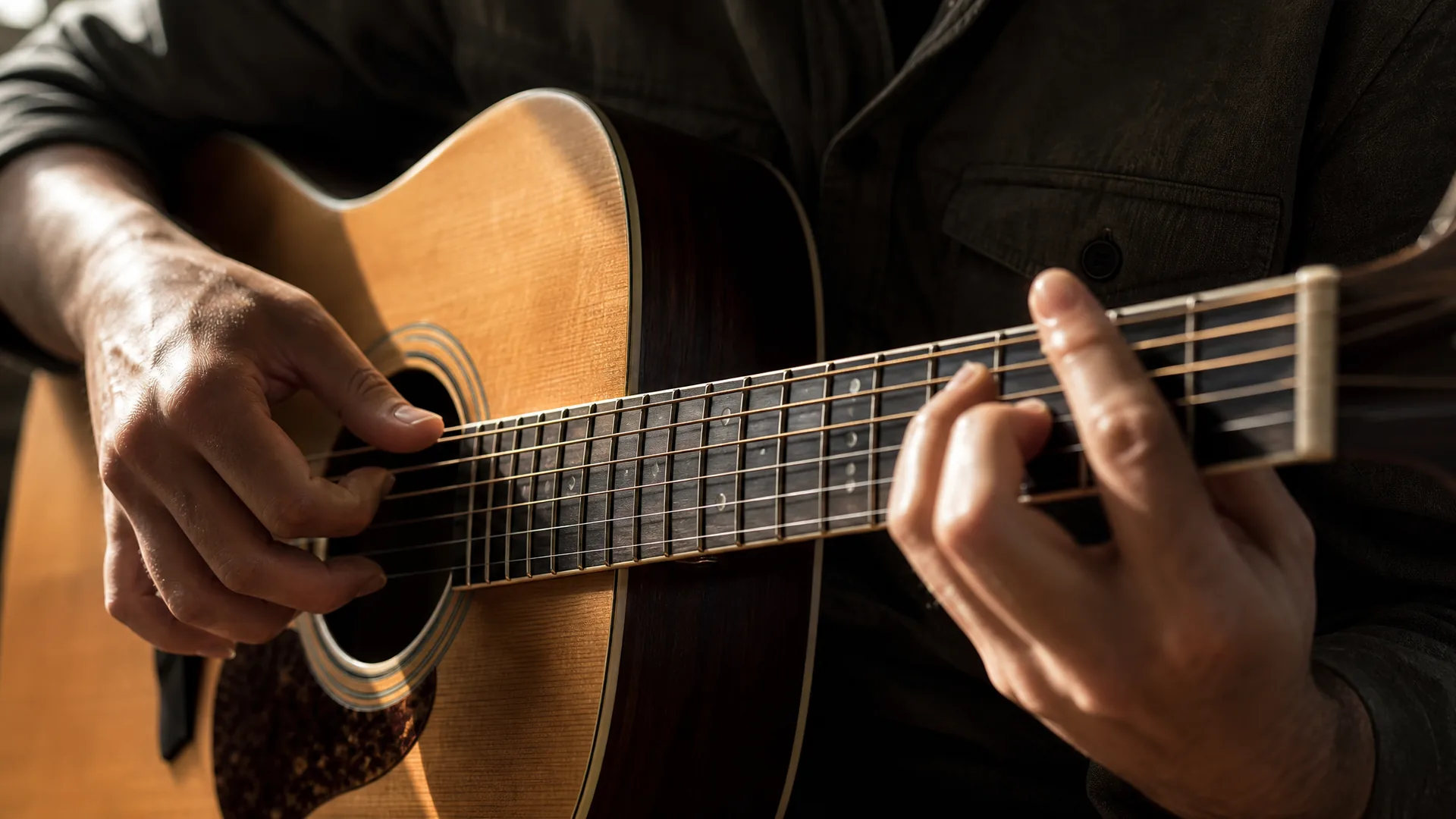
You already know your barre chords. You can run a scale up and down the neck without thinking about it. So why does your playing still sound flat, technically correct but musically thin?
Usually the answer is that you've never had to make your two hands do two different jobs at once. That's what fingerstyle guitar technique for adults actually trains. It's why so many capable players hit a wall they can't name.
Adam Levine has taught for 50 years, including a stretch as a Motown studio guitarist. That experience shaped a philosophy that separates finger dexterity from true musical independence. Fingerstyle is the technique that exposes whether your hands are actually independent, or just moving together on autopilot.
Why Learn Fingerstyle Guitar If You Already Play Chords
Most guitarists learn fingerstyle guitar backwards. They pick up a pattern, memorize it, apply it to a song, and call it a skill. That's mimicry.
The real reason to learn fingerstyle goes well beyond sounding pretty on an acoustic ballad. Fingerstyle forces your hands to stop cooperating and start collaborating. A pick moves one way. Fingers move four different ways, independently, at the same time. That distinction is the entire point.
If you've plateaued on rhythm guitar, you've probably never been asked to separate what your thumb does from what your fingers do. Fingerstyle asks that of you immediately. There's no faking it.
Fingerstyle Guitar vs Flatpick: Two Different Relationships With the Instrument
A flatpick gives you one point of contact with the strings. Every note, whether it's a bass note, a chord tone, or a melody line, comes through the same attack, the same angle, the same voice.
Fingerstyle guitar gives you four or five points of contact. Each one is capable of its own volume, its own timing, its own tone. That's the actual difference between fingerstyle guitar and flatpicking. In short, it's mono versus polyphonic control.
With a pick, you play a progression. With fingerstyle, you can play a bass line, a chord, and a melody at the same time, each with its own dynamic shape. Flatpicking rewards speed and rhythmic drive. Fingerstyle rewards precision and independence. Neither is better. But only one of them teaches you to hear the guitar as an ensemble instead of a single voice.
Fingerstyle Guitar Hand Position: Building the Foundation Correctly
Here's the uncomfortable truth: most self-taught fingerstyle players have already built bad habits into their hand position. Bad hand position limits tone, and it caps how far your technique can ever go.
Correct fingerstyle guitar hand position starts with the wrist, before the fingers. A relaxed, slightly arched wrist lets each finger move independently from the knuckle, not from tension in the forearm. If your wrist is locked or collapsed, your fingers will always fight each other instead of working apart.
Thumb and Finger Assignment Without Tension
Classical guitarists have relied on deliberate right-hand finger assignment (p-i-m-a) for centuries. It enables independent voice control, and fingerstyle borrows that same principle to unlock phrasing on steel-string guitar. The thumb (p) handles bass strings. The index (i), middle (m), and ring (a) fingers each take a treble string, consistently, every time.
Assigning each digit a job, and keeping that assignment consistent, is what lets your brain stop micromanaging which finger plays what. Once the assignment is automatic, you're free to think about phrasing instead of logistics.
Common Hand Position Mistakes That Cap Your Ceiling
The most common mistake is anchoring the palm on the guitar body for stability. It feels secure early on, but it locks the hand into one position and kills your dynamic range.
The second mistake is letting the thumb cross over the fingers instead of staying on its own plane. This creates constant collisions and forces you to slow down just to avoid clashing notes.
The third mistake, and the most damaging long-term, is gripping too hard to compensate for a lack of finger independence. Tension learned in your first month of practice quietly becomes the ceiling on your technique years later. Fixing it after the fact takes far more discipline than building it correctly the first time.
Finger Independence Exercises Guitar Players Actually Need
Most finger independence exercises for guitar are sold as speed drills. That's the wrong frame entirely. Speed without control just means you can make mistakes faster.
The right frame is this: each finger needs to move without dragging the others along with it, and each finger needs to control its own volume. That's what separates a musician's hands from a hobbyist's.
How well do you really know the fretboard?
Take the free Fretboard Challenge and find out exactly which notes cost you time, then get the note map that fixes them.
One email with the sheet. Unsubscribe whenever. No card, nothing to cancel.
On its way.
Check your inbox in the next minute or two. If it is not there, look in promotions.
Building Finger Strength for Fingerstyle Without Overplaying
Strength, in a fingerstyle context, means the ability to sustain a consistent, controlled attack over a full piece without fatigue or tension creeping in.
Building finger strength for fingerstyle starts with slow, deliberate plucking: one finger at a time, at a fixed volume, on a single string. The goal is consistency. A finger that overplays to compensate for weakness is a finger you haven't trained yet.
Exercises That Train Control, Not Just Speed
A genuinely useful drill isolates one finger while the others stay still. Play a steady bass pattern with the thumb, then bring in the index finger alone, holding its volume slightly below the thumb's. Add the middle finger. Then the ring finger. Each addition should be audible as its own layer, not blended into a wash of sound.
Another drill: play the same four-note pattern at four distinct dynamic levels, finger by finger, without changing the tempo. If tempo drifts when you change dynamics, that's proof the independence isn't there yet.
These exercises feel slow. They should. Precision over speed is the actual mechanism by which independence gets built.
Voicing and Harmony: What Fingerstyle Reveals About the Guitar
This is where fingerstyle stops being a technique exercise and starts being a musicianship lesson. Once your hands are genuinely independent, you're voicing harmony in real time.
Students who can already nail a barre-chord progression often freeze the first time they're asked to keep a bass line steady while a melody moves independently on top. That's the exact moment fingerstyle exposes the gap between technique and musicianship. The freeze is a missing skill that nobody taught them yet.
Voicing Melody and Bass Simultaneously
When your thumb holds down a bass line and your fingers carry a melody above it, you're doing something a pick physically cannot do: playing two independent musical ideas at once, on one instrument, with one set of hands.
This is the single biggest shift fingerstyle offers an intermediate player. You stop thinking in chord shapes and start thinking in voices: bass, harmony, and melody, each one deliberate, each one audible on its own terms.
Classical Fingerstyle Technique as a Harmony Teacher
Classical fingerstyle technique makes this relationship explicit. Composers wrote for guitar assuming the player could sustain a bass note, sound inner harmony, and move a melody line all in the same measure. Playing that repertoire, even briefly, retrains your ear to hear the guitar as three or four instruments at once instead of one strummed block.
That's the real payoff. Beyond adding a new sound to your playing, fingerstyle teaches you to hear harmony the way a composer hears it: as moving parts.
Fingerstyle Guitar Phrasing Control and Touch Dynamics
A phrase only communicates if it has shape: louder here, softer there, a slight push forward, a slight pull back. Fingerstyle is where that shape becomes possible, because each finger can shade its note independently of the others.
Fingerstyle guitar phrasing control comes down to one question: can you make a listener feel the difference between a note that matters and a note that's just passing through? A pick struggles to answer that question. Fingers, trained properly, answer it constantly.
Touch, Dynamics, and the Discipline of Deliberate Practice
Touch is the fingertip's relationship with the string: angle, speed, and pressure, all controlled deliberately rather than left to habit. Change any one of those, and the same note changes color, weight, and meaning.
A teacher who has coached players performing alongside Michael Jackson, George Benson, Celine Dion, and Norah Jones has a clear-eyed view of what separates competent hands from expressive ones. That view consistently comes back to the same discipline: deliberate, slow, attentive practice. Attention paid counts for more than hours logged.
Touch comes from deliberate repetition, where you actually listen to the dynamic difference between two notes. That distinction is what separates a player from a musician.
From Technique to Musicianship: Where Fingerstyle Takes You Next
Fingerstyle guitar is the point where technique either turns into musicianship, or stalls out as a collection of patterns.
If you've already got the chords and the scales, fingerstyle is the next honest test. It asks whether your hands can do two things at once, whether you can hear harmony instead of just fretting it, and whether you can shape a phrase instead of just playing the notes in it.
Most players never get pushed to answer those questions. If you're ready to find out, structured guidance, the kind built on decades of real teaching, is where that gap actually closes.
