
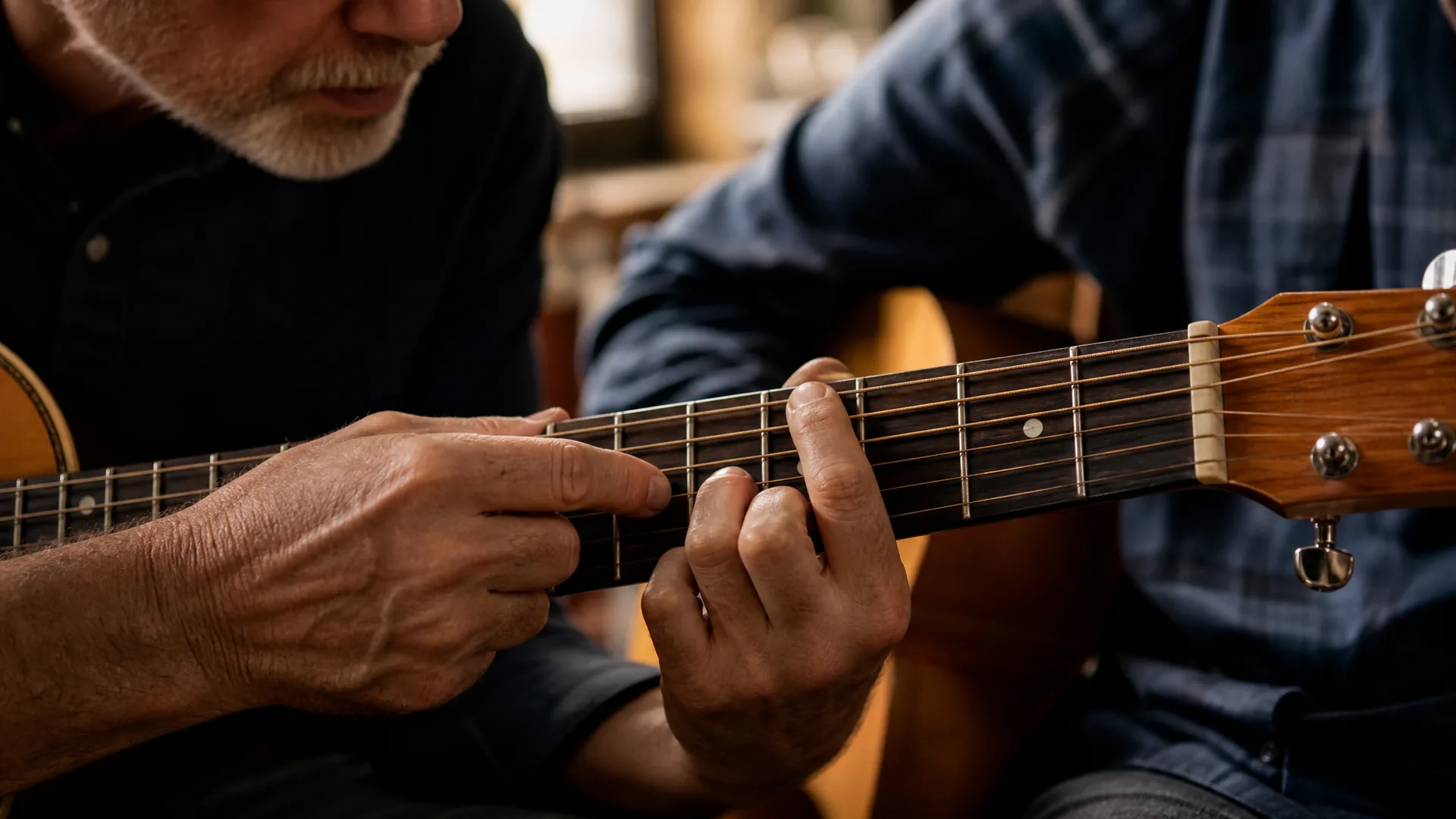
After fifty years of teaching guitarists at every level, Adam Levine will tell you the same thing he's told every student who walks in stuck: fretboard note recognition is the single most reliable predictor of whether a player breaks through their plateau, or stays trapped in shapes forever. Most guitarists never hear that. And it shows.
Why Most Guitarists Never Really Know the Fretboard
Here's the uncomfortable truth: most guitarists know shapes on the fretboard, and that is a long way from knowing the fretboard.
A guitarist who has drilled the minor pentatonic box for years can play it convincingly, until you ask them what note they're landing on. Silence. They know where their fingers go; they don't know what those fingers are saying.
Shape memory is a shortcut the guitar makes dangerously easy. Patterns are visual and repeatable. The brain locks them in fast, which feels like progress. But it doesn't develop precise chord tone targeting and the ability to generate real musical conversation. When the pattern runs out, the player is lost.
That gap, between knowing a shape and knowing the notes inside it, is the root cause of nearly every intermediate plateau. Guitarists who hit a wall and can't explain why have almost always skipped this step. After fifty years of teaching, that pattern holds without exception.
What Fretboard Note Recognition Actually Means
Counting up from the open string to work out that the fifth fret of the low E string is an A is recall. Recall is slow, and slow doesn't work in music.
Real fretboard note recognition means you look at any fret on any string and the note name is already there. Instant. Effortless. No counting, no landmarks, no math.
Knowing vs. Naming, the Real Distinction
There are two tiers here, and they are not equal.
Passive recognition means you can identify a note given a few seconds. Useful for studying. Useless in performance.
Active recognition means you know the note under musical pressure, mid-phrase, at tempo, in a key you didn't choose. That is the skill. Everything else is a rehearsal for it.
A Berklee-trained guitarist learning alongside Adam's students quickly discovers the foundational drill is calling out every note on the fretboard without hesitation, in any position, at tempo. The scales come after. Note recognition comes first.
Why String-by-String Memory Isn't Enough
Some players try to solve this by memorizing each string as a separate sequence, E, F, F#, G, G#, A... across all six strings. It works as a chart. It fails as a skill.
The problem is retrieval speed. When you're improvising over a moving chord progression, you don't have time to run a mental sequence. You need the note to surface the way a word surfaces when you speak, automatically, without translation.
Rote string-by-string memorization builds a lookup table. Active note recognition builds fluency. Those are different things, and only one of them works on a bandstand.
The Musical Stakes: What You Can Do Once You Own the Fretboard
Studio session musicians, the players who cut records with artists like George Benson or Norah Jones, navigate the fretboard by note name. When a producer calls a chord change, they decide on the spot. That decisiveness is a direct product of note knowledge.
Once you own the fretboard, here's what changes concretely:
Chord tone targeting. You can land on the third, fifth, or seventh of any chord by name, instead of hoping a scale shape puts you somewhere good. Your phrasing gets harmonic intent behind it.
Instant transposition. A melody you worked out in G becomes playable in Bb in seconds, because you're moving notes. Shapes have to be re-learned. Notes just move.
Real musical communication. When a bandmate says "resolve to the major third," you know exactly where that is. You're speaking the same language. Guitarists who navigate by shape alone often can't hold that conversation, a gap that reveals itself immediately in an ensemble or studio setting.
Shapes give you options. Note knowledge gives you intent. The difference between a guitarist who plays lines and a musician who tells stories often comes down to one thing: whether they know what note they're on at any given moment. That is, quite literally, playing guitar with feel, and it starts here.
How to Build Real Fretboard Note Recognition: A Structured Approach
There is a sequence that works. It requires short, consistent daily sessions, fifteen to twenty minutes beats a two-hour weekend marathon every time. Here's the method.
How well do you really know the fretboard?
Take the free Fretboard Challenge and find out exactly which notes cost you time, then get the note map that fixes them.
One email with the sheet. Unsubscribe whenever. No card, nothing to cancel.
On its way.
Check your inbox in the next minute or two. If it is not there, look in promotions.
Start with the Natural Notes on Every String
Begin with the natural notes only, no sharps, no flats. Twelve naturals across the fretboard, and they anchor everything else.
Start with the low E and A strings. These two strings are the root of most chord and scale navigation. Bass notes, root positions, key centers, they all live here first. Drill them until the note names come before your conscious mind asks for them.
Then move string by string, D, G, B, high E, using the same approach. Name every natural note out loud as you land on it. Don't trust your eyes; train your mouth. Vocalization accelerates the encoding.
With consistent daily practice, most committed students achieve solid natural-note recognition across all six strings within four to six weeks. Sharps and flats fall into place quickly after that, because they're just the spaces between what you already know.
Use Octave Shapes to Expand Across the Neck
Once the natural notes are solid on individual strings, use octave relationships to cross-reference the neck.
The octave shapes on guitar are consistent and reliable. The note on the sixth string at any fret has a direct octave partner on the fourth string two frets up. That same logic applies in slightly different configurations across all string pairs. Learning these shapes means you can locate any note in multiple positions, which is what fluency across the whole neck actually requires.
This step turns isolated string knowledge into a connected map. You stop thinking in one dimension and start seeing the fretboard as a whole.
Anchor Learning to Real Music, Not Drills
This is where most structured approaches fail. Students memorize the fretboard as a chart, then freeze when the music starts.
The fix is simple: take a lick you already play, and name every note in it: the actual notes, in order, rather than the scale it came from. Do this for every riff, lick, and phrase in your current repertoire.
This step bridges the gap between academic knowledge and musical reflex. Now you're learning the fretboard in the context where it has to perform. That's when recognition becomes real.
Common Traps That Slow Fretboard Note Recognition Down
Relying on dot markers as landmarks. The dots on a guitar neck are position guides. Players who navigate by "the dot at the fifth fret" are building map knowledge. The dots tell you where you are on a physical object; they tell you nothing about what you're playing musically.
Drilling without musical application. Flashcard-style fretboard drills have their place, but they can become a loop, students feel productive while making no real-world progress. If you can name the note on a chart but freeze when asked mid-song, the drill hasn't done its job. Every practice session should include at least one moment where the recognition is tested under musical pressure.
Treating the fretboard as a visual grid. The fretboard is an auditory and conceptual map. Guitarists who memorize it as a picture often can't transfer the knowledge when they change position or key. The goal is to hear the note, or at least name it instantly.
Fretboard Mastery Is the Gateway to Musical Freedom
Every advanced skill in guitar sits downstream of note recognition. Improvisation, composition, ear training, playing with genuine feel, they all get easier once you know where you are at every moment on the neck.
You can't tell a story in a language you don't speak. Guitarists who play by shape alone are borrowing vocabulary without knowing what the words mean. They can produce sound that resembles music. But the moment the musical conversation requires precision, a specific chord tone, a deliberate resolution, a phrase that answers the one before it, the shape-based player has no answer.
Note knowledge is what turns instinct into intent. It separates the player who hopes they're in the right place from the musician who knows they are.
If you're ready to stop guessing and start knowing, the Fretboard Note Recognition course is where that work begins. It's a structured, sequenced program built around the exact method outlined here, and it's where intermediate guitarists finally close the gap that's been holding them back.
