
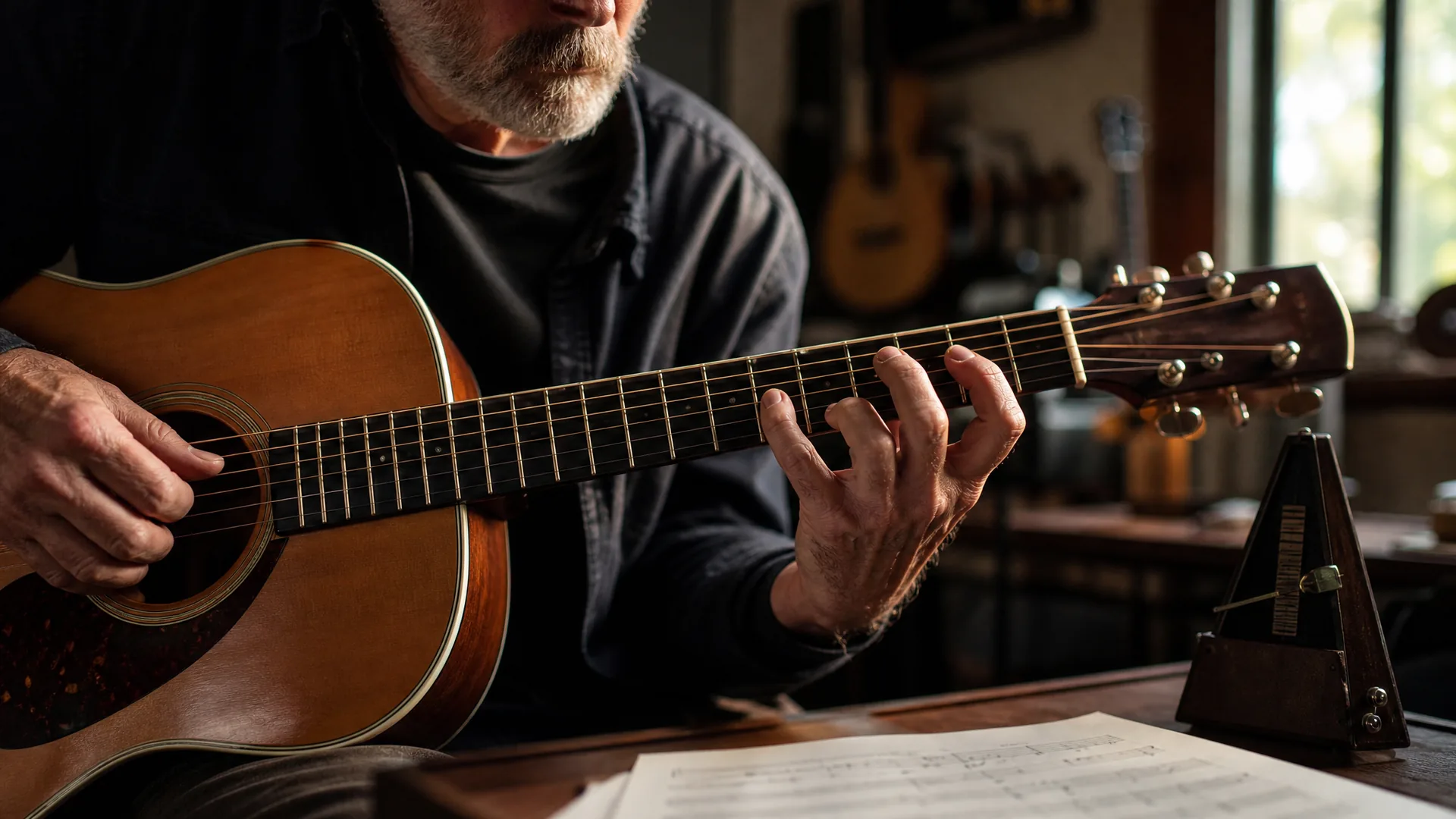
Fast fingers are cheap. Any player willing to grind a chromatic run for six months can build them. What's rare, what actually separates a musician from a technician, is control: the ability to make a finger do exactly what a phrase demands, no more, no less. That distinction is the whole subject of this article. If you're searching for finger dexterity exercises for guitar, you'll find no shortage of speed drills online. What you won't find as often is the reason those drills exist in the first place.
Why Most Finger Dexterity Exercises for Guitar Miss the Point
Most guitar sites treat dexterity as pure mechanics, a set of finger gymnastics disconnected from the music they're supposed to serve. Practice this pattern, they say, and your fingers will get faster. That's true. It's also incomplete, and incomplete advice builds incomplete players.
Adam has taught guitar for 50 years, including a stretch as a Motown studio player where sloppy fingering simply wasn't an option. In that time he's watched thousands of students confuse fast fingers with real musicianship. In the studio, there was no room for a player who could shred but couldn't sit inside a groove or shape a phrase on command. Speed without intention gets you nowhere near a real session, and it gets you nowhere close to real expression either.
The Difference Between Fast Fingers and Musical Control
A student who can rip through a chromatic finger exercise at 160 bpm but can't shape a single phrase with intention has built a habit disconnected from music. That's the trap. Dexterity, done right, is the servant of intention. Every exercise below exists to answer a musical question: can your finger arrive exactly when it's needed, land exactly where it's needed, and release without wasted tension. If a drill doesn't eventually serve that, it's just finger calisthenics.
Finger Independence Guitar Exercises That Build Real Foundation
Finger independence and finger strength are not the same thing, and confusing them is where a lot of players go wrong. Strength is about force: how hard a finger can press. Independence is about control: whether one finger can move without dragging its neighbors along. A guitarist needs both, but independence is the one that actually shows up in music, in a melody line where the third finger has to hold a note steady while the first finger walks a passing tone underneath.
Isolating Fingers Without Losing Musical Context
The classic 1-2-3-4 finger pattern, one finger per fret, ascending and descending across the strings, is a legitimate starting point. But played as pure mechanics, it teaches nothing beyond finger placement. Play it instead as if it were a phrase: vary the dynamics, let some notes ring longer, treat the last note of each pattern as a resolution rather than just the end of a drill. That single shift turns a mechanical exercise into a musical one. It's the difference between building fingers and building ears-and-fingers together.
Cross-String Independence Drills for Coordination
String-skipping drills, moving a finger pattern across non-adjacent strings instead of straight down the neck, build the kind of coordination guitar players actually need for real repertoire: arpeggios, chord-melody arrangements, fast harmonic movement. The point is to notice how your hand has to reorganize itself for each new interval, and to do that reorganizing without tension creeping into the wrist. Done slowly and attentively, these drills teach your hand to solve spatial problems the way real music will demand of it.
Guitar Finger Strengthening Technique Without Injury
Here's a myth that needs killing: that finger strength comes from squeezing harder, gripping tighter, pressing with more force. It doesn't. Guitar finger strengthening technique that actually holds up over years is built on efficient motion, and this matters even more for adult players whose hands don't recover the way a teenager's do.
Recognizing Tension Before It Becomes Pain
Tension is sneaky. It builds in the wrist, the thumb, the forearm, long before it registers as discomfort, and by the time it's pain, you've already been reinforcing a bad pattern for weeks. Dexterity drills that ignore tension and release build strain. Control is the ability to make a finger do exactly what the music asks, nothing more. Learn to check your fretting hand mid-exercise: is the thumb clamping the back of the neck? Are fingers not in use curling into a fist instead of resting? Those are the early signals, and catching them is what separates a technique that lasts decades from one that ends in a wrist brace.
How well do you really know the fretboard?
Take the free Fretboard Challenge and find out exactly which notes cost you time, then get the note map that fixes them.
One email with the sheet. Unsubscribe whenever. No card, nothing to cancel.
On its way.
Check your inbox in the next minute or two. If it is not there, look in promotions.
Building Strength Through Efficient Motion, Not Force
Real strength on guitar comes from economy: the minimum pressure needed to fret a note cleanly, the minimum finger travel needed to move between positions. Practicing slowly, at a volume and tempo where you can actually feel excess tension, is how that economy gets built. It's less exciting than a speed drill. It's also the only version of strengthening that doesn't quietly cost you your hands ten years down the line.
Improving Finger Agility on Guitar Through Purposeful Practice
Agility is what independence and strength add up to when they're pointed at something. But agility built through mindless repetition stalls out, and it stalls out predictably.
Why Mindless Drilling Stalls Intermediate Players
This is where most intermediate players get stuck: running the same finger exercise for months, watching the metronome number creep up, and wondering why their playing still doesn't sound like music. The problem is usually the absence of a musical target attached to the drill. If you've hit this wall already, it connects directly to why technical practice alone won't break a plateau. Technique in isolation just doesn't transfer to musicianship on its own.
Practicing Dexterity Drills With a Musical Target
The fix is straightforward, if not easy: attach every drill to a phrase, a lick, or a passage from a piece you actually want to play. Instead of running a stretch exercise in the abstract, run it as the fingering for a phrase in a tune you're learning. This is the essence of practicing guitar with intention rather than repetition. The drill becomes a means to an end, and progress starts showing up in your playing as well as your metronome settings. It's also the surest way out of relying on shapes and patterns instead of real fluency, a trap that keeps many intermediate players stuck longer than it should.
As for how often and how long: dexterity work rewards daily, short sessions, ten to fifteen focused minutes, far more than occasional long ones. Most attentive players notice real improvement in coordination and ease within four to eight weeks, provided the practice stays slow, deliberate, and tension-free. Rushing the tempo before the movement is clean just re-teaches the same sloppy habit faster.
Finger Control for Jazz Guitar and Other Demanding Styles
Jazz asks more of finger control than almost any other guitar style, because the harmony moves faster than the hands naturally want to. Chord voicings shift by a single note at a time across fast-moving ii-V-I progressions, and there's no room for a finger that arrives a beat late or presses harder than the phrase requires.
Coordination Exercises That Translate to Real Phrasing
Jazz guitarists who work through independence exercises without a musical target often develop fast hands and empty phrases. The fix is always to reconnect the drill to a musical decision. That means practicing voicing transitions as if you were comping through an actual tune. It also means training your ear alongside your hands, because in jazz, finger control without harmonic awareness is directionless. That's part of why hearing the harmony before your fingers move matters as much as the mechanics themselves. The fingers should be executing a decision your ear already made.
Turning Dexterity Into Musicianship: What Comes Next
Dexterity is a gateway. Every exercise in this article, the isolation drills, the cross-string coordination work, the tension checks, the jazz voicing transitions, exists to put your fingers in service of a musical idea. Fingers that move fast but answer to nothing are just busy.
If you want a fuller sense of what that distinction looks like in practice, playing with feel instead of just technical accuracy is where dexterity finally earns its keep. And if you've been putting in the hours on drills without seeing the musical payoff, that's usually a sign you need structure. That's what decades of teaching adult players has shown, again and again.
For adult players serious about closing that gap, a structured academy built for adult players ready to break through offers the kind of guided, injury-safe progression that isolated YouTube drills can't. And if you're ready to move past scattered exercises toward a real system, Adam's method for building real musical foundation is built exactly for that: technical development that never loses sight of the music it's meant to serve.
