
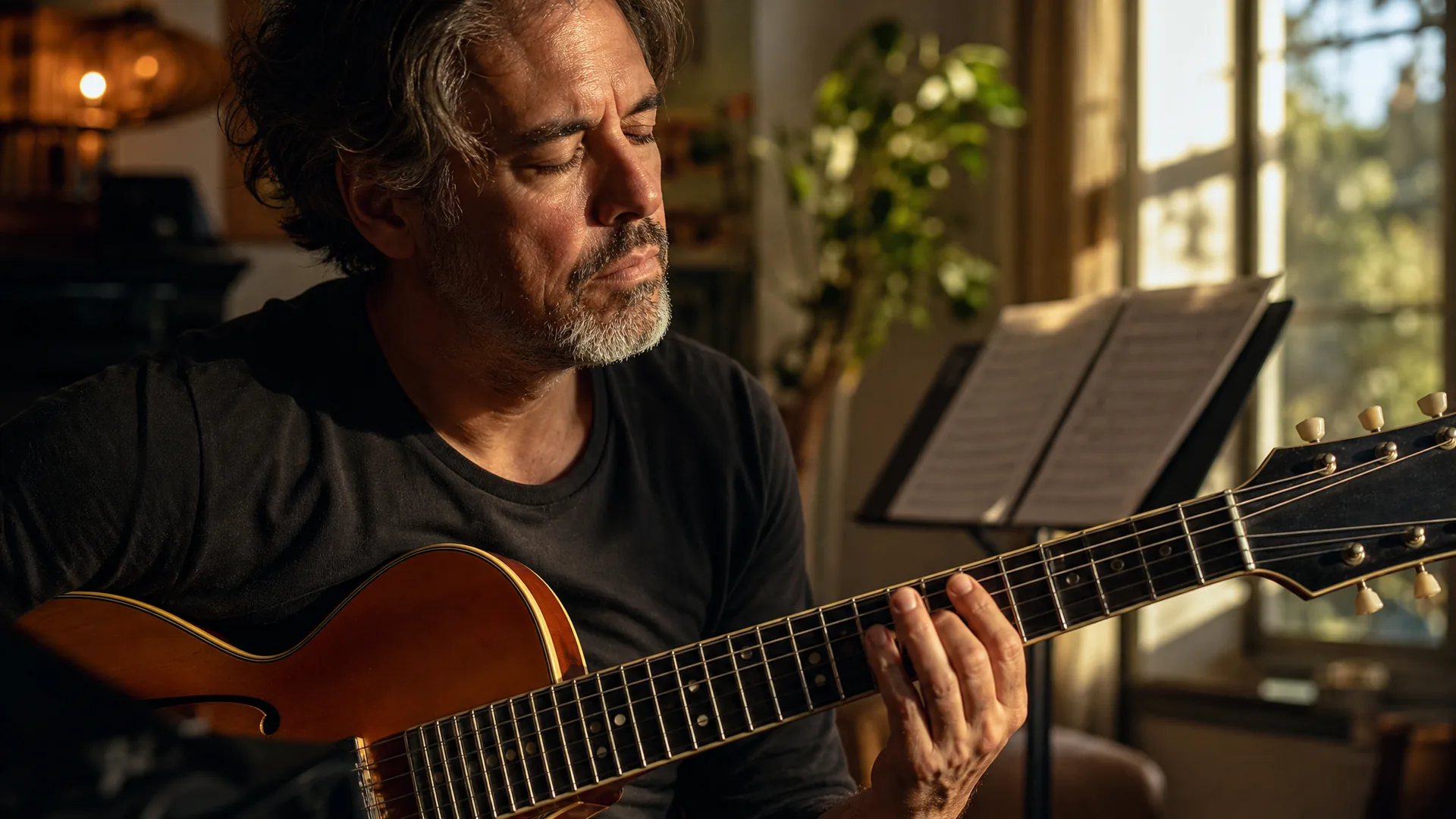
You can name every chord tone on the fretboard and still sound lost the moment the changes move. That's a listening problem.
In five decades of teaching, Adam Levine has watched thousands of technically capable adult players hit the same wall. They can name every chord tone on the fretboard. They can't hear one coming before they play it. Knowing where the notes live and knowing when to land on them are two different skills. This article is about the second one, how to use chord tones when soloing so your lines actually mean something.
Why Knowing Chord Tones Isn't the Same as Using Them
Most guitarists learn chord tones the same way they learn scales: as shapes to memorize and drill up and down the neck. That gets you accuracy. It doesn't get you music.
Using a chord tone means choosing it. You decide, before you play it, that this note resolves the phrase you just started. It's a decision made with your ear. That distinction is the whole game.
The Scale-Exercise Trap Most Guitarists Fall Into
Practice a chord tone arpeggio a thousand times and your fingers learn the pattern. Your ear learns nothing. You end up with fast, correct notes that don't say anything.
The trap is practicing chord tones as shapes instead of as sounds you're chasing. A player stuck in this trap can play flawless arpeggios over a ii-V-I and still sound like they're reciting.
How to Hear Chord Tones Before You Play Them
If you want to stop hunting on the fretboard, stop starting on the fretboard. Start in your ear. Before you touch the string, you should already know what note you're going for and why it fits the sound you just heard.
Chord tones are notes your ear should predict before your fingers ever move. That single shift, ear first and fingers second, separates a guitarist who targets from one who guesses.
Training Your Ear to Predict the Next Target Note
The simplest way in is singing. Sing the root of a chord, then sing where you think the 3rd sits. Then find it on the guitar and check yourself. Do that over changing chords and you're training prediction.
This is slow work at first, and it should be. You're building the connection between what you hear internally and what your hands do. For a deeper look at this kind of practice, ear training built around decision-making walks through how to structure it so it actually changes your playing.
Guide Tones: The Fast Path to Targeting Chord Tones Guitar Improvisation
Once you can hear a little, you need a shortcut for real tempo. That shortcut is guide tones, the 3rd and 7th of any chord.
Guide tones are often the two notes doing most of the harmonic work in a progression. That's why targeting just those two intentionally can transform a solo faster than adding more scale patterns. They tell you, and the listener, exactly which chord you're on without needing the root or the 5th to spell it out.
Why the 3rd and 7th Do Most of the Work
The 3rd tells you major or minor. The 7th tells you the chord's function and often points straight at where the next chord wants to go. Together they carry the harmony on their own.
A Motown studio session leaves no room for guessing. The guitarist either lands the 3rd or the 7th on the downbeat with intention, or the take gets scrapped. That's a working standard, and it's a useful one to hold yourself to when you practice.
Over fast-moving changes, chasing every chord tone is unrealistic. Chasing the guide tones is not. Learn to hear those two moving voices and you can outline changes at tempo that would otherwise leave you scrambling. If you want to take that further, soloing over chord changes with real intention builds directly on this guide-tone foundation.
Arpeggios vs. Chord Tones When Soloing
These get treated as the same thing. They're not.
An arpeggio is a shape, the chord tones played in order, usually ascending or descending. It's raw material. Chord tone targeting is what you do with that material: which tone you land on, when, and why. You can play a perfect arpeggio and still fail to target anything, because targeting is about intention.
How well do you really know the fretboard?
Take the free Fretboard Challenge and see exactly which notes cost you time. Then get the note map that fixes them.
One email with the map. Unsubscribe whenever: no card, nothing to cancel.
On its way.
Check your inbox in the next minute or two. If it is not there, look in promotions.
Where Arpeggio Patterns Fall Short of Real Musical Intention
Arpeggio patterns are linear by design. Real phrases aren't. A musical line might skip straight to the 7th, sit on it, then resolve down to the 3rd of the next chord, never touching the root at all.
Students who've gone on to perform with artists like George Benson and Norah Jones got there by learning to hear where a phrase needed to resolve. That's the difference between playing an arpeggio and using a chord tone. For more on breaking free of pattern-based playing altogether, improvisation built on decisions covers the mindset shift directly.
Landing on Strong Beats: Turning Chord Tones Into Phrasing
Hitting the right note in the wrong place is still guessing. The strong beats, typically beat 1 and beat 3 in common time, are where the ear expects resolution. Land a chord tone there and the listener feels it arrive.
Land it on a weak beat or an off-beat and it can still work, but only if you mean it. That's the difference between a passing tone and a target: placement, and the intention behind the placement.
Voice Leading Between Chords, Not Just Landing
A chord tone is part of a line moving from one chord's guide tones to the next chord's guide tones, usually by the shortest possible distance.
This is voice leading, and it's what turns a series of correct landings into a phrase that tells a story. Instead of jumping around the fretboard to hit each chord's root, you move a note a half step or whole step to the next chord's 3rd or 7th. The result sounds connected instead of stitched together. For a focused look at rhythmic placement specifically, rhythmic placement and landing on strong beats goes deeper into timing your targets for maximum effect.
How to Practice Soloing With Intention Instead of Noodling
Noodling is chord-tone knowledge without chord-tone decisions. Fingers move because they know the shapes, not because the ear called for a specific note.
Here's a framework you can start using today:
- Pick one chord tone per chord. Before you play a progression, decide in advance which chord tone you'll target on each chord, usually the 3rd or 7th.
- Sing it before you play it. If you can't sing the target note, you're not ready to play it with intention yet.
- Land it on beat 1. Force yourself to arrive on the strong beat until it's automatic.
- Connect targets by the shortest path. Move from one target to the next using the closest available note, not the nearest scale run.
- Slow the tempo down until every note is a decision. Speed hides guessing. Slow practice exposes it.
This is a starting discipline. But it's how you stop noodling and start soloing on purpose. For a broader approach to structuring practice time around focus instead of repetition, practicing with focus instead of repetition is worth working through alongside this.
If any of this sounds like it's naming a wall you've hit before, it probably is. Why so many players plateau on guitar explains why chord-tone knowledge without ear training is one of the most common plateaus for intermediate and advanced players alike. And if you're ready to hear harmony before you analyze it, hearing harmony before analyzing it is a natural companion piece to everything covered here.
Chord tones were never the hard part. Hearing them before you play, targeting them with a reason, and phrasing them into something that resolves, that's the actual skill. If you're serious about building it instead of drilling around it, a structured path to soloing with real musical intention is where that work starts.
