
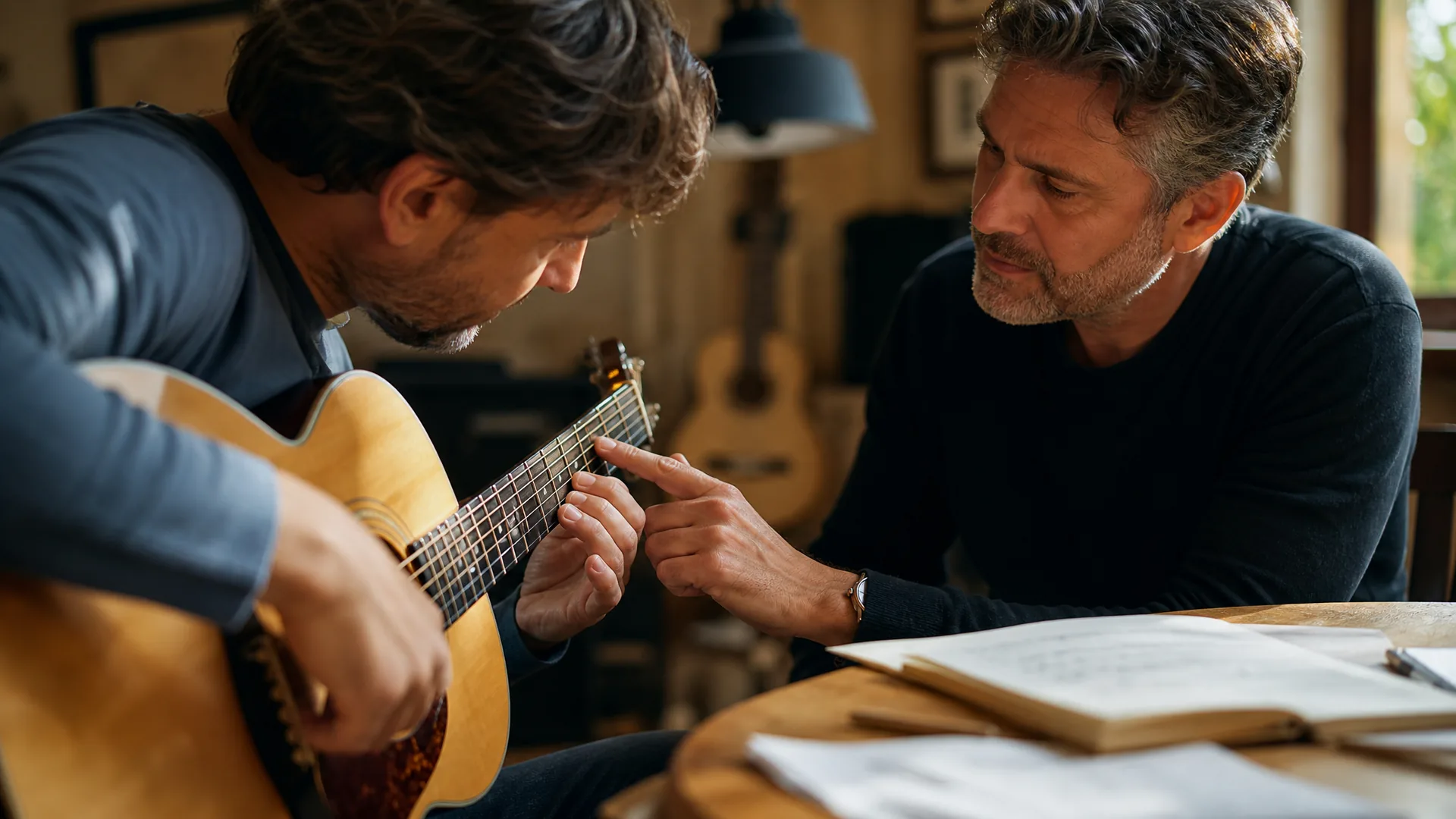
You've booked "1-on-1 guitar lessons" before. You filled out a form, got matched with whoever was available, and spent six months learning shapes you'd forget in a month. That's scheduling dressed up as instruction.
One on one guitar coaching for adults should mean something different: one teacher, one relationship, one clear diagnosis of why your playing stalled. If you're done guessing what to practice next, the distinction below matters more than any app feature list.
Why Most "1-on-1 Guitar Lessons" Aren't Really One-on-One
Plenty of platforms sell "private" lessons. Almost none sell a relationship. They sell access to a rotating pool of instructors, matched to your calendar with no regard for your ceiling.
The Marketplace Model: Scheduling Over Philosophy
Marketplace lesson platforms match students to whichever teacher is free at 6pm Tuesday. A coaching relationship matches a student to one teacher for the duration of their development. Those are two different products wearing the same label.
Convenience is the whole pitch in the marketplace model. You pick a time slot. A teacher shows up. The lesson runs through a generic curriculum built to work for anyone. It's built to scale, and diagnosing you is nobody's job.
What Gets Lost When You Rotate Through Teachers
Every teacher hears your playing differently. One flags your timing. Another pushes chord voicings. A third mentions neither, because he's seeing you for the first time with twenty minutes to fill.
Nobody builds a full picture of you. Progress resets every time a new face shows up on the screen. For an adult player with limited practice hours, that reset costs real money. You pay for the same diagnostic conversation over and over instead of building on it.
Guitar Coach vs. Guitar Teacher: What Actually Changes
The guitar coach vs guitar teacher question marks a real difference, between someone who assigns material and someone who tracks your development over months and years.
Diagnosing the Break, Not Assigning the Next Shape
A real coach listens to your playing for ten minutes and tells you exactly where your musicianship breaks down. Knowing a hundred exercises is one skill; knowing which one fixes your specific problem, right now, is a rarer one.
A teacher, in the generic sense, delivers content. A coach reads a player and adjusts the plan in real time. For more on this line, see what separates a music coach from a lesson provider.
Accountability Built Around One Relationship
Coaching only works if someone remembers what you struggled with last month and checks whether you fixed it. That takes continuity: one person, tracking one student, across real time.
A rotating roster can't offer that kind of accountability. Someone meeting you for the first time can't hold you to a standard.
Playing Guitar vs. Being a Musician
There's a meaningful gap between playing guitar and being a musician. Most adult players cross into competence and then stop. Coaching exists to close that second, harder gap.
Why Adult Players Plateau on Patterns
Patterns get you moving fast. You learn a scale shape, a chord voicing, a strumming pattern, and suddenly you sound like you're improving. Then the improvement stops, because patterns are a ceiling disguised as a staircase.
Most intermediate players plateau exactly here: competent, comfortable, and stuck. If that sounds familiar, read how to break through the intermediate plateau instead of adding one more pattern to the pile.
How well do you really know the fretboard?
Take the free Fretboard Challenge and find out exactly which notes cost you time, then get the note map that fixes them.
One email with the sheet. Unsubscribe whenever. No card, nothing to cancel.
On its way.
Check your inbox in the next minute or two. If it is not there, look in promotions.
What Changes When Someone Forces You to Decide, Not Guess
Patterns let you avoid decisions. You just execute the shape. Musicianship demands decisions about phrasing, dynamics, when to leave space, when to push forward.
A coach forces those decisions instead of letting you default to muscle memory. That's uncomfortable at first. It's also the only path past the plateau.
Inside Adam's Academy: 50 Years, One Teacher, No Rotation
Adam is a Berklee graduate and former Motown studio guitarist who has spent 50 years teaching adult players one-on-one. Those years are the reason his diagnostic ear works the way it does. Fifty years of watching where players break down builds a kind of pattern recognition no algorithm replicates.
Berklee and Motown: Where the Standard Comes From
The Berklee training gives the coaching its structure: real harmonic and rhythmic fundamentals, with no shortcuts. You can read more about that grounding in Berklee-trained fundamentals.
The Motown studio years gave it something else: discipline under pressure, the kind session players need when there's no second take. That's the Motown studio discipline behind the method, and it shows up in how sessions run: direct, efficient, no wasted time.
Students Who've Stood Next to Legends
Students coached under this method have gone on to perform alongside Michael Jackson, George Benson, Celine Dion, and Norah Jones. That record is evidence the method holds up against the highest professional standard in the industry.
If you want the fuller case for why decades of experience beats another app subscription, there's a dedicated look at what actually works after 50 years of teaching guitar.
What a Custom Guitar Lesson Plan for Adults Looks Like
A custom guitar lesson plan for adults starts with listening.
How the First Sessions Diagnose Your Ceiling
Early sessions are for diagnosis. Adam listens to how you play, where you hesitate, what you avoid, and what you lean on as a crutch. That diagnosis shapes everything that follows.
This is the opposite of a fixed curriculum. Nobody hands you a syllabus before hearing a single note.
Building the Plan Around Your Music, Not a Curriculum
Once the ceiling is identified, the plan gets built around your actual goals: the songs you want to play, the style you want to master, the specific gap holding you back. It's not a generic path that happens to include your name.
That's what an academy built for adults stuck at the plateau is designed to deliver: a plan built around your musicianship instead of a course outline built for everyone.
Is Private Guitar Coaching Online Right for You?
Private guitar coaching online works when the relationship is real: one teacher, consistent sessions, direct feedback on your actual playing from someone listening live. The quality of attention matters far more than the format.
For serious adult players, video doesn't blunt the diagnostic process much. A trained ear can hear timing problems, tension, and phrasing issues over a screen just as it can in a room. What online coaching can't fix is a teacher who isn't paying attention, and that problem exists in person too.
Who This Is For (and Who It Isn't)
This is for adults who've played long enough to plateau and are serious about moving past it. It's for players who want a guitar mentor for serious players, and who have half-finished enough courses already.
It's not for someone who wants an app to gamify practice, or a casual hobbyist happy repeating the same three songs forever. Both are fine goals. They're just not this.
How to Start the Conversation
If you recognize yourself here, stuck, competent, tired of guessing, the next step is a real conversation about where your playing actually breaks down.
You can start a coaching relationship inside the Academy with a consultation built around your playing. Bring your guitar. Bring your honest assessment of where you're stuck. That's where a coaching relationship actually starts.
