
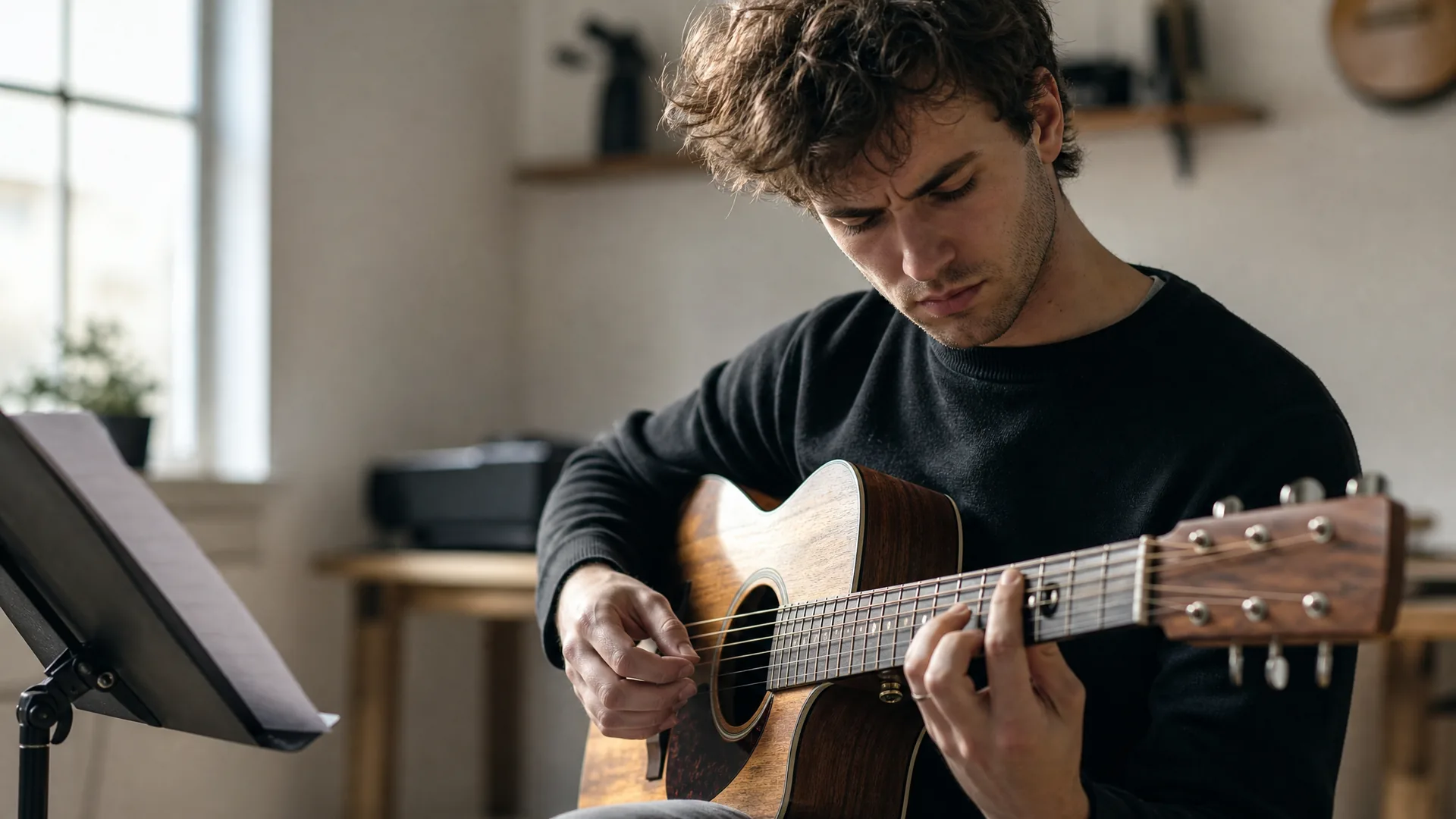
You already know how to play guitar. That's not the problem. You can run scales, nail the licks you've tabbed out, and hold your own in a jam. But something has stalled. You practice, and the needle doesn't move. That's the exact point where online guitar lessons for advanced players need to look nothing like the ones that got you here.
Why Generic Online Guitar Courses Stop Working Past a Certain Point
Video-course platforms do one job well: teaching someone their first open chords. They break skills into small, sequential steps and let a beginner move at their own pace. That's a real strength, for a beginner.
Once you're past that stage, the format itself becomes the limit. A library of pre-recorded lessons can't hear you play. It can't tell you that your timing drags on beat three, or that your vibrato sounds tense because your thumb is locked around the neck. It just delivers the next video, whether or not it's the thing you actually need.
This is why intermediate and advanced players plateau even after years of steady practice. The content keeps flowing, but nothing corrects what's actually holding them back. If that sounds familiar, it's worth reading why intermediate players get stuck on a plateau before you assume more practice hours are the fix.
The Fender Play / JustinGuitar Problem: Built for Beginners, Not You
Fender Play, JustinGuitar, and similar platforms are built and priced for absolute beginners. That's their design intent, and they do it well.
But guitar lessons for experienced players require something these platforms were never built to do: diagnosis. An experienced player needs someone to find the one habit, a picking angle, a rhythmic blind spot, a harmonic gap in their ear, that's quietly capping everything else. No video library, however well produced, can do that.
What Separates Real Coaching from a Video Course Library
There's a difference between playing guitar and being a musician. Content can teach you to play. Only coaching can turn that into musicianship: the judgment, timing, and taste that make notes sound like they mean something.
Content Delivers Information; Coaching Delivers Correction
A course delivers information on a schedule, whether or not you already know it, whether or not you badly need something else instead. Coaching works the opposite way. A real teacher listens, hears the specific error, and corrects it on the spot.
That's the whole point of what a real music coach actually does. The growth happens in the correction.
Why Feedback Loops Matter More Than More Material
Advanced players often hit a wall where hours of scale drills and tab-based tutorials stop producing progress. They can already play everything technically correct. It just sounds musically flat. A tighter feedback loop fixes that.
When a teacher hears you play a phrase, tells you exactly what's wrong with it, and hears you play it again, that loop compresses months of guesswork into a single session. No amount of additional video content replicates that exchange.
The Case for 1-on-1 Guitar Mentorship at an Advanced Level
The real ceiling for intermediate players is the absence of a teacher who can hear what they can't yet hear in their own playing. That's exactly what 1-on-1 guitar mentorship online is built to solve: a second set of trained ears, applied directly to your playing, in real time.
Personalized guitar instruction online works because it starts from where you actually are. Your teacher hears your strengths, hears your specific weaknesses, and builds the next session around closing that gap.
How well do you really know the fretboard?
Take the free Fretboard Challenge and find out exactly which notes cost you time, then get the note map that fixes them.
One email with the sheet. Unsubscribe whenever. No card, nothing to cancel.
On its way.
Check your inbox in the next minute or two. If it is not there, look in promotions.
What Changes When a Teacher Can Hear You Play
Everything changes once a teacher can actually hear you play. Timing issues that a self-assessment would miss become obvious in seconds. Phrasing that sounds fine to you but flat to a trained ear gets named and fixed. Theory you've studied in the abstract gets tied directly to the lick you're struggling with today.
That's the difference between practicing and being coached. One produces motion. The other produces progress.
Inside Adam's Academy: How a Berklee-Trained, Motown Veteran Teaches Advanced Students
Adam Levine is a Berklee graduate and former Motown studio guitarist with 50 years of teaching experience. That background matters more for advanced students than it does for beginners. Advanced coaching depends on a teacher who has already solved the problems you're facing, under real pressure, in a real studio, on someone else's clock.
Students from Adam's studio have gone on to perform with Michael Jackson, George Benson, Celine Dion, and Norah Jones. The same standard applies to the curriculum: play in tune, play in time, and play like it means something. That's what a session player learns has to be true every single take.
50 Years of Teaching, Shaped by Real Studio Sessions
Five decades of teaching guitar has taught Adam one thing above all: information is cheap, correction is rare. His formal training explains part of this. How formal Berklee training shapes real fundamentals gives structure and rigor most self-taught players never got.
The studio years explain the rest. Motown sessions demanded discipline, restraint, and precision under time pressure no course can simulate. If you're curious how that era still shapes phrasing today, the Motown guitarists who shaped modern restraint and phrasing is worth reading. It's also documented directly in what actually works after 50 years of teaching guitar: a track record built one student at a time.
What to Look for in a Teacher Once You're Past Intermediate
Choosing online guitar coaching for adults at this level is different from picking a beginner course. Look for a teacher who can actually diagnose as well as demonstrate.
Ask what they check for in the first lesson. A teacher worth your time will listen for timing, tone, phrasing, and ear accuracy before ever assigning material. Ask about their own performance background too. Repertoire depth built from real playing situations teaches things a purely academic path can't.
Push on ear training. Advanced players who can read tab all day but can't transcribe a phrase by ear have a gap that no amount of technical drilling closes. And ask how theory gets applied. Theory that stays abstract is trivia. Theory tied to the exact passage you're struggling with is a tool.
If a prospective teacher can't answer these plainly, that's the answer.
How Lessons Are Structured for Advanced Guitar Students at the Academy
Advanced guitar lessons online at Adam's academy start with a conversation and a listen.
From Diagnosis to a Personalized Curriculum
The first session is diagnostic. Adam listens to how you actually play, your timing, your phrasing, your harmonic instincts, and identifies the specific habits capping your progress. From there, he builds a curriculum around you.
Sessions are one-on-one, so every note of feedback is aimed at your playing. Repertoire, technique work, and ear training target the exact gap identified in that first listen, and the plan adjusts as you close it. It's the same approach behind how the academy breaks the intermediate plateau, applied here to players who are further along but still stuck.
If you've outgrown tutorials and want a teacher who can actually hear what's holding you back, explore the academy for advanced players and book a trial lesson. Fifty years of teaching, a Berklee foundation, and real studio experience are waiting to hear you play.
