
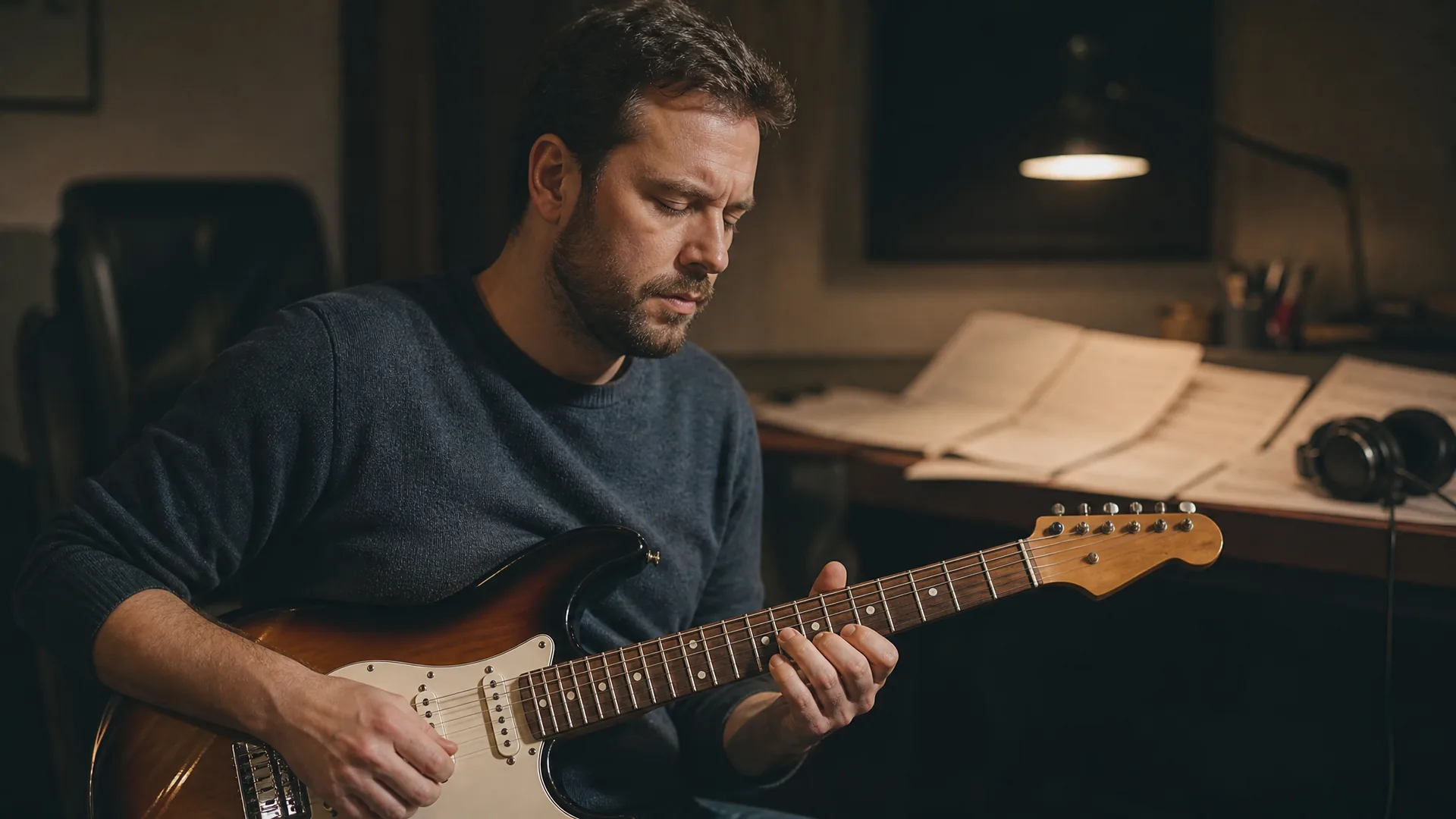
Every guitarist who's downloaded a tab site knows the feeling: the solo sounds nothing like the recording, the timing is off, and half the bends are guessed at best. Transcribing guitar solos by ear fixes that problem at the root. It's the difference between a player who depends on someone else's interpretation and one who can hear music and own it.
Why Transcribing Guitar Solos by Ear Separates Musicians from Hobbyists
Tabs feel like a shortcut, but they're a substitute for the one skill that actually makes a musician useful in a room full of other musicians: hearing something and reproducing it accurately, on the spot, without waiting for someone to write it down first.
Hobbyists learn songs. Working musicians learn to hear. That distinction shows up the moment the material runs out, the key changes, or the band calls a tune nobody printed a chart for.
The Hidden Cost of Relying on Tabs and Sheet Music
Tabs strip out the decisions. They hand you a fret number and a string, and they skip the part where you had to figure out why that note works. You never build the internal map of intervals, phrasing, and tone that a transcribed-by-ear solo forces you to build.
The cost compounds quietly. A player who can only follow tabs freezes the moment the material runs out. A player who's trained their ear can sit in on any tune in any key. That gap stays hidden in the practice room and shows up on stage, in the studio, in the audition, exactly when it matters most.
This is also why so many players plateau without ever addressing this. They keep collecting tabs instead of collecting listening reps. The skill that would actually move them forward never gets touched.
How to Transcribe Guitar by Ear: The Decision-Making Process Nobody Teaches
Most guides treat transcription as a mechanical hunt: play a note, guess a fret, check it against the recording, repeat. Real transcription, for anyone who's fast and accurate at it, is a chain of decisions, made quickly, using information you've trained your ear to recognize instantly.
Hearing Intervals vs. Hearing Shapes
Beginners hear a note and start scanning the fretboard for where it might live. Trained ears hear an interval, the distance between the note they just played and the one before it, and already know the shape before their fingers move.
That's the shift that matters. You stop thinking "what note is this" and start thinking "what's the relationship between this note and the last one." A minor third sounds like a minor third whether it's in the first position or the twelfth. Once your ear locks onto that relationship, the specific fret becomes a formality.
Making a Call: Committing to a Note Instead of Guessing
Here's the part nobody teaches directly: transcription is about training the ear to make a decision and commit to it, the same way a musician commits to a phrase on stage. You hear the interval, you hear the rhythmic placement, you make a call, and you move on.
Hesitation is the real enemy. Players who stop and second-guess every note lose the thread of the phrase. Players who commit to a decision, even an imperfect one, can go back and correct a single note without losing the whole passage. That habit of committing is exactly what ear training built around decision-making is designed to build.
Developing Ear Training for Guitar Transcription: A Practical Framework
You don't start by transcribing a three-minute guitar solo. You start smaller, and you build the instinct in layers, the same way you'd build technique on the instrument itself.
Starting Small: Single Phrases Before Full Solos
Pick a two- or four-bar phrase, not the whole solo. Loop it. Sing it back before you touch the guitar. Only then find it on the neck.
This sequencing matters. If you can't sing a phrase accurately, you can't transcribe it accurately. You'll just be guessing with your fingers instead of your ears. Singing forces the decision-making to happen in your head first, where it belongs, before your hands get involved.
How well do you really know the fretboard?
Take the free Fretboard Challenge and see exactly which notes cost you time. Then get the note map that fixes them.
One email with the map. Unsubscribe whenever: no card, nothing to cancel.
On its way.
Check your inbox in the next minute or two. If it is not there, look in promotions.
Building Speed Without Sacrificing Accuracy
Speed comes after accuracy, never before it. Once single phrases stop being a struggle, string two or three together. Then work up to a full chorus of a solo. The jump from phrase to full chorus is where most players quit. It feels like a wall, but it's really just repetition catching up to itself.
Adam felt this pace firsthand during his years as a Motown studio guitarist, where charts sometimes didn't exist and a part had to be caught by ear in the time it took to hear it once or twice. That kind of pressure builds speed because there's no alternative. You either hear it fast or you don't play the session. Most players won't face that exact pressure, but the training principle is the same: repetition under a tightening deadline turns slow, deliberate listening into fast, reliable instinct.
There's no fixed timeline for "getting good" at this. Some players hear real improvement within weeks of daily short-phrase work. Others take longer because they skip the phrase stage and jump straight to full solos, which slows progress rather than speeding it up. The structure matters more than the calendar.
Listening Skills for Transcribing Guitar: Training Your Ear Beyond Pitch
Getting the notes right is only the minimum bar. A transcription that nails every pitch but ignores everything else the soloist did is technically correct and still sounds nothing like the original.
Tracking Phrasing, Dynamics, and Tone Choices
Every solo is a series of choices beyond which notes to play: how hard a note is picked, how long it's held, whether it's bent up to or slid into, how much space sits between phrases. These choices make a solo sound like a story instead of a scale exercise.
Train yourself to listen for the gaps as much as the notes. Where does the soloist breathe? Where do they push the time forward, and where do they lay back behind the beat? That's musical storytelling, and it doesn't show up in a tab file at all. Developing listening skills that go beyond pitch recognition is what separates a technically accurate transcription from one that actually sounds like the recording. The same expanded listening applies directly to genres built on nuance and variation: transcribing jazz solos for analysis rather than mimicry makes that especially clear.
Why Picking Up Solos by Ear Builds Professional Musicianship
There's a reason working musicians treat ear transcription as a baseline skill rather than a bonus talent. It's the skill that gets tested constantly, often with no warning and no do-overs.
What Studio and Touring Musicians Do Differently
Adam's years as a Motown studio guitarist required transcribing parts by ear under real time pressure, with no tabs and no second takes. Session work came with a producer counting off and an expectation that the part would be right the first time, and often no printed chart on the stand. That environment shaped how Motown session players shaped modern recording habits, and the discipline it demanded still applies to any working musician today.
Adam Levine is a Berklee graduate whose 50 years of teaching have produced students who've performed with Michael Jackson, George Benson, Celine Dion, and Norah Jones. That range of work, across decades and across genres, was built on hearing something once and playing it back accurately, under pressure, on demand.
Touring musicians face a version of the same test: a bandleader calls an unfamiliar tune, or a set list changes mid-show, and there's no time to look anything up. The player who's trained their ear treats that moment as routine. The player who hasn't treats it as a crisis.
Moving Beyond Tabs: Making Transcription a Weekly Habit
None of this works as a one-time exercise. Ear training compounds the same way technique does. A little, consistently, beats a lot, occasionally. Set aside real time each week for short-phrase transcription, and treat it as seriously as you treat scales or picking exercises.
This approach connects directly to an ear-first approach to music theory, where understanding grows out of listening instead of memorized shapes. It's also consistent with what fifty years of teaching has proven actually works across students at every level.
If you're ready to stop guessing and start deciding, structured ear-training coaching makes the process far faster than working alone. Explore structured coaching inside the Academy and start building the listening instincts that actual working musicians rely on every day.
