
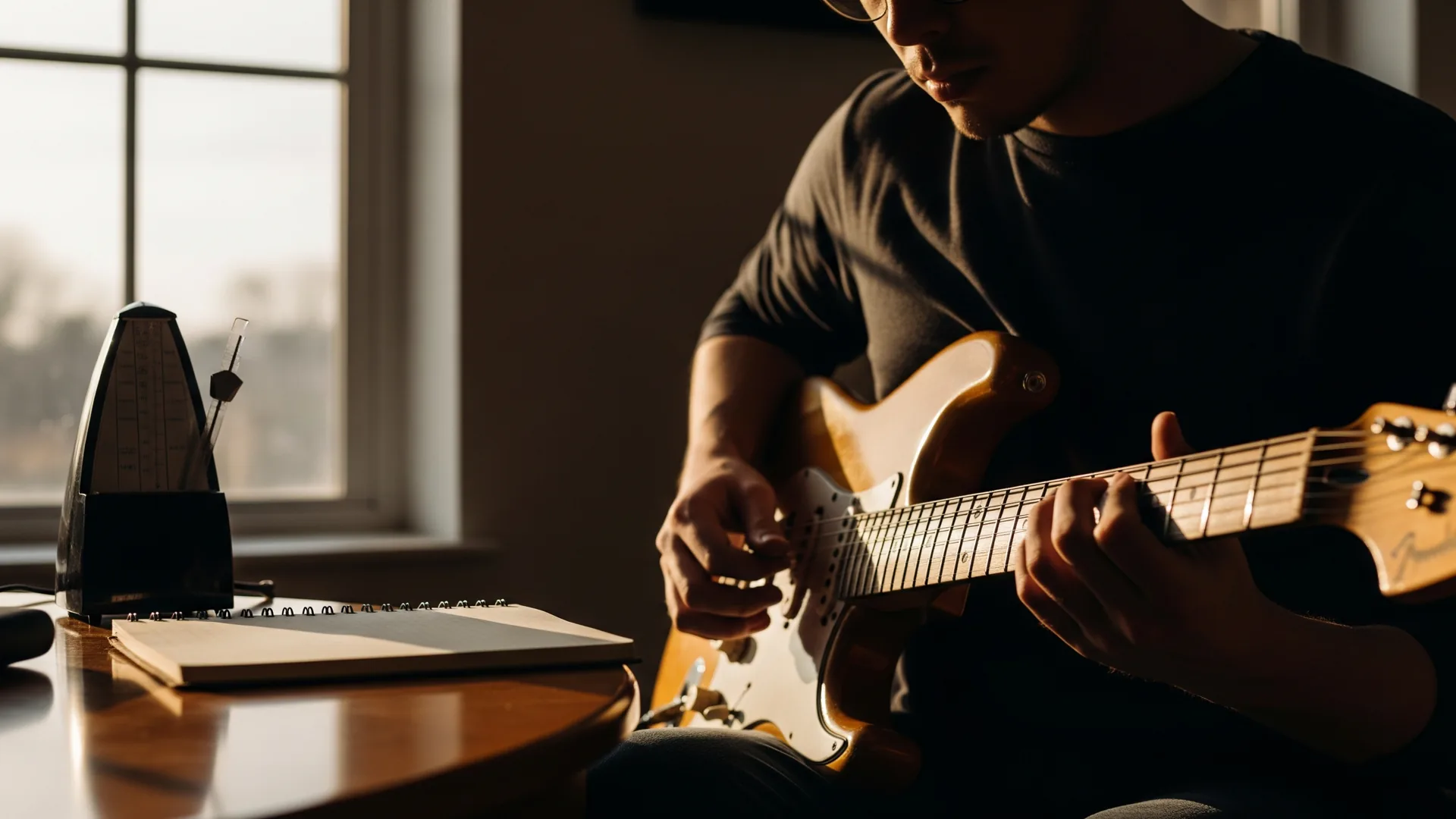
Most advanced players have hit a wall. They can run modes, sweep arpeggios, and hold their own in a jam. Yet something is missing. They sound like someone who has practiced a lot, without yet having something to say. That gap is a practice-philosophy problem.
A guitar practice routine for advanced players has to look different from the routines that got you here. What worked at the intermediate stage, scales, drills, hour counts, stops paying off once your hands can already do most of what you ask of them. The bottleneck moves from your fingers to your musical decision-making.
Why Most Advanced Guitarists Practice the Wrong Way
Open any forum thread on guitar practice and you'll find the same advice: practice more hours, add another scale pattern, run the metronome faster. None of it addresses the actual problem facing an experienced player. The problem is direction.
Volume vs. Deliberate Practice for Guitarists
Deliberate practice for guitarists means every minute has a specific musical purpose. A session goal sounds like "make this phrase read like a sentence," where most players settle for "run this lick for twenty minutes." Hours logged mean nothing if you can't say what you were trying to improve and how you'll know you got there.
Most advanced players confuse motion with progress. They sit down, play for an hour, and feel productive because they're tired and their fingers hurt. But the goal is better musical judgment.
The Hidden Ceiling of Pattern-Based Repetition
Pattern-based repetition has a ceiling, and most serious players hit it without realizing why. You can drill the same lick in twelve keys and still not know what to play when a bandmate hands you an unfamiliar tune in real time. Technique built without musical context doesn't transfer.
This is exactly why so many players hit a real plateau after years of steady, focused-looking practice. They've mastered the exercise. They haven't mastered the music.
The Philosophy Behind a Structured Practice Routine for Guitar
A structured practice routine for guitar is a philosophy about what you're actually training. There's a real difference between playing guitar and being a musician, and that difference should organize every session you sit down for.
Playing guitar means you can execute. Being a musician means you can choose, the right note, the right space, the right dynamic, in the moment, under pressure. Everything in an advanced practice routine should push you toward the second definition.
Practicing Decisions, Not Just Digits
Your fingers already know more than your ears do. That's the honest state of most advanced players: technical vocabulary that outpaces musical judgment. So the routine has to flip the ratio. Less "can I play this," more "should I play this, and why."
Practicing decisions means you stop and ask, after every phrase: did that serve the music? Did it fit the chord? Did it say something? Ask that question daily. It will do more for your playing than another hour of pattern drilling ever will. This is what practicing with genuine focus actually means: sharper sessions, whatever their length.
Building a Goal-Oriented Guitar Practice Plan
A goal-oriented guitar practice plan starts with a question most players skip: what am I actually trying to get better at this month? Pick something specific enough that you'll know if you got there.
Setting Musical Objectives Before Technical Ones
Before you touch a scale, set the musical objective. Maybe it's phrasing a ballad solo with more space. Maybe it's comping through a jazz standard without losing the form. Maybe it's transcribing a specific solo cleanly enough to play it from memory. The technical work exists to serve that objective. That includes the scales, the drills, and the metronome.
An advanced guitar player practice schedule built this way looks nothing like a generic list of exercises. It looks like a short set of musical goals, each with a technical plan attached underneath it.
How well do you really know the fretboard?
Take the free Fretboard Challenge and find out exactly which notes cost you time, then get the note map that fixes them.
One email with the sheet. Unsubscribe whenever. No card, nothing to cancel.
On its way.
Check your inbox in the next minute or two. If it is not there, look in promotions.
Time Blocks: Technique, Ear, Repertoire, Improvisation
A workable weekly structure divides your time into four blocks. Each one ties to a purpose rather than a fixed hour count:
- Technique, the minimum maintenance work your hands need, kept tight and specific rather than sprawling.
- Ear training, intervals, chord qualities, and short melodic dictation, so your ear leads your fingers instead of trailing behind them.
- Repertoire, real songs, learned to performance standard.
- Improvisation, deliberate soloing over changes, evaluated afterward for musical choices as well as note accuracy.
How much time each block gets depends on your current goal. A player prepping for a gig leans into repertoire. A player stuck in pattern-thinking leans into ear training and improvisation. What matters is that every block answers to a musical goal you set on purpose.
How to Practice Guitar Like a Professional
If you want to know how to practice guitar like a professional, look at what happens in a studio. Adam Levine, a Berklee graduate and 50-year veteran teacher, built his teaching method on studio-floor discipline he learned as a Motown session guitarist, where there was only time to deliver.
A session player gets one take to find a good idea, maybe two. That constraint forces a different kind of practice: rehearsing musical decisions until they're reliable under pressure.
What Separates Studio and Stage Discipline from Bedroom Practice
Bedroom practice tolerates drift. You can noodle, restart, and lose the thread with no consequence. Studio and stage discipline tolerate none of that. Every phrase has to land the first time, in front of people who are paying attention.
Students who've trained under this approach have gone on to perform with artists like Michael Jackson, George Benson, Celine Dion, and Norah Jones. That's proof that musical decision-making separates working professionals from hobbyists. A professional's practice session looks less like a workout and more like a rehearsal for actual musical choices. Every minute goes toward asking "what am I trying to say here?" rather than "how many reps did I get in?"
That's the standard an advanced player's practice routine should aim at, even alone in a practice room with no audience at all.
Translating Technique into Real Musicianship
Technique is a tool. Musicianship is what you build with it. An advanced practice routine has to explicitly bridge the two, because they don't connect on their own no matter how many hours you log.
From Exercises to Expression
Take any exercise you already run and ask a harder question of it: what would this sound like as a phrase in an actual song? A scale run in isolation is just information. Shape the same notes with dynamics and phrasing inside a chord progression, and they become expression.
This is the difference improvisation as a series of musical decisions makes clear: soloing well means choosing fewer notes, more deliberately.
Ear Training and Transcription as Practice Anchors
A guitarist who has played the same twelve bar blues for a decade but never transcribed a solo by ear has likely built technique without musicianship. The routine above is designed to close that specific gap.
Transcription forces your ear to lead, which is exactly backward from how most players learn: off tab, by eye, with the ear as an afterthought. Sit with a phrase, find it without help, and you train the skill that actually separates good improvisers from good pattern-players. If you haven't built this into your week yet, start with transcribing solos by ear. Even five minutes of it a day changes how you hear.
Sustaining a Professional Practice Discipline Long-Term
A routine only matters if it survives contact with a busy month, a slow week, or a stretch where nothing seems to be improving. Advanced players sustain their practice discipline by revisiting their goals often.
Set a new musical objective every few weeks. Reassess what your ear needs, what your repertoire is missing, what your improvising still leans on habit instead of choice. The moment a routine stops targeting a real goal, it turns back into volume for its own sake. That's the exact trap this approach is built to avoid.
This is what what actually works after decades of teaching looks like in practice: a discipline of constantly asking what you're actually trying to say with your instrument, and building the week around answering it.
If you've been running the same drills for years and feel the plateau closing in, a self-directed routine can only take you so far. Breaking the intermediate plateau for good usually takes an outside ear and a structured path. That's exactly what a structured method built for serious players is designed to provide.
