
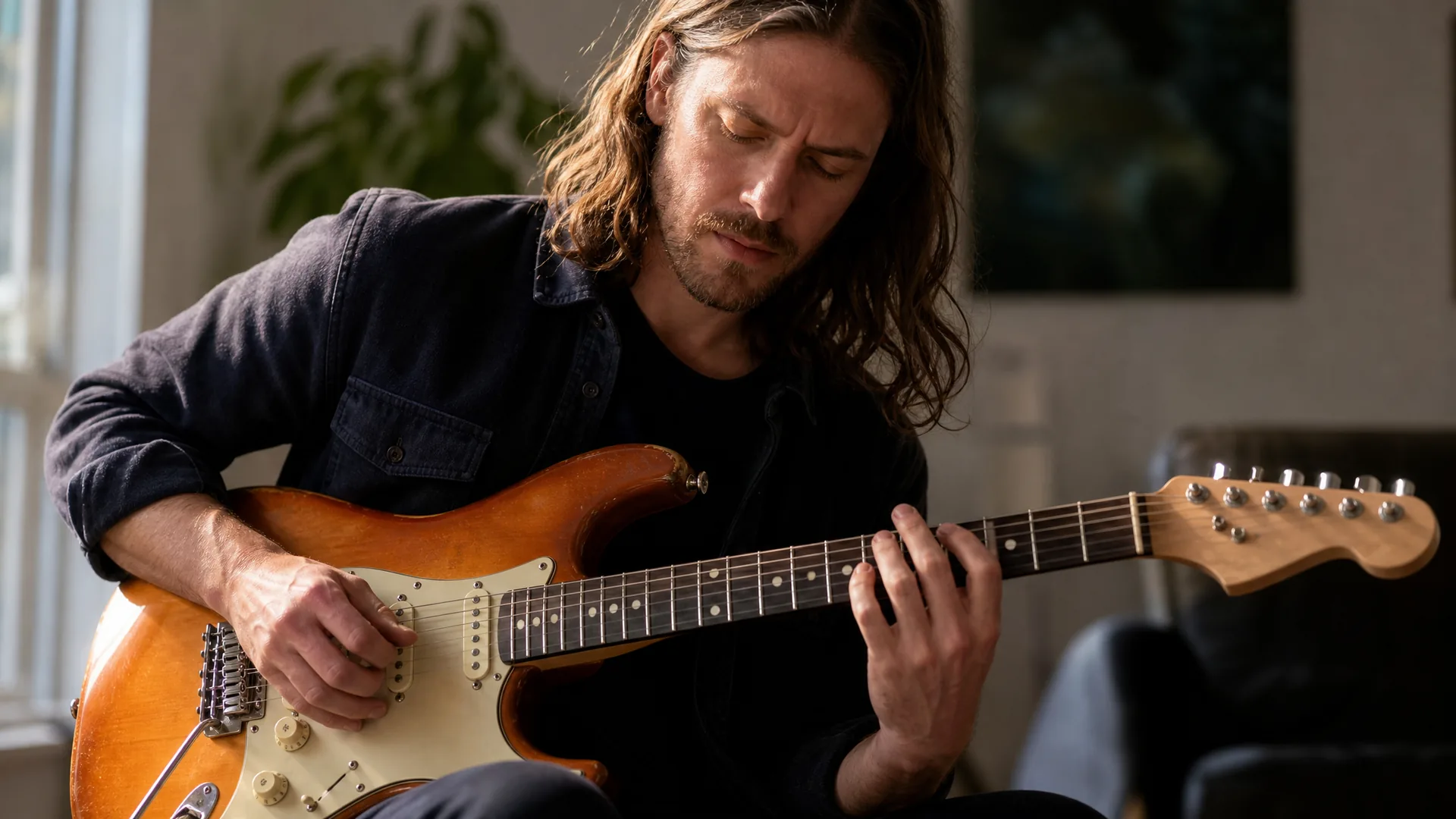
Two guitarists can play the exact same note, on the exact same guitar, at the exact same volume. One will sound like a musician. The other will sound like a student running an exercise. The difference is the decision behind the note: how it's shaped and where it lands. That decision is what this article is about, and it's the thing most guitar phrasing content skips entirely.
Why Tone and Phrasing Are One Decision, Not Two Settings
Most instructional material treats tone as a knob problem and phrasing as a rhythm problem. Dial in the right amp settings, then separately learn where to place bends and slides. That split is convenient for writing lesson plans. It's also wrong.
Tone is how a note sounds. Phrasing is when and how it arrives. But a note exists once, as a single expressive gesture. The speed of your vibrato changes the emotional weight of a phrase. The angle of your pick attack changes whether a note starts a sentence or finishes one. You can't separate the sound of a note from its placement in a musical thought. They're the same choice, made at the same instant.
This is the unified argument behind guitar tone and phrasing for adult players: you're making one decision, over and over, about what you want a note to say.
The Mistake of Treating Tone as an Amp Knob
Ask most players how to improve guitar tone and they'll talk about pedals, tube amps, pickup height. Gear matters. But gear only amplifies a decision. A guitarist with mediocre gear and a clear musical intention will out-communicate a guitarist with a wall of boutique pedals and no idea what they're trying to say. Tone shaping starts in the hands, long before it reaches the amp.
Guitar Phrasing Techniques for Adults: Unlearning Muscle Memory First
Adult players carry an advantage no beginner has: years of repetition. They also carry a liability from that exact same place. Muscle memory built without musical intention doesn't disappear just because you decide to play differently. You have to actively unlearn it.
Why Years of Practice Can Work Against You
Ten years of scale runs practiced for speed and accuracy builds a hand that moves fast and clean. It doesn't build a hand that knows when to hold back. Adult students who've played for a decade or more often still can't tell a phrase that serves the music from one that just fills space. Technique drills alone don't close that gap. The fingers know what to do. Nobody ever taught them when not to do it.
This is the real reason so many capable adult players hit a wall. It's a surplus of automatic decisions running underneath conscious ones, made years ago for reasons that had nothing to do with musical meaning. If that plateau sounds familiar, the pattern is well documented in breaking through the intermediate plateau.
How Mechanical Habits Block Musical Decisions
Most adult players have a listening problem. They've drilled the mechanics so long they stopped asking what the note is supposed to say. Unlearning that habit means slowing down enough to hear the gap between what your fingers want to do by default and what the phrase actually needs. That gap is where real phrasing lives, and it's uncomfortable to sit in at first. Most players speed past it out of habit.
Guitar Vibrato Control and Dynamics as Emotional Vocabulary
Vibrato control is part of what the note is. A narrow, fast vibrato says something different than a wide, slow one. A guitarist who only owns one setting only has one thing to say, regardless of the moment.
Vibrato Width and Speed as a Voice, Not a Decoration
Think of vibrato and dynamics the way a singer thinks about breath and volume. A singer varies vibrato across the held notes in a song, widening it, narrowing it, holding it back entirely, depending on what the lyric needs at that moment. Guitarists who treat vibrato as a single fixed skill to "have," rather than a range to draw from, are playing with one emotional register.
Guitar dynamics and expression work the same way. Playing every phrase at the same volume and intensity is the guitar equivalent of speaking in a monotone. Dynamics tell the listener which words matter. Note choice and feel only land when the player is willing to vary volume, attack, and vibrato within a single phrase, from beat to beat as well as from song to song.
How to Improve Guitar Tone by Playing Like You Mean It
If tone starts in the hands, then improving it means examining what the hands are actually doing, independent of any pedal, amp, or pickup.
How well do you really know the fretboard?
Take the free Fretboard Challenge and see exactly which notes cost you time. Then get the note map that fixes them.
One email with the map. Unsubscribe whenever: no card, nothing to cancel.
On its way.
Check your inbox in the next minute or two. If it is not there, look in promotions.
Touch, Attack, and Pick Angle as Expressive Tools
Pick attack changes tone more than most players realize. A pick striking the string aggressively, flat against it, produces a different color than one gliding across at an angle with lighter pressure. Each says something different, and a musical player chooses between them constantly, phrase by phrase, based on what the moment calls for.
The same applies to where you strike relative to the bridge and neck, how much finger pressure you use fretting a note, and whether you let a note ring or choke it off. These are expressive tools. Motown session players understood this instinctively. They built entire careers on restraint, where a single bent note placed exactly where it needed to be said more than a fast run ever could. That's a lesson in how Motown guitarists built careers on restraint worth studying directly.
Gear can shape and color what your hands already do. It can't replace the decision your hands are making. Adjust the amp all you want. A note played without intention still sounds like a note played without intention, just at a different volume.
What Makes a Guitarist Musical: Lessons from Players Who Backed Benson and Norah Jones
Adam Levine, a Berklee graduate and former Motown studio guitarist, has spent 50 years teaching adult players the difference between playing guitar and being a musician. That distinction is the entire subject of this article, and it comes from decades of watching what actually separates the two.
Students coached in this studio have gone on to perform alongside George Benson and Norah Jones, musicians whose entire reputations rest on phrasing. Both built careers on knowing exactly which note to play, exactly how to shape it, and exactly when to leave space instead.
The Difference Between Playing Notes and Telling a Story
A player who "just plays fast or accurate" is executing information. A musician is communicating something. The technical difference between the two might be small: a slightly different vibrato speed, half a beat of hesitation before a phrase starts, a note bent a quarter-tone under pitch on purpose. The perceptual difference is enormous. One version of the phrase is data. The other is a sentence with meaning in it.
This is what makes a guitarist musical: the willingness to let the notes serve an idea larger than themselves, instead of treating the solo as a container to fill with correct information as densely as possible. It's the same principle covered in sounding musical when soloing, and it applies well beyond any one genre, including in blues phrasing techniques for authentic expression, where restraint and space carry as much weight as the notes played.
Guitar Phrasing vs. Technique: How to Practice So You Actually Sound Different
Here's the uncomfortable part. None of this changes by practicing more scales, more arpeggios, or more speed exercises. Technique and phrasing are related, but they aren't the same skill, and drilling one doesn't automatically improve the other. Guitar phrasing vs. technique is a real distinction. The first is a set of expressive decisions. The second is the physical vocabulary that makes those decisions possible.
A Practice Framework for Turning Mechanics into Expression
Advanced players who want real feel need a different kind of practice, one built around listening before playing. A few shifts make the difference:
- Record yourself and listen back before deciding the phrase was "good." Most players judge a phrase while they're still inside the muscle memory of playing it, which hides its actual musical weight.
- Play the same four-bar phrase five different ways, varying vibrato, dynamics, and pick attack each time, before deciding which version says what you mean.
- Practice leaving space deliberately. Silence is part of phrasing.
- Study a vocalist's phrasing, not another guitarist's. Vocalists can't hide behind technique. Their phrasing is pure decision-making, and it translates directly.
This kind of practice is slower and less satisfying in the short term than another hour of scales. It's also the only kind that actually changes how you sound, a principle covered in more depth in practicing guitar mindfully.
Guitar tone and phrasing for adult players comes down to a decision to stop treating the guitar as a machine to operate correctly and start treating it as a voice to speak with. That shift is hard to make alone, especially after years of habits built the other way. That's exactly the gap covered in what 50 years of teaching guitar has revealed, and the reason so many capable players eventually look toward developing your own musical style as the next real step in their playing.
If you're ready to make that shift with guidance instead of guesswork, training with a world-class guitar academy is the fastest way to turn years of mechanical skill into something that actually sounds like you.
