
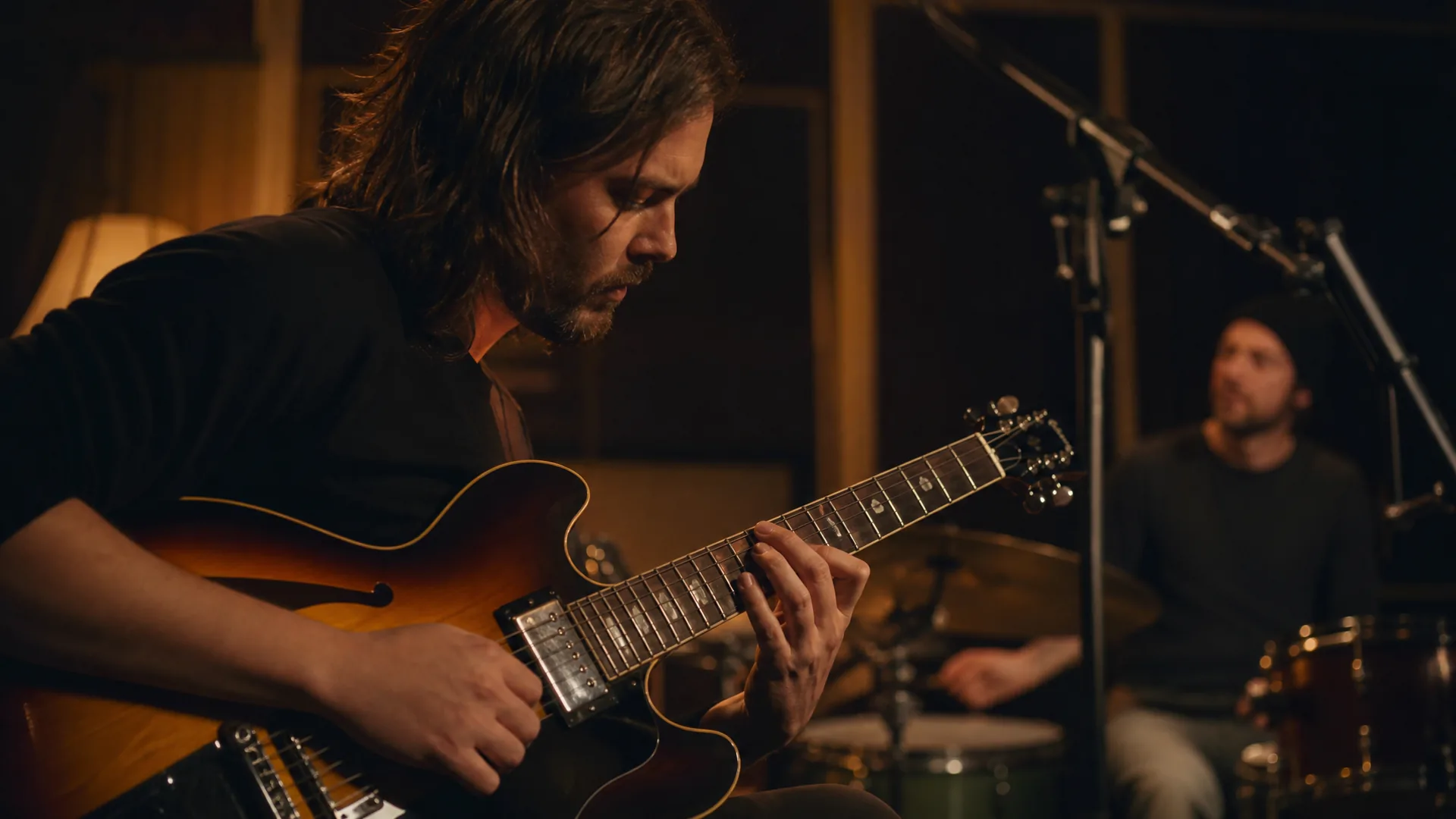
You can play every note in the right key, hit every shift clean, and still leave a room cold. That's the trap. Speed and accuracy feel like progress. But saying something with your guitar is a different skill. This article is about the decisions that separate a player who executes from a musician who speaks, and how to sound musical when soloing instead of just fast.
Playing Notes vs. Making a Statement: The Real Difference
Nobody is grading whether you hit the correct scale tone at the correct beat. A solo is a statement. It has a point of view, a shape, and an ending that means something. Most intermediate players never learn this. Nobody ever tells them the goal changes once the notes are under their fingers.
Why Technical Skill Doesn't Guarantee Musicality
Technique gives you the vocabulary. It doesn't give you anything to say. You can own a huge vocabulary and still bore a room. Fluency and expression are different skills, and you learn them in different ways. Musicality comes from decisions, what note, when, how loud, how long, made on purpose instead of by habit.
The Guitarist vs. Musician Divide
The guitarist vs. musician difference shows up the moment someone solos over a real song with real people listening. A guitarist plays what their fingers already know. A musician plays what the moment calls for. After 50 years of teaching, I've found the most common wall intermediate players hit is that they've never been taught to make a decision with a note instead of just finding one that fits. If that sounds familiar, it's worth understanding why you might be stuck on a plateau before you add another scale to your toolkit.
Note Choice: Deciding What to Play Instead of What Fits
Here's where most solos quietly die: note choice. The notes may be fine, but nobody chose them. They got found instead. A finger lands on a scale shape, the note happens to fit the key, and the player moves on without ever asking why that note, in that spot, over that chord.
Chord Tones vs. Passing Notes as Decisions
Every note in a solo does a job. Chord tones create stability. They land, they resolve, they sound like home. Passing notes create motion. They pull toward something and demand to be resolved. A musical solo uses both on purpose. You decide when to land and when to lean. That's the whole craft of deciding on chord tones instead of guessing, and it's the fastest route to note choice that actually sounds intentional.
Why "It's in the Scale" Isn't a Reason
"It's in the scale" is a permission slip. Plenty of notes are technically legal and still sound like noise. Being in the scale only means the note won't clash. It says nothing about whether it belongs in that phrase. This is exactly how you stop noodling on guitar: stop asking "is this allowed" and start asking "is this what I mean." If you're leaning on the same five shapes out of habit, getting out of the pentatonic box will force you to make real choices again instead of coasting on muscle memory.
How to Use Space When Soloing
Space is where the listener catches up with what you just played. Constant note density sounds nervous, like you're afraid of what happens if you stop.
How well do you really know the fretboard?
Take the free Fretboard Challenge and find out exactly which notes cost you time, then get the note map that fixes them.
One email with the sheet. Unsubscribe whenever. No card, nothing to cancel.
On its way.
Check your inbox in the next minute or two. If it is not there, look in promotions.
Silence as a Phrase, Not a Gap
Treat a rest as a phrase you're playing. A well-placed silence builds anticipation the way a pause before a punchline does. It makes the next note land harder. This is how you use space when soloing without losing momentum: you plan the silence the same way you plan the notes around it. Part of that discipline is rhythmic placement and where notes land. A note arriving a hair behind the beat can feel more like a statement than the same note played perfectly on time.
Building a Phrasing Arc: Musical Storytelling on Guitar
A solo without shape is just a list of licks played back to back. A solo with an arc has a beginning that sets up a question, a middle that develops it, and an end that answers it. That arc is what makes guitar solo storytelling actually work as storytelling, instead of as a demonstration reel.
Question-and-Answer Phrasing
The oldest trick in the book is still the strongest: play a phrase, then answer it. Call and response is how guitar players actually learn to phrase like a musician. You state an idea in one bar, then respond to it in the next, either by finishing the thought or twisting it. It's the same logic behind phrasing techniques rooted in blues expression, where a single unanswered line can carry more weight than a whole chorus of continuous runs.
Shaping a Solo Like a Sentence, Not a List
A sentence has punctuation. A list just has commas, forever. Musical phrasing means every solo needs a comma, a pause, and a period, not sixteen bars of the same rhythmic value in a row. Ask where your solo's sentence ends. If you can't answer, it probably doesn't have one yet.
Dynamics: The Difference Between Loud and Meaningful
Volume and intensity are not the same thing. A solo played at one constant loudness, from the first note to the last, has nowhere left to go once it starts. Dynamics in guitar solos let a phrase breathe, then hit, then breathe again.
Touch, Volume, and Emotional Contrast
Dynamics live in your hands before they live in your amp: attack, pick angle, vibrato width, how hard you dig in. A quiet, cleanly-picked phrase followed by a hard-driven bend creates emotional contrast a distortion pedal alone can't fake. This is the missing ingredient in soloing with feeling. Most players never vary their touch across sixteen bars, so nothing in the solo ever surprises the listener. Adam Levine spent decades as a Motown studio guitarist, where the entire session culture was built on restraint. Musicians played the fewest notes that told the truest story. That's the Motown approach to restraint, and it still separates working musicians from hobbyist shredders today. A solo built entirely from a pentatonic box and constant sixteenth notes can be technically flawless and still leave a room silent out of politeness rather than out of feeling. Musicians can hear that difference immediately.
How to Practice Playing With Intention
None of this happens at full speed. Playing with intention means you actually hear your own choices while you're making them, and that's impossible at tempo, on autopilot.
Slowing Down to Hear Your Own Choices
Cut your usual tempo in half. At that speed, you can't hide behind muscle memory. Every note choice, every silence, every dynamic shift has to be conscious, because there's no momentum to carry you past it. Ask yourself, out loud if you have to: why this note, why now, why this loud. Do that for ten minutes a day and you'll hear the noodling drop out of your own playing within weeks. Students who've trained under this philosophy have gone on to perform alongside Michael Jackson, George Benson, Celine Dion, and Norah Jones, artists whose bands are built around musical taste as much as chops. That's what happens when someone spends years being coached on decisions instead of just drills.
If you've read this far, you already know the gap you're trying to close. The fastest way to close it is a trained ear listening to your actual phrasing and telling you exactly where the decision-making breaks down. That's also the natural next step toward developing a personal musical voice, once your phrasing choices stop being accidental. If you want that kind of direct, personal feedback, you can get personalized feedback on your phrasing and start playing like you mean it.
