
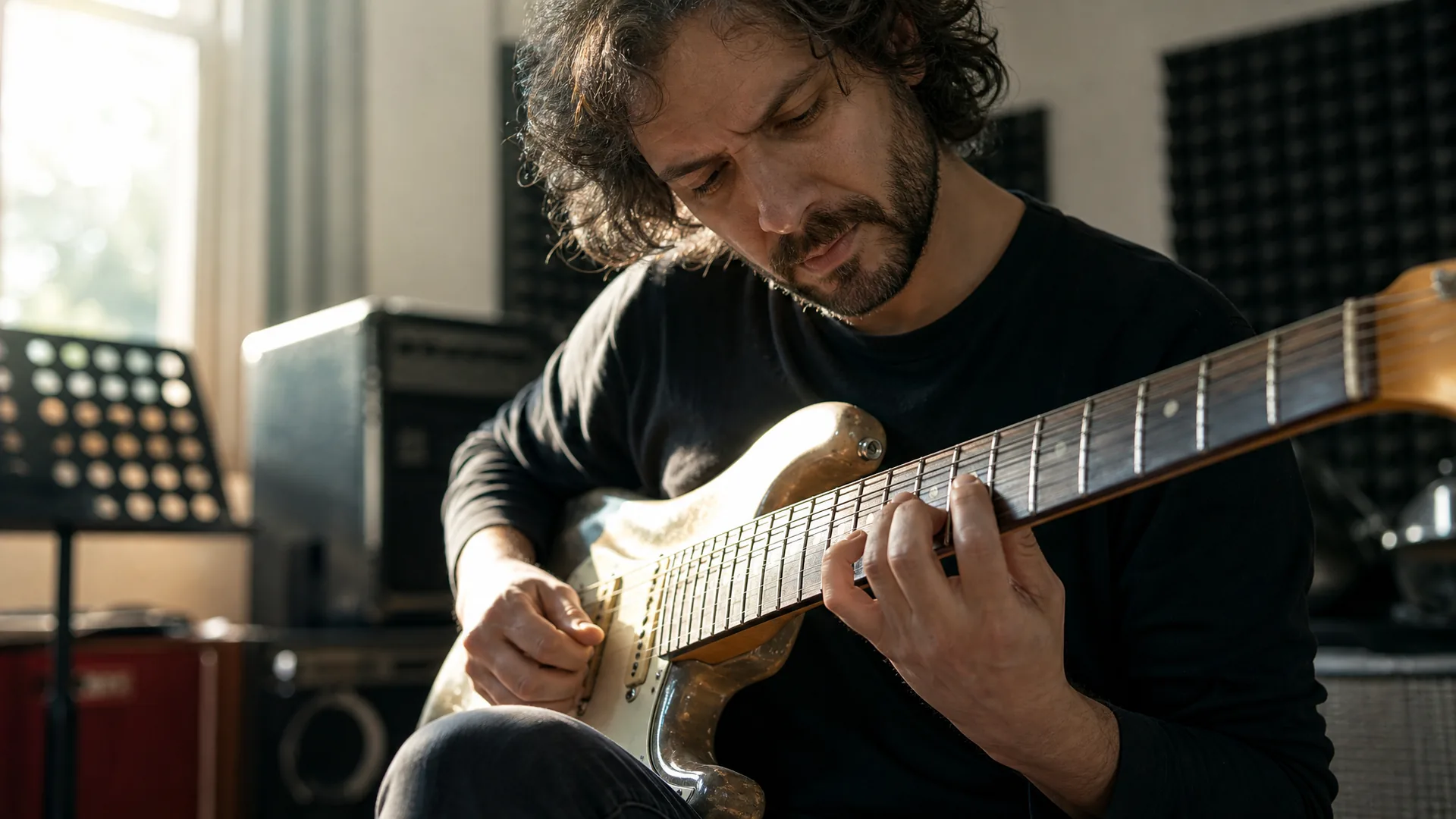
If you've been playing guitar for a few years and you already know the pentatonic boxes, the major scale positions, and maybe a handful of modes, but your solos still feel like a tour of the fretboard rather than a musical statement, this article is for you. Improvisation guitar for adults is where most players stall, because they've been solving the wrong problem. They've been learning shapes when they should have been learning to speak.
Adam Levine spent years as a Motown studio guitarist, where every take had to serve the song. There was no room for pattern running. That environment forged the core principle behind his academy: musicians make decisions; pattern runners make noise. After 50 years of teaching, the single most common plateau Adam sees in adult guitarists is a decision-making problem. They've learned the shapes. They just haven't learned what to say with them.
Why Most Adult Guitarists Are Stuck in Pattern Mode
Here's the hard truth. Knowing scales is not improvising. Running the pentatonic scale fluently over a backing track is a technical exercise: useful, necessary even, and still short of music. The moment you land on a note because your finger arrived there next, rather than because your ear chose it, you stopped improvising and started executing a program.
The distinction is sharp. A pattern runner asks: Where does my hand go next? A musician asks: What do I want to say? Those are entirely different questions, and they produce entirely different sounds.
Most adult guitarists get stuck in pattern mode because that's what most teaching reinforces. Scale diagrams, position charts, mode names, all useful tools, none of them improvisation. Improvisation is a sequence of intentional musical decisions made in real time. Until you train that decision-making process directly, more scale knowledge just gives you more places to wander without saying anything.
What Guitar Improvisation Actually Is (And Isn't)
Improvisation is prepared spontaneity, the ability to make fast, intentional musical choices because you've built the vocabulary and the ear to support them. That's a different skill than scale fluency, and it requires different practice.
The difference between noodling and storytelling
A story has shape. It has a beginning that sets a tension, a middle that develops it, and a resolution that pays it off. A good guitar solo does the same thing. It introduces a melodic idea, develops it through repetition, variation, or contrast, and lands somewhere purposeful.
Noodling has none of that. It moves, it fills space, it might even be technically impressive, but it doesn't go anywhere. The listener has nothing to follow because the player has no destination in mind.
The fix is playing guitar with feel, developing the internal sense of phrasing and intention that turns notes into narrative.
How jazz and blues improvisation illuminate the real goal
Jazz guitar improvisation and blues improvisation techniques approach musical decision-making from different angles, and both angles are instructive.
Jazz privileges harmony navigation. A jazz improviser is always listening to the chord underneath them and targeting notes that define or color that harmony. They track the changes bar by bar, choosing notes that tell you exactly where the harmony is. The complexity is harmonic, and the discipline is relentless.
Blues improvisation techniques take a different road to the same destination. The blues idiom is built on feel, space, and melodic intention. B.B. King was celebrated for the notes he chose not to play. Space, timing, and a single bent note held at exactly the right moment, that's blues vocabulary applied with decision. Here the complexity is emotional and rhythmic.
Both traditions demand the same underlying skill: knowing what you want to say before you play it.
Building Guitar Vocabulary You Can Actually Use
Developing guitar vocabulary means absorbing short, complete musical ideas, motifs, call-and-response fragments, rhythmic cells, and owning them deeply enough to deploy them instinctively under pressure.
Learning phrases, not fingerings
A lick is a complete musical gesture with rhythmic placement, phrasing, and harmonic context baked in. When you learn it as a fingering, you get a shape. When you learn it as a phrase, with its rhythm, its feel, its place in the measure, you get something you can use.
This is why transcription is the most effective vocabulary-building tool available. Jazz musicians have long used it as their primary method: learn a Charlie Parker phrase note-for-note, then sing it, then find it on the instrument, then personalize it. This four-step loop, hear → sing → find → play → vary, is as relevant to improvisation guitar for adults today as it was in the 1940s. The order matters. Singing before playing forces your ear to own the phrase along with your hand.
How well do you really know the fretboard?
Take the free Fretboard Challenge and find out exactly which notes cost you time, then get the note map that fixes them.
One email with the sheet. Unsubscribe whenever. No card, nothing to cancel.
On its way.
Check your inbox in the next minute or two. If it is not there, look in promotions.
How to internalize vocabulary so it becomes instinct
Hearing something once and finding it on the guitar is only the beginning. A phrase becomes vocabulary when you can play it in multiple keys, at different tempos, over different chord qualities, and vary it on the fly.
The drill is simple but demanding: take one phrase and practice it in every position, in every key, starting on different beats of the measure. Then alter it, shorten it, extend it, invert the rhythm, resolve it differently. Adult learners who practice this kind of deliberate, decision-focused repetition develop musical intuition faster than those who practice scales for the same amount of time, because they're encoding intention along with motion.
Be disciplined here. Resist the temptation to collect more phrases before you've truly owned the ones you have. Depth beats breadth every time.
How to Improvise Over Changes Without Getting Lost
Here's a practical framework. When you're figuring out how to improvise over changes, prioritize in this order: chord tones first, chromatic approach notes second, scale color last.
Chord tones, the root, third, fifth, and seventh of each chord, are always the safest landing spots because they define the harmony. They tell the listener exactly where you are. Chromatic approach notes, played a half step above or below a chord tone and resolving into it, add tension and movement. Scale color, the extensions, the modes, the passing tones, comes third, once the harmonic skeleton is solid.
Apply this to a ii–V–I in the key of C: Dm7 → G7 → Cmaj7. Instead of running the C major scale across all three chords, target the third of each chord as your resolution point. On Dm7, aim for F. On G7, aim for B (the leading tone). On Cmaj7, resolve to E or G. Those three notes alone create a line with harmonic logic.
The player who waits for the "right" scale before committing is always a half-beat behind the music. The player who knows the chord tones leads with intention and the harmony follows. That's the difference between sounding lost and sounding deliberate, even when the line is simple.
A Guitar Improvisation Practice Routine That Builds Real Skills
Structure matters. Without it, practice sessions drift toward whatever feels comfortable, which is usually the stuff you already know. A guitar improvisation practice routine for adult players should target decision-making directly.
The daily practice structure
Keep this to 45 minutes total. Four blocks:
Ear training and transcription, 15 minutes. Pick a single phrase from a recording you admire. Slow it down if needed. Sing it before you find it on guitar. This is non-negotiable, the singing step is what moves the phrase from your hand to your ear.
Vocabulary drilling, 10 minutes. Take one phrase from your transcription work and move it through at least three keys. Vary the rhythm once. Play it over the appropriate chord quality with a metronome instead of a backing track: you need to hear just the phrase and the beat, with nothing to hide behind.
Slow improvisation over a backing track, 15 minutes. Set the tempo low, lower than feels challenging technically. The challenge here is decision-making. Before each phrase, choose a target note. After each phrase, evaluate: did you get there? Did it serve the moment? This reflection in real time is the practice.
Self-critique, 5 minutes. Record yourself and listen back with one specific question: How many of those notes were decisions, and how many were defaults? Honest answers to that question will tell you exactly what to work on next session.
Measuring progress: from running patterns to making decisions
Speed and note count are the wrong metrics. The right metric is intentionality: the percentage of notes you played because you chose them rather than because your hand arrived there. That ratio, tracked honestly over weeks, is how you know you're improving at improvisation guitar for adults.
Progress also shows up in your phrases getting shorter and more focused. Beginners fill space. Advancing players edit themselves. When you start leaving gaps on purpose, when silence becomes a tool, you've crossed the threshold.
Fretboard Mastery Is the Foundation, Not the Destination
You do need to know the fretboard. You need to know it well enough that you stop thinking about it, so that when your ear hears a note, your hand finds it without a search. Breaking through guitar plateaus with fretboard note recognition is a real prerequisite, and players who haven't done that work will always have a slight lag between their musical idea and their physical execution.
But fretboard knowledge is only a prerequisite for freedom. The players who plateau at the intermediate level almost always have solid fretboard knowledge and solid scale knowledge. What they lack is the habit of hearing first and playing second, of letting the musical idea precede the physical gesture.
That's the real separator. The player who breaks through to genuine musical expression is the one who has trained themselves to have something to say before their fingers move.
Stop running. Start speaking. If you're ready to apply these principles in a structured environment with a mentor who has walked this road for decades, the Adam Loves Guitar Academy is the place to do it: a practice built around exactly the kind of decision-making this article describes.
