
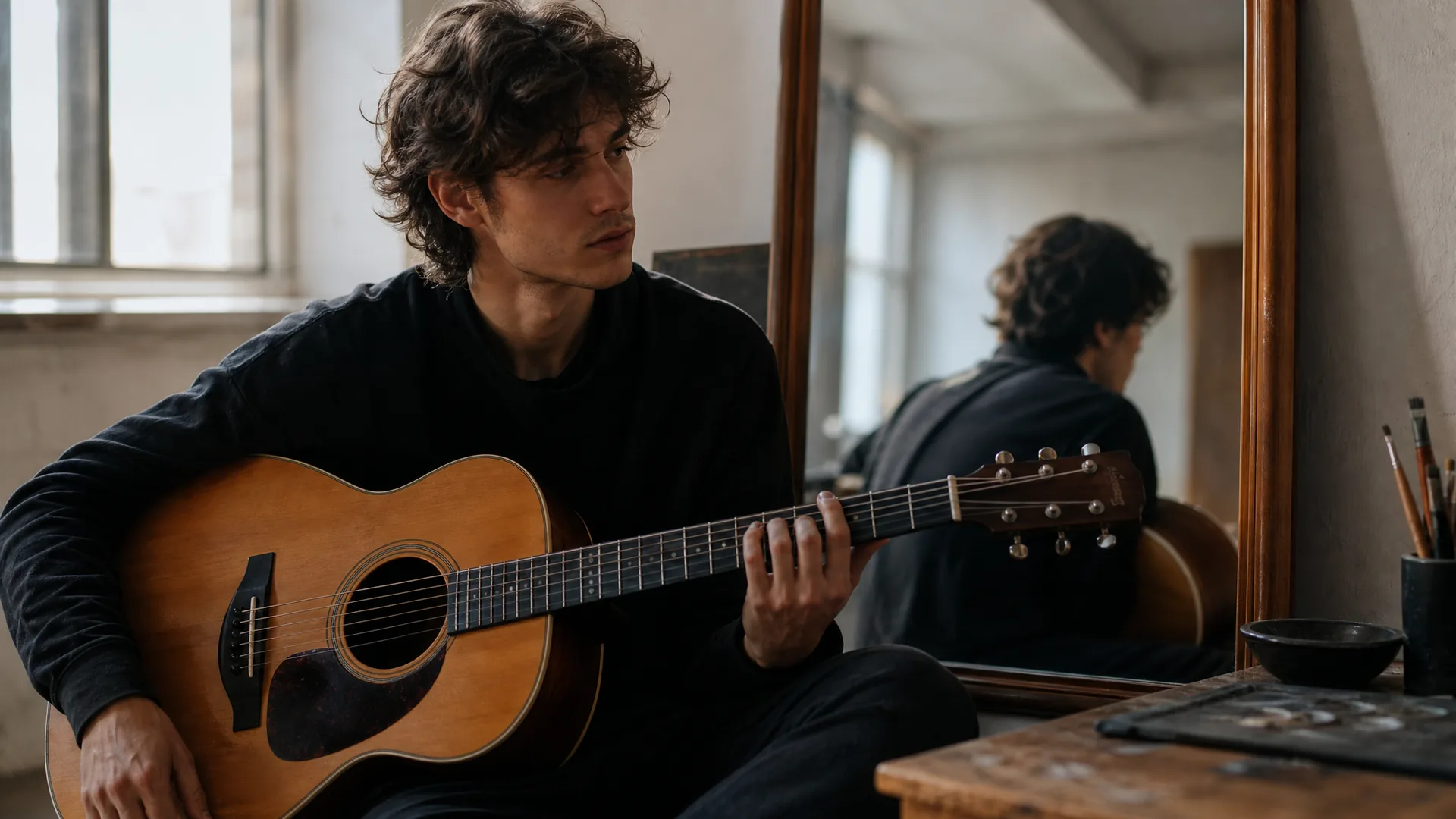
If you've been asking yourself why am I plateaued on guitar, you're already closer to the answer than most players get. Asking it means you've noticed something isn't working, and that noticing is the beginning of a real shift.
The uncomfortable truth: the plateau is a perception problem. Most players who've been stuck for years practice consistently. They run through scales, learn new songs, watch YouTube tutorials. And they stay exactly where they are. The reason has nothing to do with their fingers.
The Guitar Plateau Most Players Never Escape
The plateau most intermediate guitarists hit is an identity problem. You've built a self-image as someone who plays guitar. That identity is quietly working against you.
Playing guitar and being a musician are not the same thing. One is a skill set. The other is a way of thinking and hearing. Most players never make the leap between the two, because nobody ever showed them the leap was necessary.
The player who's been stuck for three, five, or ten years is practicing the wrong thing for the wrong reason: reinforcing what they already know instead of expanding what they can perceive and decide.
That distinction, between playing and being a musician, is the central tension of every guitar learning plateau. Resolve it, and the ceiling disappears.
Why More Practice Won't Fix a Guitar Learning Plateau
Here's what most advice gets wrong: it treats the plateau as a technique deficit. So the prescription is always more, more scales, more songs, more drills. But if the approach itself is the problem, doing more of it just deepens the rut.
Repetition Without Intention Is Just Rehearsing Your Ceiling
Running a pentatonic scale for the hundredth time is maintenance, and maintenance is a poor substitute for practice. Muscle memory is only a tool. When you repeat a pattern without a clear musical goal attached to it, you're rehearsing your current ceiling until it feels permanent.
Intentional practice means engaging a specific musical problem: why does this phrase feel flat? Where does the tension need to resolve? What would make this passage breathe? Those questions produce growth. Repetition without them produces comfort, and comfort is the enemy of development.
The Intermediate Trap: Competence That Feels Like Progress
This is where the advanced beginner identity takes hold. You can play through chord changes. You know your pentatonic boxes. You've learned dozens of songs you're proud of. You're clearly not a beginner anymore, so the assumption is that you're progressing.
In fact, you're consolidating.
Adult learners who've been playing for five to fifteen years often arrive technically proficient, able to navigate a chord progression or solo in a familiar key, yet describe feeling stuck in a loop they can't name. The plateau is conceptual. Competence has become a ceiling because it stopped demanding anything new from them.
More songs won't fix this. Another scale pattern won't fix this. The fix requires a different kind of work entirely.
The Psychological Shift Behind Every Guitar Plateau Breakthrough
Every guitar plateau breakthrough worth having starts in the same place: a shift in how you relate to the fretboard. What matters is how you use what you know.
From Reacting to the Fretboard to Deciding on It
Here's a distinction that changes everything. An intermediate player can solo over a chord progression using a pentatonic shape and land every note in key, and still sound like they're practicing. A musician playing the same progression chooses which notes to play, when to leave space, and how to resolve tension. The notes may be identical. The intent is not.
Players react. Musicians decide.
Muscle memory is reactive by design, it fires before you think. That's useful for technique. It's destructive for expression. When your playing is driven entirely by patterns your hands already know, you're retrieving music you already stored.
The shift from player to musician is psychological and perceptual. It means developing the ability to hear an idea before your hands play it, then choosing how to execute it. This is the principle of decision over patterns in improvisation, and it's what separates expressive playing from technically correct playing that leaves no impression.
The students who break through fastest are the ones who start making decisions on the fretboard instead of reacting to it. Muscle memory gets you to competent. Musical understanding gets you to expressive.
What Getting Better at Guitar After Years Actually Requires
Getting better at guitar after years of playing means building the musical infrastructure that your technique has been waiting for.
How well do you really know the fretboard?
Take the free Fretboard Challenge and find out exactly which notes cost you time, then get the note map that fixes them.
One email with the sheet. Unsubscribe whenever. No card, nothing to cancel.
On its way.
Check your inbox in the next minute or two. If it is not there, look in promotions.
Musical Understanding, Not Just More Technique
Real progress means understanding what you're playing harmonically, why a chord resolves the way it does, what the relationship is between a melody note and the chord beneath it, how tension and release work across a phrase. Think of it as the conceptual map that turns your technique into a language.
Without that map, you're fluent in the sounds but illiterate in the meaning. You can execute, but you can't compose in real time, which is what musical expression actually is.
Fretboard note recognition as a plateau-breaking skill is one of the most concrete ways to start building that map. When you know precisely where every note lives on the neck as an actual pitch with harmonic identity, you stop navigating by shape and start navigating by sound.
Learning to Hear What You're Playing
Ear training is the piece most intermediate guitarists skip entirely, because it feels abstract and unglamorous. It is also the single greatest accelerant of musical growth.
When your ear leads and your hands follow, you are making music. When your hands lead and your ear observes, you are running patterns. The difference in sound is immediately apparent to any listener, and once you develop the ear to hear it yourself, you can't unhear it.
This is ultimately what bridging technical skill and real musical feel requires: building the feedback loop between what you intend and what you produce, until intention drives the hand rather than the other way around.
Why Adult Guitar Players Break Through Faster with the Right Teacher
Adult learners have an underrated advantage. They learn conceptually. They want to understand why something works as well as how to do it. That disposition, when met with the right instruction, accelerates development faster than rote drilling ever could.
The right teacher gives you the map. There's a real difference between a teacher who assigns you a new scale and one who shows you why that scale resolves tension in a particular harmonic context, and what to listen for when it does.
Adam Levine spent 50 years teaching guitar and training students who went on to perform with artists including George Benson, Michael Jackson, Celine Dion, and Norah Jones. That span of experience gives him a precise view of exactly where capable players stall and why. His core teaching distinction, the difference between playing guitar and being a musician, emerged from decades of studio work at Motown and concert-level teaching, where technical ability alone never separated the great players from the merely good ones.
A Berklee education and a Motown career give you a very specific lens on what musical intelligence actually looks like in practice. The players who made it listened differently, whatever their technical gifts.
How to Break Through Your Guitar Plateau Starting Now
Three directional shifts that change the trajectory immediately.
One: Stop adding and start interrogating. Before you learn the next song or scale, sit with something you already play and ask hard questions. Why does this phrase feel unresolved? Where am I defaulting to habit instead of making a choice? Diagnosis is the first act of musical thinking.
Two: Play one note and mean it. This sounds reductive, but the ability to commit to a single note, to choose it, place it, and resolve it, is a higher skill than running a clean pentatonic run. Practice that commitment daily. It rewires your relationship to the instrument faster than any technical exercise.
Three: Train your ear before your hands. Sing a phrase before you play it. Identify the harmonic function of what you're playing as you play it. Build the habit of hearing first, playing second. This single shift begins the move from reacting to deciding.
The plateau you're on is a threshold. Getting through it requires a different kind of decision, about how you practice, what you listen for, and who you learn from.
That decision is the same kind the article describes: deliberate, chosen, musical. Adam's online guitar academy is built for players who are ready to make it.
