
Free · in Adam's Academy
The Triad Trainer
Triads everywhere on the neck: every key, every inversion, closed and open voicings, and along a single string.
Try it in the Academy → How to use it
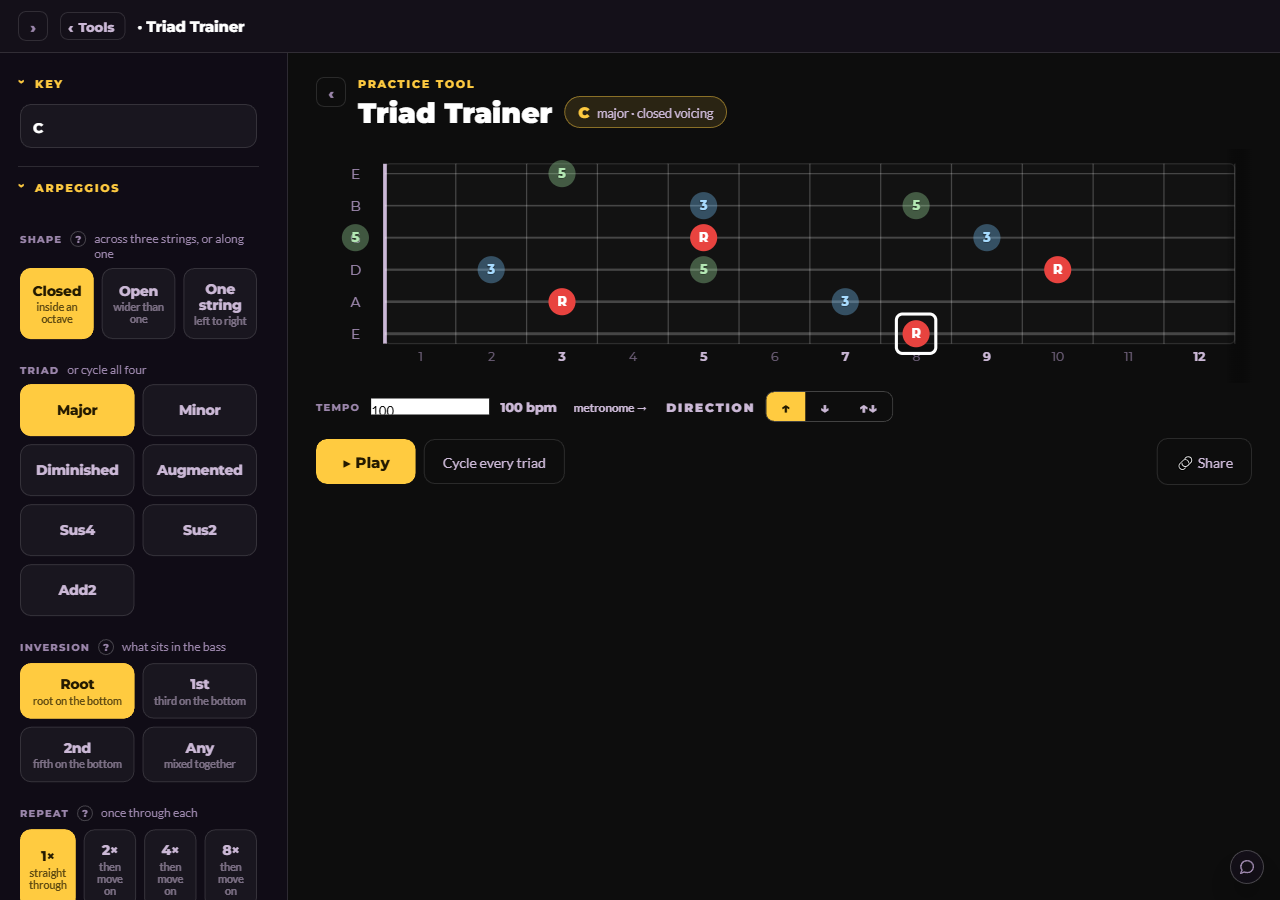
Three notes, and the whole neck opens. A triad is the smallest chord there is, and the reason to learn it everywhere is the reason players get stuck: one shape, played for the rest of your life.
The trainer finds the same triad on every string set, in root position and both inversions, closed or open voiced, or lays it along one string so you hear how far apart the notes really are. Each shape repeats up to eight times, because one pass is long enough to hear and far too short to locate.
Who it is for. Rhythm players who want more than the barre chord, and anyone working through Adam's Triad Challenge.
What opens it. One shape is free to everyone. Every key, inversion and string set comes with the membership.
How to use it
- 1
Pick the triad and the key
Major, minor, diminished, augmented. Then the key. The neck shows the triad on the string set you have chosen, root in red.
- 2
Choose the string set
Top three strings, the middle sets, or the bottom three. The same chord lives on all of them and sounds different on each. Learn one set at a time, then move the same key across.
- 3
Choose the inversion
Root position puts the root in the bass. First inversion puts the third there; second, the fifth. Pick one, or Mixed to hear them in turn. The point is learning the sound of the note in the bass.
- 4
Closed, open, or along a string
Closed is the tight three-note shape. Open spreads the middle note up an octave, the sound of a lot of great rhythm playing. Along a string strips out the tuning's irregularity so you hear the distances plainly.
- 5
Repeat, then Play
Set how many times each shape repeats (up to eight) and the tempo. Press Play. Find the shape with your hand while it repeats, then play along on the last two.
- 6
Share
The share link carries everything: key, quality, string set, inversion, voicing, tempo. Send a student the exact drill.
Adam's tips
- Learn one string set in all twelve keys before adding a second. Moving a shape is easier than learning a new one.
- Play the root alone first, then add the third, then the fifth. Hear each note join.
- Open voicings under a singer are a gift: they get out of the way of the melody.
- Take a song you know and play its chords as triads on the top three strings only. That is the Triad Challenge in one line.
Questions people ask
- What is the difference between closed and open?
- Closed keeps the three notes within an octave; open moves the middle one up an octave, which spreads the sound. Both are the same chord.
- Why repeat a shape eight times?
- One pass is long enough to hear and far too short to find. Repeats give your hand time to locate it and then play along.
- Diminished and augmented too?
- Yes. All four qualities, every inversion, every string set.
Try it now
One shape is free to everyone. Every key, inversion and string set comes with the membership.
Open Triad Trainer in the Academy → What the membership includes
Already a member? Go straight to the tool.
Share this guide
The caption and the teaser below are written to be lifted as they are.
One triad, every string set, every inversion. The Triad Trainer plays the same three notes everywhere they live on the neck and repeats each shape until your hand finds it. The way out of playing one chord shape forever.
Three notes, the whole neck
The Triad Trainer finds the same triad on every string set, in every inversion, closed or open, and repeats each shape up to eight times so your hand can find it. Here is how to work through it.
The video walkthrough
Coming soon. It follows this script, about 1.3 minutes.
- 10sOpen. Tools, Triad Trainer. Major, key of G, top three strings.
- 20sInversions. Root position. First inversion puts the third in the bass. Second, the fifth. Mixed plays them in turn.
- 15sClosed and open. Closed is tight. Open spreads the middle note up. Same chord, different room.
- 20sRepeat and play. Four repeats, 80 bpm, Play. Find it on the first two, play along on the last two.
- 10sInto the Academy. One shape is free. All of it comes with the membership, and Fretboard Diagrams will print any of these shapes for you.
The other tools
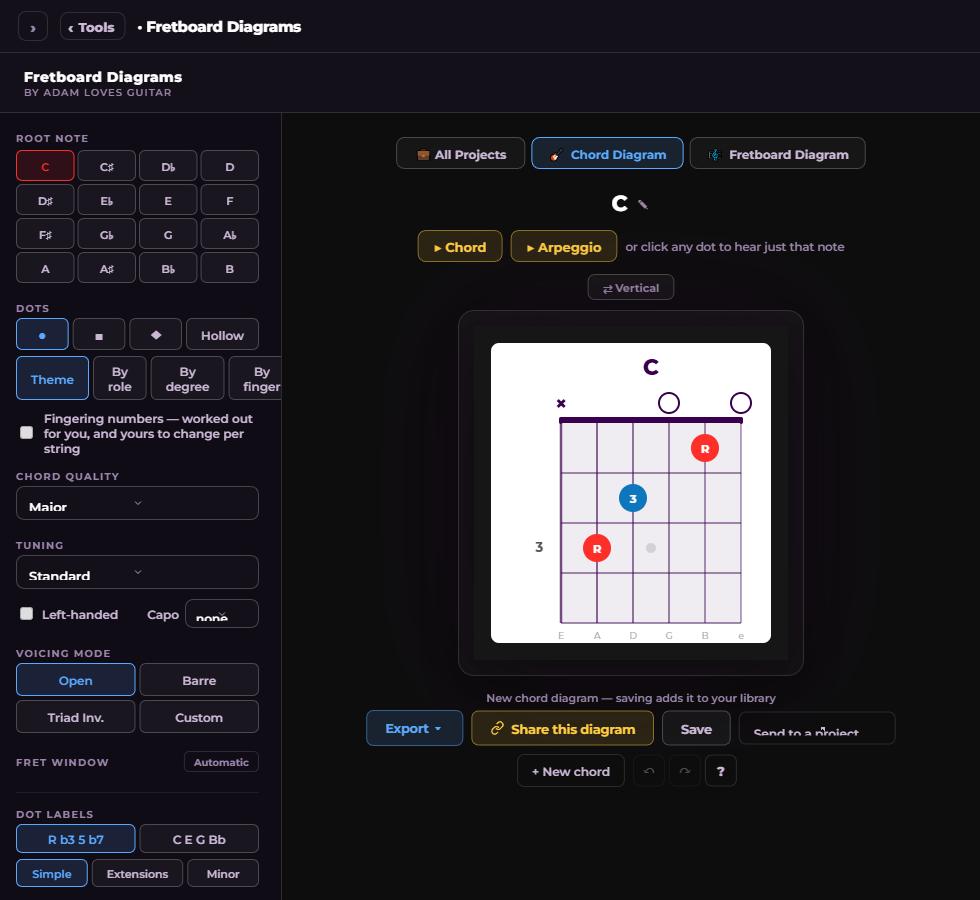 Fretboard DiagramsBuild any chord voicing or fretboard map Adam teaches, and lay them out into practice sheets you can print, share and hand to a student.
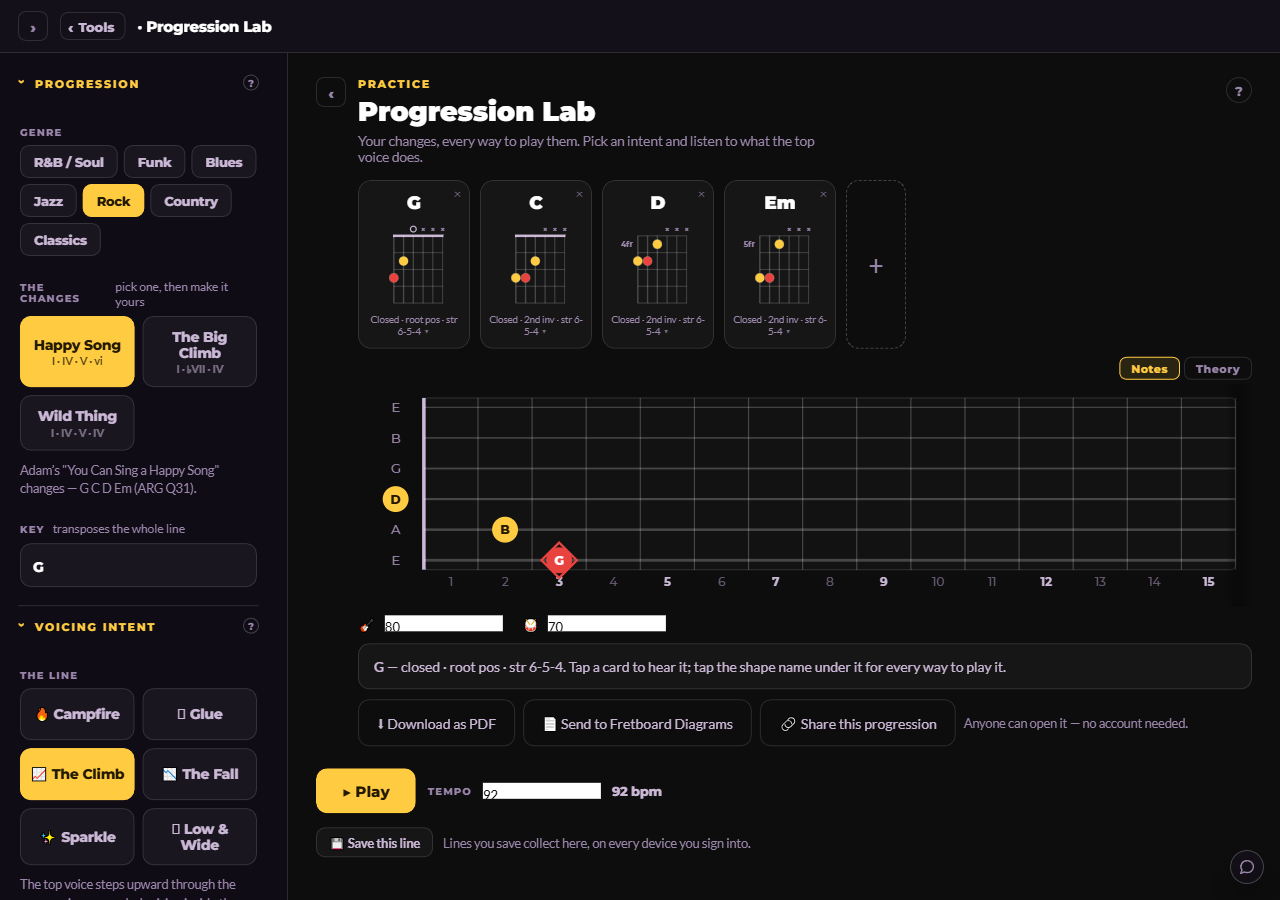 The Progression LabWrite any chord progression and hear it played back with a strum pattern, swing, and a drummer behind you.
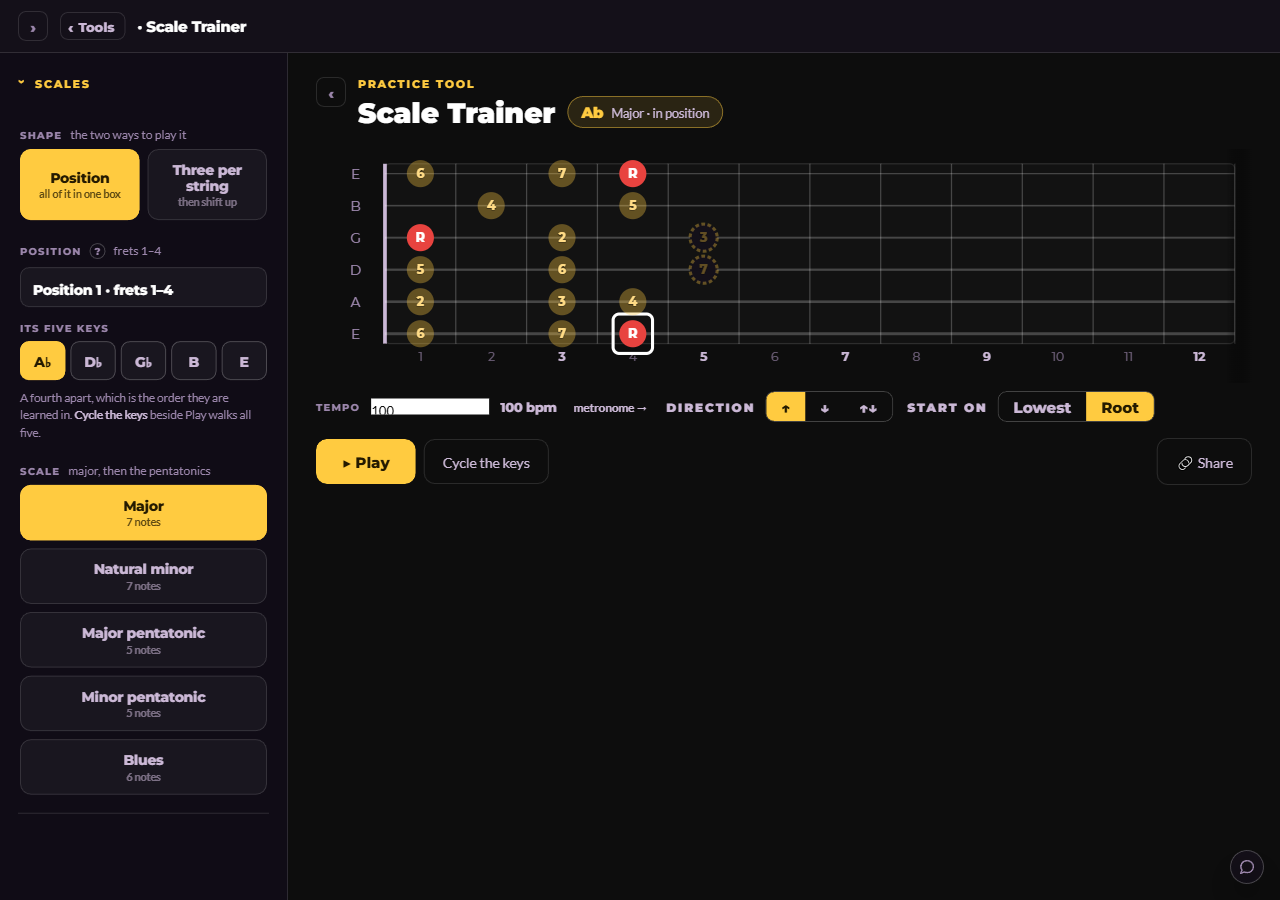 The Scale TrainerEvery scale, in every key, in the positions Adam teaches them in, played back at your tempo while the neck shows you where you are.