
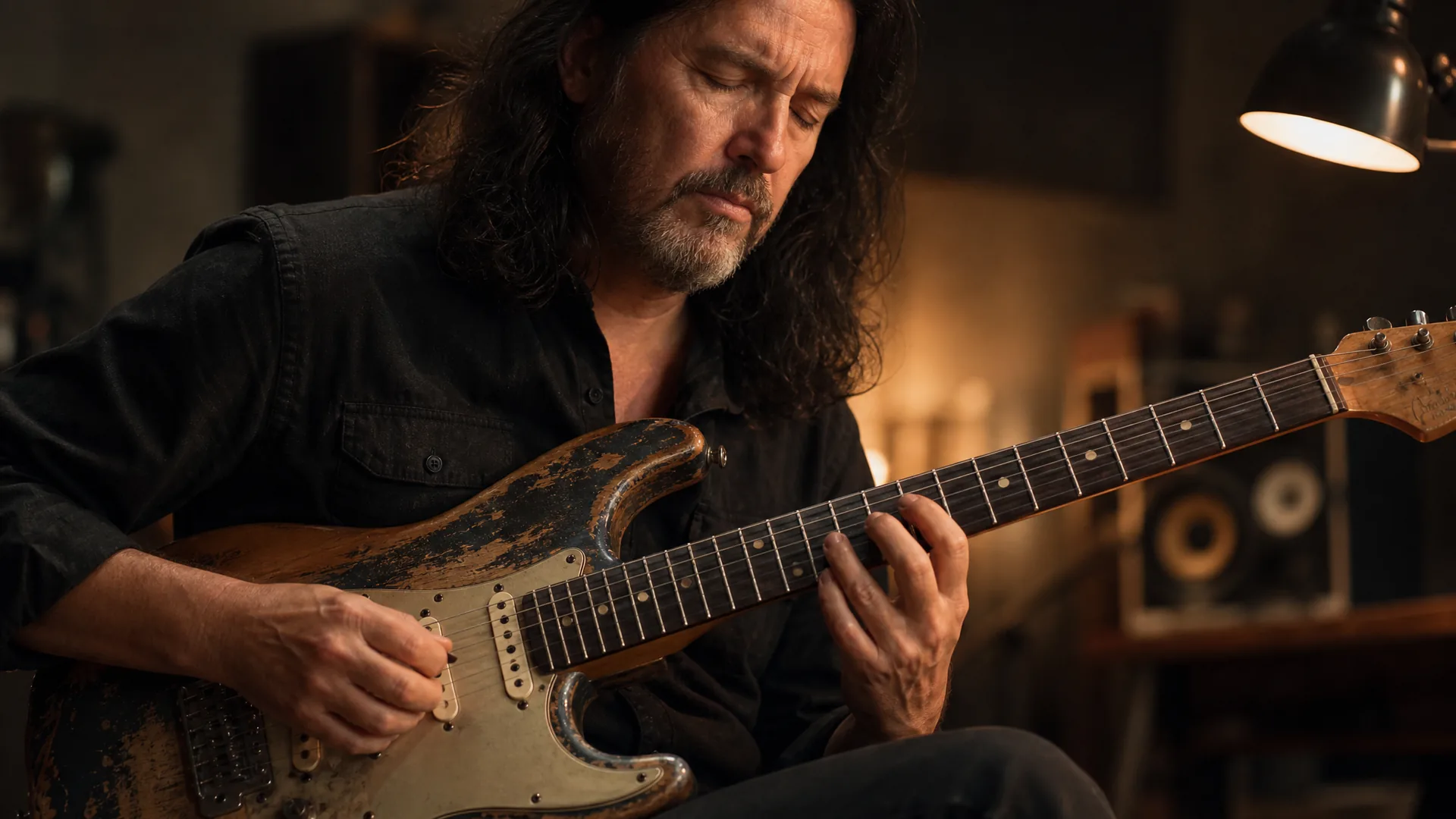
You know the scales. You know the positions. You know the theory. And your solos still feel like memorized shapes stitched together. That frustration is exactly what drives serious guitarists past beginner mechanics to look for real improvisation coaching: a way to treat improvisation as a language you actually speak.
Most online resources ignore this problem entirely. They target beginners, or they hand out fragmented tips that never touch the intermediate plateau, the place where your technical ability has outrun your musical intent. Adam Loves Guitar exists for that exact gap. The focus here is becoming a musician. That means unlearning the habit of guessing and replacing it with the discipline of deciding.
Why Adult Guitarists Need More Than Scale Patterns
Technical proficiency without narrative direction is just typing fast without knowing what to say. You can move around the fretboard effortlessly and still be organizing notes instead of communicating ideas.
The Gap Between Technical Skill and Musical Intent
Students often arrive knowing all five pentatonic positions. Ask them to build a coherent four-bar phrase that resolves intentionally to a chord tone, and most can't. Scale mastery is a mechanical achievement. Musical intent is a cognitive and emotional one, and the two don't automatically connect. Closing that gap means targeting chord tones intentionally, so every note lands with purpose against the harmony instead of floating above it.
Your fingers already know where to go. Your ear has to learn to decide when, and why, they get there.
Why Generic Improv Tips Fail Intermediate Players
The internet is saturated with content built for day-one beginners. Most search results for guitar improvisation lessons either target beginners or repeat generic tips, which leaves a real gap for intermediate-to-advanced adults who want mentorship-level coaching. What's missing is any real attention to the psychological barriers and physical tension that keep mature players from expressing themselves freely.
If you've already worked through the free resources out there, this is exactly where they stop helping. What you need at this point is diagnosis.
Structured Improvisation Training vs. Random Practice
Random noodling over YouTube loops feels productive, but it mostly reinforces what you're already comfortable doing, because that's what feels good to play.
Building a Vocabulary of Musical Decisions
Fluency shows up when aimless exploration gets replaced by exercises that force specific choices, in real time. Structured improvisation coaching gives you the framework to turn isolated techniques into a connected vocabulary, phrases that respond to harmonic movement instead of sitting on top of it. You stop thinking about finger patterns. You start hearing the relationship between melody and accompaniment, and your hands catch up to what your mind already conceived before the beat passes.
Vocabulary is how fast you can deploy the right lick.
Moving Beyond Backing Tracks to Real-Time Interaction
A backing track can't hear you. It can't adjust to your dynamics or challenge your timing. It offers a safe simulation of performance, but none of the reciprocal tension that actually forces growth. Play with a teacher in real time, and the timing flaws and dynamic inconsistencies that stayed invisible in your bedroom suddenly aren't.
Improvisation is a conversation. You don't learn to converse by talking to a recording.
What Real Guitar Improvisation Coaching Looks Like
Instruction built for experienced players looks nothing like the standardized curriculum used for kids or hobbyists. It's a collaborative partnership, where the teacher is both mirror and editor, reflecting your actual output back to you, without softening it.
How well do you really know the fretboard?
Take the free Fretboard Challenge and find out exactly which notes cost you time, then get the note map that fixes them.
One email with the sheet. Unsubscribe whenever. No card, nothing to cancel.
On its way.
Check your inbox in the next minute or two. If it is not there, look in promotions.
Diagnosing Your Specific Musical Blind Spots
Every intermediate player has built unique compensations that mask a real weakness, in either hearing or execution. A skilled mentor spots those blind spots fast, and knows the difference between a lack of knowledge and a failure of application in the moment. You can't get this from self-study. You can't objectively observe your own unconscious habits while you're busy trying to create music.
You can't fix what you can't hear. And you can't hear what you've normalized over years of playing alone.
Accountability and Feedback Loops for Adults
Adult learners need instruction that respects their cognitive maturity while still challenging their physical habits directly. One-on-one coaching for adults builds a feedback loop tight enough that errors don't get a week to calcify between sessions. That's what makes your practice time count toward specific goals, instead of some vague sense of "getting better."
Feedback has to be specific enough to act on today. General feedback gets forgotten by tomorrow.
Curriculum Designed for Mature Ears and Hands
Your life experience gives you emotional depth a younger player doesn't have. It also means your motor patterns are set, and reprogramming them takes deliberate work. A curriculum built for adults uses your analytical strengths to speed up conceptual understanding, while it patiently deals with the physical resistance that decades of playing built in. You're a complex instrument that already exists, and the work is refining its tuning.
Maturity is an asset in interpretation, even where it's an obstacle in mechanics.
Learning From a Veteran Mentor Instead of Algorithms
Information is everywhere. Wisdom isn't, and it doesn't compress into a ten-minute video. An algorithm can recommend a video based on what's popular. Only a mentor can prescribe guidance based on where you specifically are as an artist.
Pedigree Matters: Studio Experience Translates to Teaching
Adam Levine has taught guitar for 50 years. Along the way, his students have gone on to perform with Michael Jackson, George Benson, Celine Dion, and Norah Jones. That history means your questions get answered from lived experience in high-stakes musical situations. When a teacher has already navigated the exact challenges you're facing, on real stages, the instruction carries weight that speculation never does.
Credibility comes from having done the work.
Transmitting Nuance That Video Courses Cannot Capture
A pre-recorded lesson delivers the same content to thousands of viewers, and strips out the context that makes improvisation personal. Tone, micro-timing, restraint, these get transmitted through real-time demonstration and correction, adjusted to what you're ready to receive right now. A video can't pause to show you exactly how much pressure to put on a bend. It can't demonstrate the silence a phrase needs to breathe.
Nuance lives in the margin between the note and the feeling. That's where a mentor works.
Developing Musical Storytelling on Guitar
A solo is composition happening in real time, with the same structural demands as anything written down. You need to introduce a theme, develop it, build tension, and resolve it, all inside a single chorus.
Learning to sound musical when soloing connects emotional expression directly to theory and ear training. That connection is what lets you tell a story that actually resonates, because it's grounded in logic and the emotion is earned. Listeners can tell the difference between someone showing off their speed and someone saying something that matters.
Storytelling means editing yourself ruthlessly, in service of the song rather than your ego.
Private Guitar Lessons for Improvisation: Is It Worth It?
Free resources got you this far. They won't take you much further without a lot of wasted time. The real question is whether you want to spend another year reinforcing the same plateau that focused instruction could resolve in months.
Investment in Long-Term Musicianship Over Quick Fixes
Serious adult guitarists know that breaking through the intermediate plateau takes sustained effort under expert guidance. It's an investment in permanent capability. Weigh the cost of private lessons against the years of frustrated practice they can save you, and against finally getting the musical freedom you picked up the instrument for in the first place.
You're paying for acceleration and accuracy.
Taking the Next Step Toward Intentional Playing
Readiness for mentorship comes down to mindset and commitment more than technical proficiency or how many songs you know. If you recognize yourself in what's described above, and you're ready to be held to a higher standard, the next step is a direct conversation about your specific goals.
Schedule a consultation to find out whether this level of structured improvisation training fits where you are and how you're willing to work. Bring your guitar. Bring your honesty about where you're stuck. Leave with a clear read on whether this partnership can close the gap between your technique and your artistry.
