
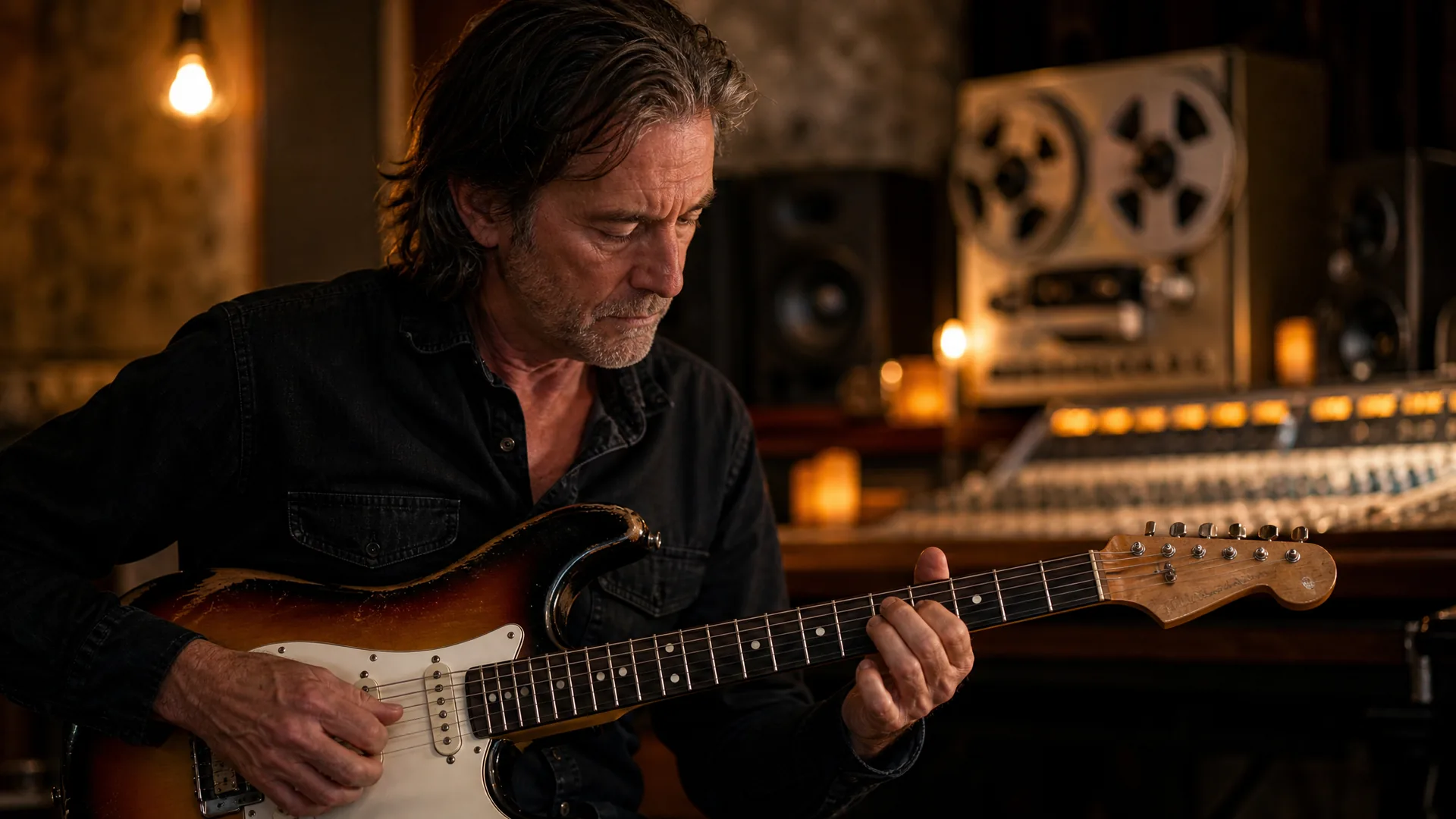
You can name every interval in under two seconds on a flashcard app and still freeze the moment a chord change asks you to use one. That gap is the whole problem. Most guitarists treat interval training as a memory test, a quiz to pass. This article takes a different angle: interval recognition only matters once it changes what you play next.
Adam Levine has taught for 50 years, including a stretch as a Motown session guitarist where every phrase had to say something in one take. He treats intervals as the raw material of phrasing decisions. That's the lens for everything below.
Why Interval Training for Guitarists Usually Fails
Ear-training apps have made interval recognition faster than ever. Punch in a sound, guess minor sixth or major seventh, get a green checkmark. None of that teaches you what to do with the interval once you hear it coming.
Naming Intervals Isn't the Same as Using Them
Naming an interval is a labeling task. Using an interval is a musical decision made in real time, under tempo, inside a chord change that won't wait for you to think. Those are different skills. They're built by different kinds of practice.
A player who can identify a perfect fifth instantly on an app may still bury it in a phrase with no shape and no direction. Recognition tells you what the interval is. It doesn't tell you why you'd choose it, or where in a phrase it belongs.
The Flashcard Trap: Recognition Without Application
Most guitarists can identify an interval on a flashcard app in under two seconds. Then they freeze the moment they have to use that same interval to shape a phrase over a chord change. That gap is about application.
The flashcard trap is comfortable because it's measurable. You either got it right or you didn't. Phrasing decisions are messier. They depend on context, on what came before, on what you want the listener to feel next. This is closer to ear training that goes beyond recognition speed, where the goal shifts from correct answers to musical choices.
What Melodic Intervals Actually Communicate
Every interval has a character: a feeling, built from centuries of use in melody and voice. Learn to hear that feeling, and interval recognition on guitar stops being abstract.
A minor second feels like friction, almost a complaint. A major third feels settled, open, even a little bright. They're sounds you learn to expect, then choose to deliver or withhold.
Perfect Fourths, Fifths, and the Feeling of Openness
A perfect fourth guitar melody has a certain plainness to it: strong, stable, almost architectural. Fourths and fifths built rock riffs, folk melodies, and modal jazz lines because they carry weight without demanding resolution. They sound finished even when the phrase keeps moving.
That openness makes fourths and fifths useful when you want a phrase to breathe. Use one at the start of a line and you set a foundation. Use one at the end and you can leave a question hanging in the air instead of answering it.
The Tritone: Guitar Phrasing Built on Tension
The tritone is the opposite instinct. It's the least stable interval in Western music, and every serious soloist eventually leans on that instability on purpose. Tritone guitar phrasing works because the ear wants resolution the moment it hears one. So you decide when, or whether, to give it.
Land on a tritone against a dominant chord and the tension is almost unbearable, in the best way. Resolve it a beat later than expected, and the release lands harder. That's a phrasing decision built entirely on knowing what the interval does to a listener's ear.
Interval Shapes on the Guitar Neck
The guitar repeats itself. Once you learn what an interval looks like as a fretboard shape, that shape works almost anywhere on the neck. This is where fretboard intervals advanced guitar work pays off. The shapes are consistent, but your ear still has to judge context every time.
How well do you really know the fretboard?
Take the free Fretboard Challenge and see exactly which notes cost you time. Then get the note map that fixes them.
One email with the map. Unsubscribe whenever: no card, nothing to cancel.
On its way.
Check your inbox in the next minute or two. If it is not there, look in promotions.
Mapping Interval Shapes Across Strings
A minor third across two strings has a shape. Move that shape up five frets, and it's still a minor third: same interval, same shape, different pitch. Guitarists who map interval shapes across strings gain speed, because they stop calculating and start recognizing patterns instantly.
Learn the shape for a fourth, a fifth, a sixth, and a tritone on every string pair. That's the physical vocabulary. But the shape alone won't tell you when to use it. Only your ear does that.
Why the Same Interval Sounds Different in Different Registers
Play a minor third low on the sixth string and it sounds thick, almost muddy, full of weight. Play that same shape two octaves higher and it sounds thin, urgent, even fragile. The interval hasn't changed. The register has.
This is why learning intervals by ear on guitar has to include the whole neck. A player who only knows fourths in open position has learned one version of one shape in one register.
How to Hear Intervals While You Play, Not Just While You Listen
Passive listening builds recognition. Active singing builds control. If you want to know how to hear intervals while playing guitar in real time, you have to put your voice into the process before your fingers get there.
Singing Intervals Before You Fret Them
Pick an interval. Sing the bottom note, then try to sing the top note before you touch the string. Check yourself on the guitar after, not before. This forces your ear to lead and your fingers to follow, which is the exact opposite of how most guitarists practice.
Do this daily with one interval at a time, moving through minor and major seconds, thirds, fourths, and the tritone. It's slow at first. It gets fast once your ear trusts itself instead of your fretboard muscle memory.
Testing Recognition Inside Real Chord Changes
Recognition drills happen in isolation: one interval, clean, no context. Real music never gives you that luxury. Take a simple chord change, ii-V-I is enough, and try to predict what a specific interval will sound like against each chord before you play it.
This single habit closes most of the gap between naming intervals and using them. It's also exactly what training your ear as a musician is built around: hearing music the way it's actually played.
Using Intervals to Build Musical Tension and Release in Solos
This is where interval training and musical tension on guitar meet the actual point of the whole exercise. A soloist who hears intervals in real time is making a string of small decisions about where tension builds and where it lets go.
Turning a Known Interval Into a Phrasing Decision
A minor third played behind the beat can sound like hesitation. The same interval played right on top of the beat can sound like confidence. The shape on the neck never changes. The story does.
That's the difference between knowing an interval and using one. Once you hear a fourth, a tritone, or a sixth coming before you play it, you can choose its timing, its dynamics, its placement in the phrase, all in service of what you want the listener to feel next. This is the same instinct behind sounding musical when soloing: the notes matter less than the decisions around them.
Interval Training as Musical Storytelling, Not Vocabulary Drill
Adam's core teaching distinction, that playing guitar and being a musician are two different pursuits, is the lens he applies to interval training specifically. Recognition is playing guitar. Using intervals to make a listener feel something is being a musician.
Students who've gone through Adam's academy and later performed with artists like George Benson and Norah Jones got there by hearing tension and resolution in real time and choosing what to do about it. That's the entire skill, stripped down to its core.
Bringing Interval Training Into Your Practice Routine
Interval training for guitarists belongs inside the practice you're already doing (scales, solos, tunes) so the ear and the hands develop together instead of on separate tracks.
A Weekly Structure for Advanced Players
Spend ten minutes a day singing intervals before fretting them. Rotate through one or two intervals per session rather than all of them at once. Then spend part of your solo practice deliberately using that interval: placing it early in a phrase one day, late the next, behind the beat, then on top of it.
Pair this with real repertoire. Transcribing solos by ear forces you to identify intervals inside phrases other musicians actually chose, which is a faster teacher than any app. Fold all of this into building this into a practice routine you already keep, rather than bolting on another disconnected drill.
If you've been stuck naming intervals correctly without ever hearing them shape a phrase, that's often a sign of breaking through an intermediate plateau rather than a gap in your theory knowledge. The fix is structured, guided practice that connects the ear directly to the fretboard, which is exactly what you'll find inside the academy's ear-to-fretboard training, where interval recognition finally becomes phrasing.
