
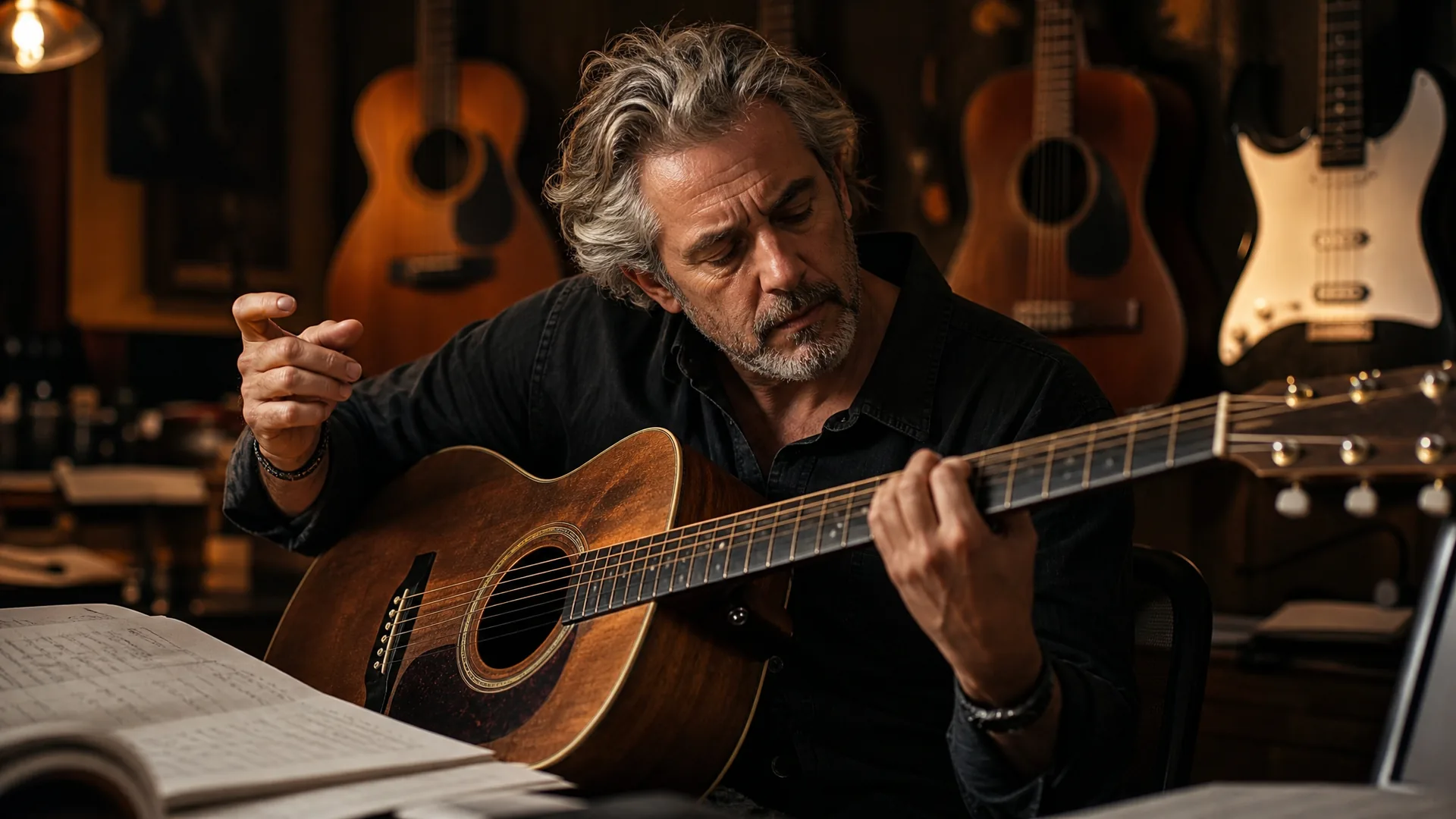
Music theory for guitar players has never been more available, and rarely more misapplied. Search any corner of the internet and you'll find interval charts, mode diagrams, and note-naming drills stacked a mile high. Yet intermediate guitarists keep hitting the same wall: they can execute the shapes, run the patterns, and name the notes, and still can't make a single real-time harmonic decision on a bandstand. The missing piece is context.
Adam Levine, Berklee graduate, former Motown studio guitarist, and 50-year veteran teacher, built his entire pedagogy around one distinction: the difference between playing guitar and being a musician. That distinction is the lens through which all theory instruction at Adam Loves Guitar is taught. It's also what separates theory content that moves players forward from content that keeps them busy.
Why Most Guitar Theory Content Misses the Point
The internet is generous with facts and stingy with context. You can learn what a Dorian mode is in five minutes. You can memorize every interval in a minor seventh chord. What you almost never get told is why that matters in the moment you're playing.
Intermediate guitarists who have been playing for several years report the same plateau: they can execute licks and chord sequences but can't make real-time harmonic decisions. Technical capability without musical agency is one of the most common sticking points in adult guitar learning, and more drills won't close that gap.
Theory is only useful when it tells you what to play next and why it sounds the way it does. If your theory knowledge can't answer those two questions in real time, it's still just homework. This is why capable guitarists stop growing: they practice the wrong thing.
Music Theory for Guitar Players Starts With the Ear, Not the Page
Hear the Function Before You Name the Note
There is a sharp difference between a guitarist who can spell a ii–V–I progression and one who hears the pull of the V chord wanting to resolve. The second player wins every time in a live context.
Functional hearing means recognizing what a chord or note does, its role in the harmonic story, before you know what to call it. That IV chord in a blues has a name, and also a feeling, a color, a gravitational direction. When you hear the harmony before you name it, your fretboard decisions become instinct.
Ear before label: that's the single most important shift an intermediate guitarist can make. It reframes the whole enterprise. You're developing a musical vocabulary you can speak in the moment.
Music Theory Ear Training on Guitar: The One Practice That Changes Everything
In jazz and session contexts, players are expected to hear chord function in real time and respond. The theory that survives on a bandstand is the theory internalized through the ear.
Music theory ear training on guitar is the practice of connecting everything you know intellectually to what you hear physically. The method is simple but demanding: play a chord, sit with its sound before moving on, identify what it wants to do next, then let it resolve and notice the difference. Do that daily with two or three chord qualities and your ears will start making decisions your brain used to slow down.
Guitar Chord Theory: From Shapes to Sounds
Why Chord Shapes Are Holding Your Ear Hostage
Most intermediate players know thirty chord shapes. They've memorized open positions, barre chords, and a handful of jazz voicings. But shapes are a visual language, and the guitar is a sonic instrument. When you think in shapes, you hear in shapes. That's the trap.
Guitar chord theory taught correctly is a sonic vocabulary, tension, release, color, weight. A shape is just the physical address. The sound is the meaning.
Hearing Chord Quality and Tension as a Player
Take three chord qualities and listen for what they actually do. A dominant seventh chord, say a G7, is unstable by nature. It leans. You can feel it wanting to fall toward a C major. That's the tritone between the third and seventh creating genuine harmonic tension. A major seventh chord floats. It's resolved but still luminous, the tonic has arrived but hasn't closed the door. A minor chord sits darker, heavier, more ambiguous in its resolution potential.
When you understand chord quality as emotional function, you stop asking "what chord comes next?" and start asking "what do I want the listener to feel next?" That's the shift from guitarist to musician. Blues phrasing as applied harmonic storytelling is one of the clearest places to hear this in action, the I–IV–V gives you tension and release in its most elemental form.
Scales and Modes on Guitar: The Right Way to Think About Them
How well do you really know the fretboard?
Take the free Fretboard Challenge and see exactly which notes cost you time. Then get the note map that fixes them.
One email with the map. Unsubscribe whenever: no card, nothing to cancel.
On its way.
Check your inbox in the next minute or two. If it is not there, look in promotions.
The Problem With Learning Scales as Patterns
Scales and modes on guitar are almost universally taught as visual patterns: five boxes, seven positions, connect the dots. Players drill them up and down until they can run them at speed, and then wonder why their solos sound like exercises.
Patterns are a tool for learning the geography. The mode is a mood. Dorian has a specific gravity, that minor sound with the raised sixth that keeps it from going fully dark. Phrygian has an edge, a tension rooted in that flat second. Mixolydian sits easy, bluesy, open. They are tonal personalities.
The right approach is making decisions on the fretboard instead of running patterns: know where the tension notes live, know where resolution sits, and choose deliberately. That's music.
Harmonic Minor Guitar: A Sound Worth Owning
If you want a concrete example of how one tonal choice defines a sonic identity, harmonic minor guitar is it. The harmonic minor scale is distinguished by its raised seventh degree, that one note creates an augmented second between the sixth and seventh scale degrees, and that interval is responsible for one of the most recognizable sounds in Western music.
It's the backbone of flamenco's Phrygian Dominant sound. It's the tension in bebop ii–V lines. It's the dark drama of metal shredding. One scale, a recognizable voice, spanning genres. When you play the V chord in a harmonic minor context, the leading tone pulls upward with an almost physical urgency, and you can feel it under your fingers the first time you hear it resolve.
Learning harmonic minor means claiming a sound. Spend two weeks with a one-octave harmonic minor pattern on a single string, learn the V7 chord that sits above its fifth degree, and resolve it to the i minor. You'll own that tension-and-release instantly. Theory made audible.
Learning Music Theory on Guitar: How to Actually Apply It
The Fretboard as a Map, Not a Grid
The fretboard is a map of harmonic space, and knowing where you are on that map at all times is what separates technical fluency from genuine musical expression.
Students of Adam Levine have gone on to perform with Michael Jackson, George Benson, Celine Dion, and Norah Jones, artists whose music demands genuine harmonic fluency. What those gigs require is the ability to know, at any moment, what chord is underneath you, what scale color fits it, and what note will create the tension or release the moment needs. That knowledge lives in the ear and the hands, not the eyes.
Breaking through fretboard plateaus means committing to knowing where you are harmonically, root positions, chord tones, available tensions, so that every note becomes a decision.
That's the difference between playing guitar and being a musician. One follows the road. The other reads the map.
The Next Step: Theory in Service of Musical Storytelling
Knowing music theory and using it to tell a musical story are two different skills. Plenty of guitarists can identify a tritone substitution on paper and never deploy one with feeling in a real song. Knowledge without application is vocabulary without sentences.
The goal of learning music theory on guitar, through the ear, with harmonic context at the center, is expressive, deliberate playing. Every phrase you choose should carry intention. Every chord transition should feel earned. When theory is internalized rather than referenced, it disappears into the music and becomes feel. That's when bridging technical skill with real musical feel stops being a goal and becomes a baseline.
If you've recognized yourself in any of this, capable but stuck, knowledgeable but not yet fluent, the next step is structured instruction built around the ear-first approach, delivered by a teacher whose framework has been tested across five decades and every professional context imaginable. That's exactly what you'll find inside Adam's online guitar academy. It's a method to internalize.
