
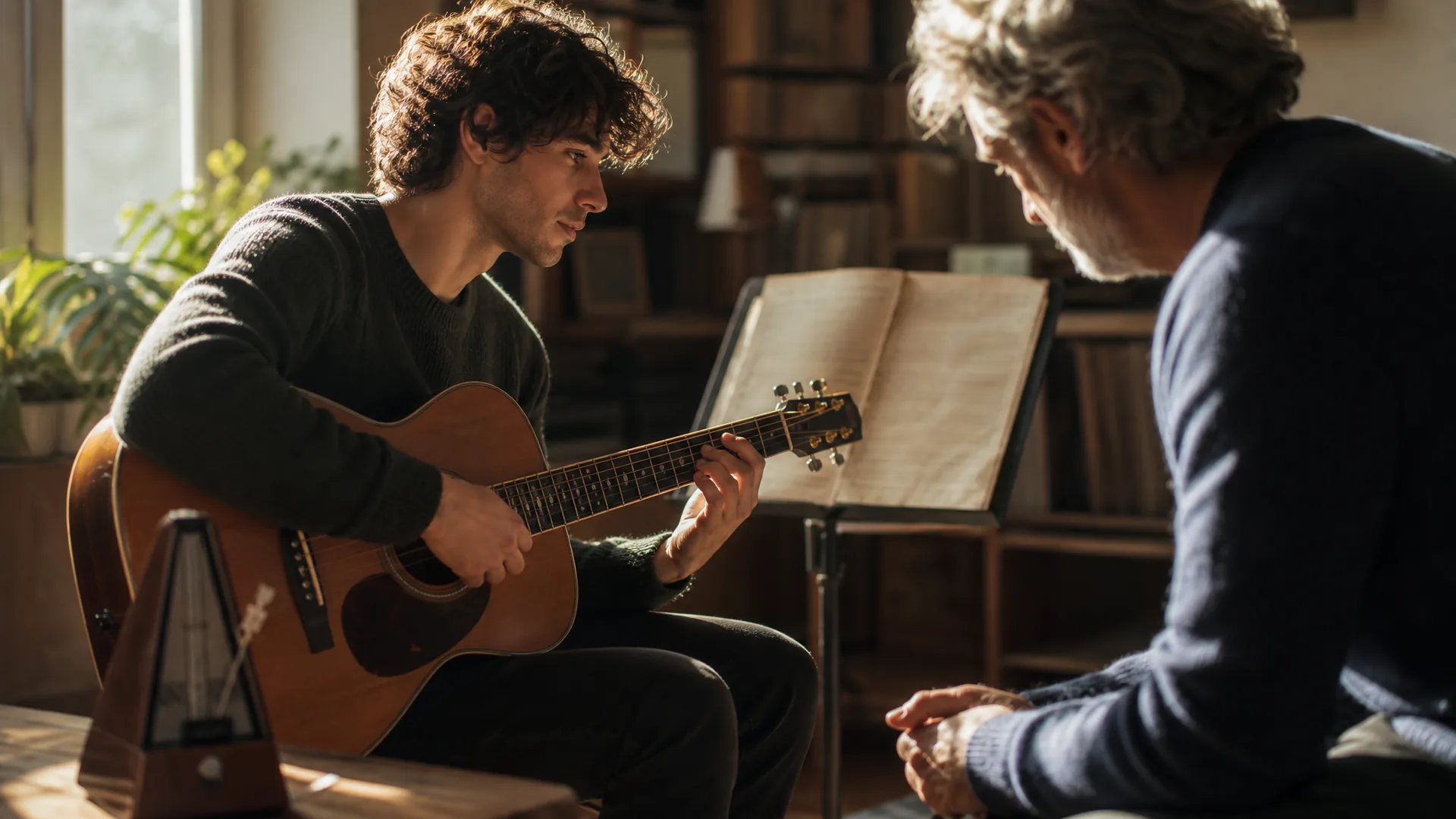
When adults search for adult guitar lessons near me, they get a list. Yelp entries, Google Maps pins, academy landing pages with stock photos of smiling students. Every result tells you how far away the teacher is and what they charge per hour. Almost none of them tell you what the teacher actually believes about music, or whether they're equipped to turn a serious adult into a real musician.
That gap is the problem. And it's the reason so many adults end their search disappointed.
Why Most Adults Searching for Guitar Lessons End Up Disappointed
The typical search returns directories. You get proximity and price; you don't get philosophy. You can't tell from a Yelp listing whether a teacher understands phrasing, or whether they'll just hand you the pentatonic box and call it a curriculum.
Most listings treat music instruction like a commodity, an interchangeable service you buy based on convenience. Proximity is the wrong filter. A teacher ten minutes away who only dispenses shapes will cost you years. The right teacher, wherever they are, changes how you hear music for the rest of your life.
If you've already been playing for a while and feel stuck, read about why you've plateaued on guitar before you go any further. Understanding your own stall point is the right starting place for evaluating any teacher.
The Real Criteria for Evaluating a Professional Guitar Teacher
Credential vs. Credibility: What Actually Matters
Certificates are table stakes. A teaching credential tells you someone sat in a room and passed a test. It tells you almost nothing about whether they can transmit musical intelligence to another adult.
What shapes a great teacher is lived experience in real musical contexts: studios, touring, sessions, performance under pressure. A professional guitar teacher who has been through a recording session knows what musical decision-making under time constraints actually feels like. That knowledge changes how they teach. They stop teaching rules and start teaching judgment.
Ask yourself: has this teacher done the thing they're asking you to work toward? If the answer is no, that's useful information.
Philosophy: Do They Teach Playing or Musicianship?
This is the most diagnostic question in guitar education, and most adults never ask it.
Most teachers teach you to play the guitar, how to finger chords, navigate scales, and execute patterns cleanly. A musicianship teacher teaches you to say something with the instrument. Those are fundamentally different goals. Most curricula only serve the first.
The distinction matters because technique without expression produces capable technicians. You can execute every pentatonic pattern across the neck and still freeze the moment someone asks you to improvise a phrase that tells a story. That is a musicianship problem, and technique-focused lessons will never close it.
Questions Every Adult Should Ask Before Booking One-on-One Guitar Lessons
Before committing to one-on-one guitar lessons with any teacher, ask these five questions directly. The answers will tell you more than any bio page.
1. "What does musical decision-making mean to you?" A teacher who can't answer this clearly has never taught it. You're listening for whether they see the guitar as a set of moves or as a vehicle for ideas.
2. "How do you teach ear training alongside technique?" Ear training is the foundation of all musicianship, and it belongs inside every lesson. If a teacher treats it as optional or supplemental, their students will always be chasing their ears with their fingers instead of leading with them.
3. "How do you approach phrasing in your lessons?" Phrasing is where technique becomes music. A teacher with a real answer will talk about breath, space, dynamics, and intention. A pattern-dispenser will pivot back to scales.
4. "How do you teach harmonic understanding, meaning why chords move the way they do?" Fretboard fluency is not the same as harmonic understanding. Push on this. You want a teacher who builds ear-first music theory for guitar players rather than one who hands you a chord chart.
5. "What does progress look like at six months for an adult at my level?" Vague answers reveal vague curricula. A seasoned professional guitar teacher can describe exactly what changes in your playing, your hearing, and your musical thinking over a defined period.
What Advanced Guitar Instruction Actually Looks Like
How well do you really know the fretboard?
Take the free Fretboard Challenge and find out exactly which notes cost you time, then get the note map that fixes them.
One email with the sheet. Unsubscribe whenever. No card, nothing to cancel.
On its way.
Check your inbox in the next minute or two. If it is not there, look in promotions.
From Shapes and Patterns to Musical Language
Most intermediate adult players hit the same wall. They have the shapes. They have the scales. They can move around the fretboard with reasonable confidence. But when the backing track starts and it's time to say something, nothing comes.
This is the intermediate plateau, and it's almost universal. The problem is that patterns never taught them to think musically in the first place.
Advanced guitar instruction is the shift from executing to expressing. It means treating the fretboard as a language. Fretboard mastery as a plateau-breaker is about restructuring how you understand the instrument, connecting what your ears hear to what your hands do, instantly and intuitively.
True improvisation built on decisions is the goal. Every phrase you play should be chosen.
How a World-Class Teacher Structures Progress
A pattern-drill curriculum gives you exercises and then gives you more exercises. Progress is measured by how many things you can execute.
A musicianship-first curriculum works differently. Ear training runs alongside technique from day one, as the lens through which technique is taught. Harmonic understanding develops through listening and analysis. And storytelling on the instrument, how to play guitar with genuine feel, is treated as a learnable, teachable skill, not a mysterious quality you either have or don't.
Studio and touring professionals who reflect on their development consistently point to the teachers who taught them to hear music structurally and make deliberate musical choices in real time, more than to the ones who drilled them hardest. That is the difference advanced guitar instruction makes.
Why Location Is the Wrong Lens for Finding the Best Guitar Teachers in 2026
The "near me" search made sense when your only option was in-person. In 2026, it's a constraint you're imposing on yourself.
A live online lesson with a world-class teacher delivers more than an in-person lesson with a mediocre one: more precision, more accountability, more musical depth. The technology is not the barrier it once was. Real-time video at low latency means a skilled teacher can hear your tone, catch a timing issue, and correct a phrasing habit as accurately as if they were across the table.
Adults rightly value human connection and accountability in their learning. A great teacher provides both, regardless of geography. What they can't provide remotely is something they never had: a genuine philosophy of musicianship.
The best guitar teachers are not distributed evenly across zip codes. When you find one who has actually lived inside music at the highest levels, geography should not be the reason you settle for less.
What to Expect from a Guitar Coach for Adults at Adam Loves Guitar
Adam Levine is a Berklee College of Music graduate, a former Motown studio guitarist, and has been teaching guitar professionally for over 50 years. That kind of real-world depth is rare at any price point.
His students have gone on to perform alongside Michael Jackson, George Benson, Celine Dion, and Norah Jones. That track record is what musicianship-first teaching produces over time. The aim is musicians who can operate at the highest level in any context.
The entire Adam Loves Guitar method is built on a single distinction: most teachers teach you to play the guitar. Adam teaches you to be a musician. Every element of the curriculum (ear training, harmonic understanding, phrasing, fretboard language, feel) serves that second goal.
If this is the standard you're holding your search to, the Adam Loves Guitar Academy is the natural next step. It is a serious answer to the question serious adults are actually asking when they search for adult guitar lessons near me.
