
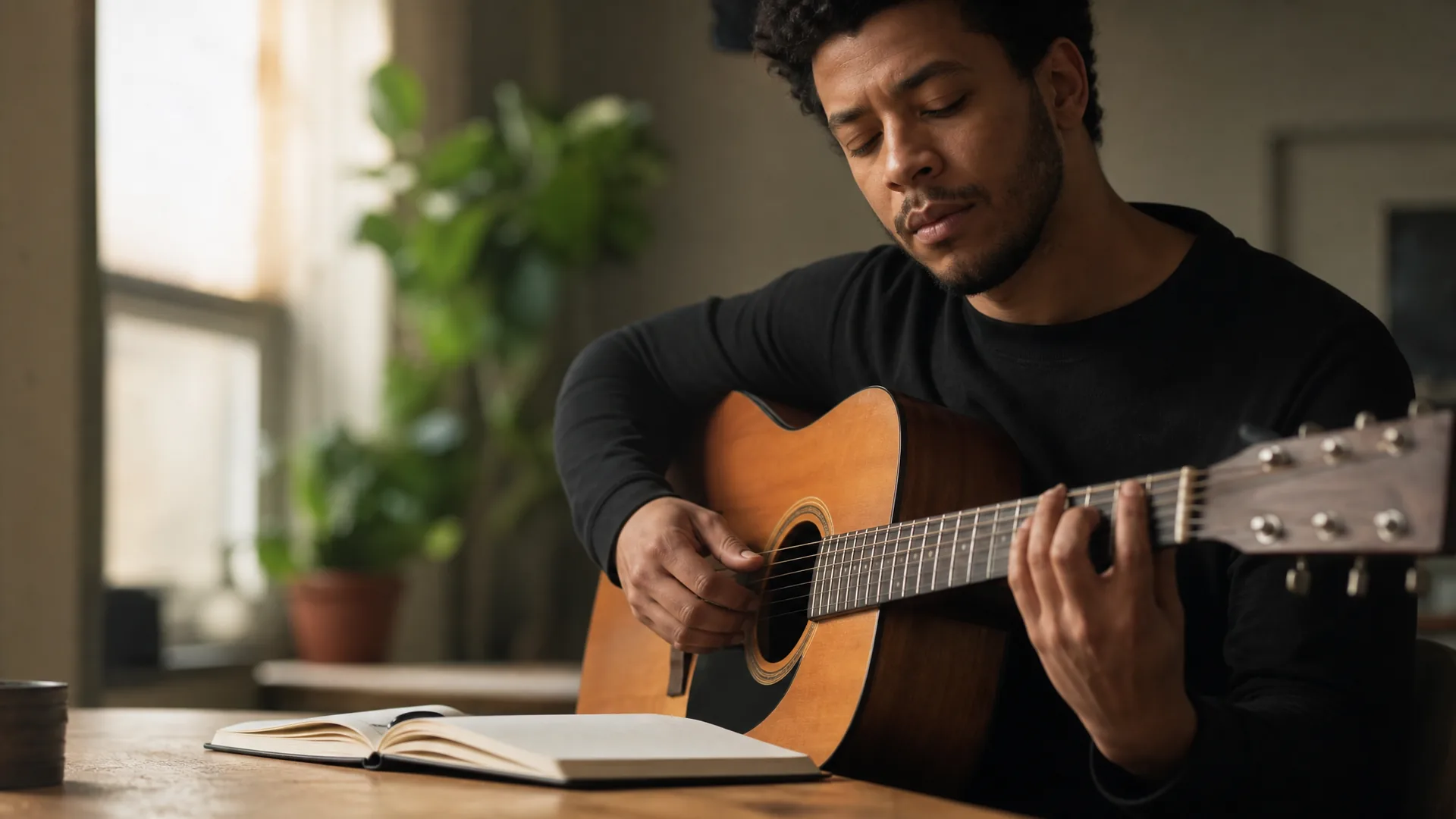
Most guitar players practice. Few of them practice well. The difference is intention. Learning how to practice guitar mindfully is the single adjustment that separates players who keep growing from players who spend years wondering why they've stalled.
The point is to make every repetition answer a question rather than just fill a clock.
Why Most Guitar Practice Routines Stay Mechanical
Here's the hard truth: volume of practice without intention produces more deeply ingrained bad habits. The player who grinds three hours of scales every day without listening is building muscle memory for mediocrity.
The "just put in the hours" mentality works for some disciplines. Music isn't one of them. A phrase played 200 times with no awareness of whether it communicated anything is 200 repetitions of the wrong lesson.
This pattern is exactly why so many guitarists plateau despite years of practice. Effort and awareness are two different things.
The Difference Between Logging Hours and Building Musicality
Adam Levine draws this distinction for every student on day one: you can be technically proficient and still not be a musician. Proficiency is a floor. Musicality is what you build above it, and it starts in the practice room.
A working musician in the studio thinks in phrases, in feel, in whether the take served the song. Adam spent years as a Motown studio guitarist where every take was judged on feel, timing, and whether the phrase served the music. That standard shaped his entire teaching philosophy. That's the mentality to bring into every practice session, regardless of your level.
Setting Intention Before You Pick Up the Guitar
A guitar practice schedule tells you what to do. An intention tells you why it matters and what you're listening for. Both are necessary. But most players build schedules and skip the intention entirely.
Before you touch the guitar, decide on one specific musical goal. Instead of "practice the solo," try "I want that opening bend to feel inevitable, like a statement rather than a question." Instead of "work on the chord progression," try "I want the transition from the IV to the I to breathe."
That specificity changes everything. It gives your ears something to hunt for.
Define What You're Listening For, Not Just What You're Playing
Structured guitar practice without listening is just choreography. The pre-practice ritual that works is simple: name the sound you're after before you play a single note. Is it the decay on a held note? The space between two phrases? The feel of landing on the one with conviction?
Once you've named it, your ears are engaged from rep one. This is what separates a productive session from a mechanical one, your attention has a target.
How to Practice Guitar Mindfully: The Three-Layer Method
This is the core framework. A repeatable loop you can apply to any passage, any style, any level of playing. Each layer builds on the last.
Layer 1, Slow Listening: Hear What the Music Is Saying
Before you play the passage, listen to it, either a reference recording or the version in your head, and listen actively. What is the phrase doing emotionally? Where does it breathe? Where does it push? Where does the note land, and how long does it stay?
This is ear training embedded into every rep, as the entry point to each session. When you know what the music is supposed to say, you have a standard to play against.
Layer 2, Focused Repetition With a Question
Now play the passage. Slowly enough to stay aware. Each repetition answers a specific question.
- Did I land that note with conviction, or did I arrive at it?
- Did the phrase breathe, or did I push through the space?
- Did that bend resolve, or did it just move?
One question per rep, or one question per short block of reps. This is what focused practice actually looks like in the room: interrogating each pass until you hear the answer. Phrasing techniques that make every note count start exactly here, with a player who knows what they're listening for.
How well do you really know the fretboard?
Take the free Fretboard Challenge and find out exactly which notes cost you time, then get the note map that fixes them.
One email with the sheet. Unsubscribe whenever. No card, nothing to cancel.
On its way.
Check your inbox in the next minute or two. If it is not there, look in promotions.
Layer 3, Play It Back as a Musician, Not a Technician
Once the repetitions have given you something, play the passage straight through. No self-correction, no interruption. Play it as a performance. This is where the ear-guided work lands in the body.
The distinction matters. Drills isolate. Performance integrates. Layer 3 is where you find out if what you practiced in Layer 2 became music, or whether you need another pass through the question loop. This cycle, listen, interrogate, perform, is how making musical decisions instead of running patterns becomes a habit rather than an accident.
Building an Effective Guitar Practice Routine Around Awareness
A mindful practice routine can be short, as long as it's structured with awareness at the center. Here's what a 45-minute session can look like.
A Sample Mindful Practice Schedule
0–5 min, Listening and Intention Don't touch the guitar. Listen to a reference, or sit quietly and hear the phrase in your head. Set your one musical intention for the session.
5–20 min, Three-Layer Work on a Single Passage Apply the three-layer method to one targeted section. Keep the passage short enough that you can hold the whole thing in your ear. Quality of attention matters more than length of passage.
20–35 min, Ear-Guided Improvisation Take a concept from the focused work, a resolution, a rhythmic feel, a tonal color, and improvise around it. No scales for their own sake. Let your ear lead and your fingers follow. This is where the ear training built in Layer 1 starts transferring into real-time musical decision-making.
35–42 min, Full Playthrough or Free Playing Play something you love, in full, as a musician. This grounds the session in music.
42–45 min, Reflection Ask one question: did what I played communicate something? Swap "did I play it right?" for "did it say something?" That shift in question is the whole philosophy in miniature.
This schedule works whether you have 45 minutes or 30. The proportions matter more than the total time. The ear-first approach to music theory on guitar reinforces exactly why this order, listen, then play, is non-negotiable.
The Role of Ear Training in Mindful Guitar Practice
Ear training for guitarists is woven into every mindful rep, every session, every pass through the three-layer method.
When your ear leads and your hands follow, patterns stop being shapes and start being phrases. Scales stop being exercises and start being vocabulary. The difference between a guitarist who sounds musical and one who sounds mechanical is almost always audible in the ears, not visible in the hands.
Berklee's curriculum is built on this principle, and it's one Adam absorbed in formal training and has applied across five decades in the studio and the teaching room. What formal training actually teaches you about practicing comes down to this: technical facility is built in service of the ear.
The most common pattern in intermediate players who plateau is practicing for hours without ever stopping to ask whether what they just played communicated anything. Ear training breaks that pattern, because it gives you a standard beyond "I played the right notes."
What Changes When You Practice This Way
The changes are qualitative. You stop counting hours and start noticing phrases. You stop asking "how many times did I run that?" and start asking "did that say something?"
Students who absorb this philosophy stop sounding like players running material and start sounding like musicians making choices. Students who have come through Adam's teaching have gone on to perform alongside Michael Jackson, George Benson, Celine Dion, and Norah Jones, because they learned to listen and make musical decisions in real time.
Breaking through the intermediate plateau as an adult guitarist almost always comes down to this shift: from mechanical repetition to intentional listening. The bottleneck was awareness all along.
When you practice mindfully, breakthroughs feel different too. They sound like "I finally heard what that phrase was supposed to do, and then I played it." That's the goal. That's how to play guitar with genuine feel: the thing practice was building toward all along.
If this philosophy resonates, it's built into everything Adam teaches inside the academy. The logical next step is working with a teacher who has spent five decades applying it, in the studio, on stage, and in the room with students who came in frustrated and left playing music.
