
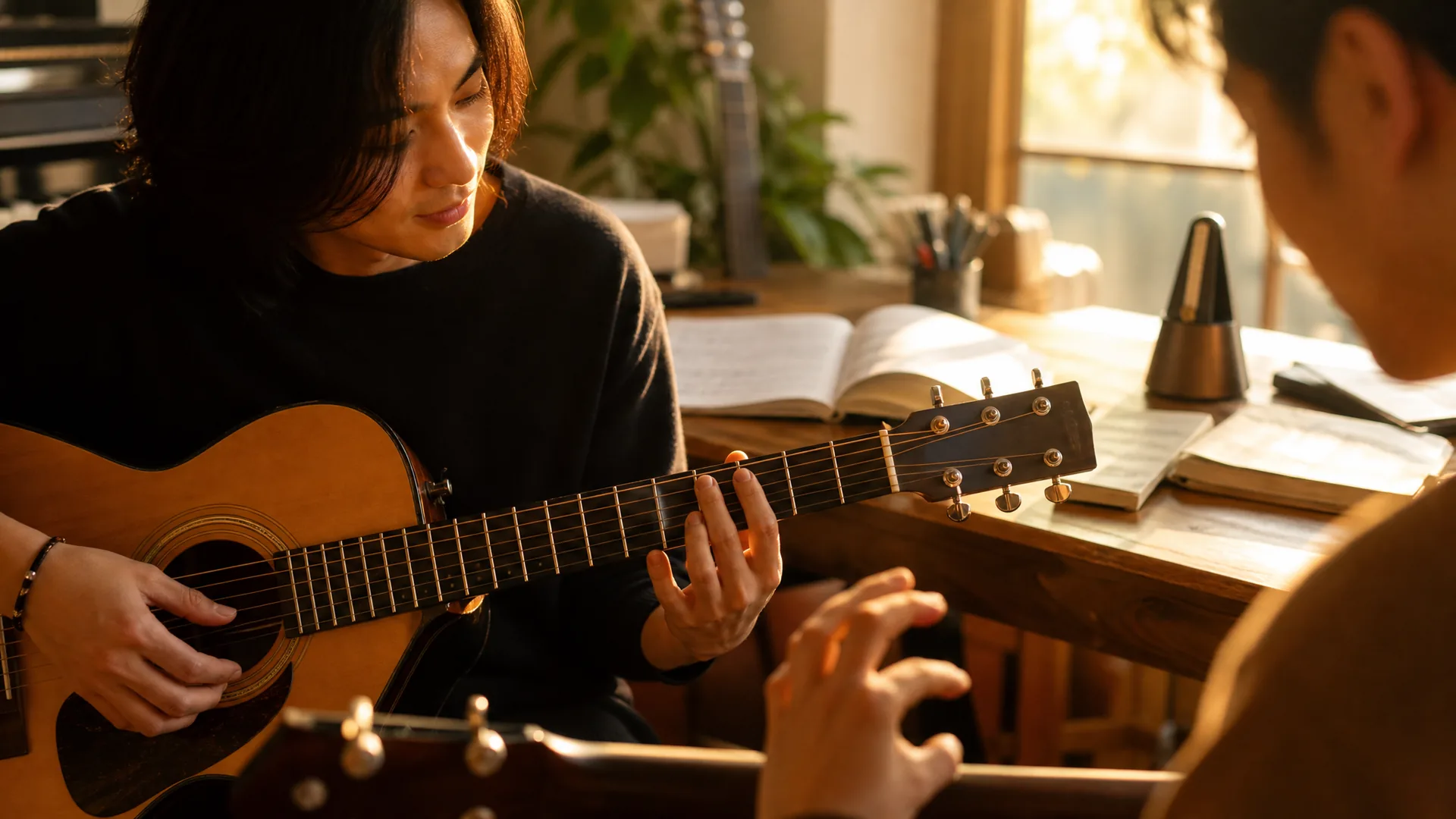
Most guitar teachers can show you where to put your fingers. A berklee trained guitar teacher shows you why, and that distinction is the entire difference between a student who plays songs and a musician who understands music. If you're here comparing credentials, you're already asking the right question. The answer matters more than most people realize.
Berklee College of Music Guitar: What the Training Really Means
Berklee College of Music is consistently ranked among the world's leading contemporary music schools. Its alumni span virtually every major genre and recording institution. That reputation rests on producing professional musicians who can hear, communicate, and create at the highest level.
The Berklee College of Music guitar program is built on harmony, ear training, improvisation, and professional musicianship. Technique is the vehicle. Students learn to hear a chord's function before they learn its shape. They learn to phrase a melody with intention before they learn to play it fast.
A curriculum built on the language of music, not just technique
Formal guitar education at this level treats music theory as a spoken language. You hear how scales move through harmonic contexts, and you learn what chords are doing, and why the ear responds to them the way it does.
Compare that to the standard private lesson model: a chord chart, a few scales, a YouTube technique drill. There's nothing wrong with those tools in isolation. But without the structural framework underneath, they produce players who can execute and freeze the moment the context changes.
Adam Levine graduated from Berklee College of Music and went on to work as a studio guitarist for Motown Records. Those two credentials mean his training was built for real professional environments, for music that gets made under pressure.
The Gap Between a Player and a Musician, and Why Your Teacher Decides Which You Become
Here's a distinction worth sitting with: a player executes patterns. A musician makes decisions.
A player knows the pentatonic scale. A musician knows when to lean on the b7, when to resolve, when to leave space. A player responds to chord changes. A musician anticipates them, shapes a phrase around them, and uses harmony as a compositional tool in real time.
Decision-based improvisation for adult guitarists is the direct result of formal guitar education that treats the ear and the harmonic mind as the primary instruments, with the guitar as their output.
After 50 years of teaching, Adam has watched this gap play out across thousands of students. It is not theoretical. Students who arrive with years of playing under their belt, often technically capable, sometimes impressively so, consistently hit the same wall. They can play. They don't yet know what they're saying. What closes that gap is a different kind of instruction.
The good news: bridging technical skill and genuine musical feel is entirely learnable at the adult level. But only if your teacher knows what it looks like and knows how to build the bridge.
What 50 Years of Teaching Reveals About How Adults Learn Guitar
Adults learn differently than kids. They bring more context, more pattern recognition, and more ego investment in what they already know, which means they plateau differently, and harder.
Most teachers respond to a plateau with one prescription: practice more. That advice is incomplete, and for an adult intermediate player, it's often actively discouraging. Because they are practicing. The work is going in. The result isn't changing.
How well do you really know the fretboard?
Take the free Fretboard Challenge and find out exactly which notes cost you time, then get the note map that fixes them.
One email with the sheet. Unsubscribe whenever. No card, nothing to cancel.
On its way.
Check your inbox in the next minute or two. If it is not there, look in promotions.
The plateau is always a diagnosis, never a sentence
A conservatory-trained guitarist walks into that conversation with a diagnostic framework. The question is: where is the block? Is it harmonic, do you not yet hear the key centers moving beneath you? Is it rhythmic, are you playing on the beat rather than with it? Is it phrasing, are you running patterns instead of building sentences? Is it conceptual, do you understand what the music is doing, or are you just reacting to it?
Most teachers can't make that distinction, because they were never trained to. That's precisely why serious players hit a wall and stay there.
Adam's Motown studio work is relevant here. Playing sessions in a professional studio demands instant harmonic literacy, real-time adaptability, and the ability to serve the music over the guitarist's comfort zone. A professional guitar teacher who has lived in that environment teaches from more than theory: from the memory of what actually works when the red light is on.
Inside the Academy: How Berklee-Level Training Shapes Every Lesson
Credentials matter, but only if they show up in the room. Here's what Berklee-rooted methodology looks like in practice, at the lesson level.
Theory as a hearing tool, not a memorization exercise
The ear-first approach to music theory on guitar means theory is introduced in the context of sound. You hear a ii-V-I before you label it. You recognize a tritone substitution by how it feels before you can name the mechanism. This is how a conservatory-trained guitarist internalizes harmony, as a language already in the ear.
Lesson structure follows that principle. Every technical element is tied back to a musical context. Fretboard fluency is built through harmonic understanding, so that fretboard fluency as a plateau-breaking tool becomes a real outcome.
Phrasing is intentional. Rhythm is felt. Harmony is heard.
This is advanced guitar education applied at the individual lesson level and calibrated to where each student actually is.
The Students Who Thrive Here, and What Separates Them
The students who get the most from this level of instruction share a profile: intermediate to advanced, technically capable, but aware that something is missing. They can play. They're not yet sure they're saying anything. They've had teachers before, and they've learned. But they've hit a ceiling they can't see clearly enough to climb past.
Over 50 years of teaching, students have gone on to perform alongside Michael Jackson, George Benson, Celine Dion, and Norah Jones. That's a signal about the method's upper range. The instruction is built to take serious players somewhere serious.
This is not for someone picking up a guitar for the first time, or someone who wants casual, low-pressure strumming sessions. Nothing wrong with that goal, it just has a different home. If you're wondering why location matters less than the teacher's depth, you're already thinking like the kind of student who belongs here.
The students who thrive here show up ready to be challenged, willing to hear hard truths about their playing, and committed to understanding music as well as executing it.
How to Know If You're Ready for This Level of Instruction
Ask yourself one question honestly: when you play, are you guessing or are you deciding?
Guessing sounds like this: you find a scale that fits, you stay in it, you hope it sounds good. You pick chord voicings because they're familiar. You improvise by running patterns you've practiced, because you don't have another tool.
Deciding sounds like this: you hear where the music is going before it gets there. You choose a note for a reason. You shape a phrase with a beginning, a tension point, and a resolution. You know why something works.
If you're still guessing, that's a starting point. If you've been guessing for years despite serious practice, that's precisely the gap a berklee trained guitar teacher is trained to close. The diagnostic is clear. The path is structured. The ceiling is high.
The Adam Loves Guitar Academy is built for adult players who have outgrown their current instruction, or who never had instruction built to this standard in the first place. If you recognized yourself in this article, the next step is already in front of you.
