
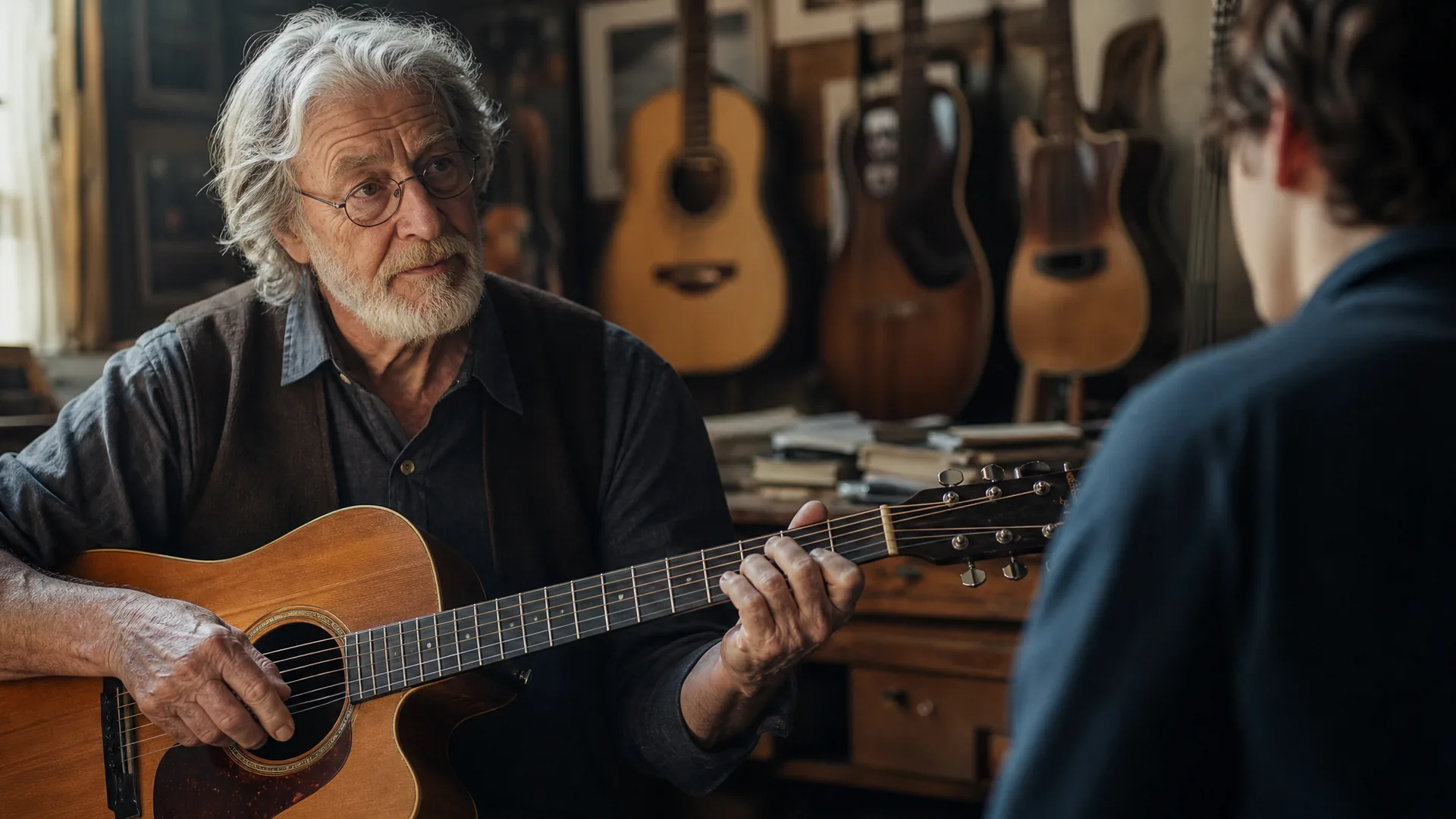
Fifty years works as a filter. Most guitar teachers accumulate habits over time, routines that feel like wisdom but are really just repetition. A genuine 50 year guitar teacher has something different: a body of evidence built from thousands of students, hundreds of breakthroughs, and just as many failures that quietly reshaped the method. What survives five decades of real teaching is exactly what works. Nothing else makes it through.
The Difference Half a Century Makes
Most instructors stop asking hard questions about their teaching within the first decade. The method gets comfortable. The explanations get rehearsed. The feedback loop closes. That's drift.
A teacher with fifty years of active, reflective practice has crossed a different threshold. They've watched trends arrive and collapse. They've seen the classical framework, the rock revolution, the fusion era, the digital age, and the rise of online education, and they've taught through all of it. That span of exposure adds knowledge, and it also strips away what doesn't work.
What a 50-Year Guitar Teacher Has Seen That Most Haven't
Adam Levine has been teaching guitar for 50 years, a span covering the analog studio era, the digital revolution, and the rise of online music education. Few active instructors have taught across all three.
That means he's seen every version of the same problems. Students who plateaued in 1985 were struggling with the same core issue as students who plateau in 2026. The surface details change. The underlying pattern doesn't. That pattern-recognition, refined across decades, is what separates a 50 year guitar teacher from an experienced one.
The Real Lessons From a Lifetime of Guitar Teaching
Technique is the entry fee.
Every serious teacher knows this, but most teach as if it isn't true. Scales get assigned. Chord voicings get drilled. Theory gets introduced in tidy modules. The student gets more capable, and somehow less musical. This is the central paradox a lifetime of teaching forces you to confront and resolve.
Why Technique Alone Always Hits a Ceiling
Technical exercises train the hands. They do not train the ear, the judgment, or the musical instinct. A player can reach a high level of physical proficiency and still be reacting, copying shapes, defaulting to patterns, playing what's safe rather than what's true.
The ceiling is conceptual. When a student can execute but cannot choose, no amount of additional technique will move them forward. That diagnosis took decades of teaching to make consistently and confidently.
The Shift From Player to Musician, and Why Most Never Make It
The shift from player to musician is a shift in identity as much as in skill. A player performs technique. A musician expresses intent. The gap between those two things is where most instruction fails, because it keeps adding tools without building the musical mind that knows how to use them.
The Motown studio tradition is a living model for this discipline. Guitarists on those sessions were expected to serve the song with absolute restraint and intentionality, how Motown guitarists defined restraint and feel. Every note was a choice. That standard, demanding, precise, and completely in service of the music, is what Adam transfers to adult students today.
What a Veteran Guitar Teacher Spots in the First Five Minutes
A seasoned guitar educator doesn't need to hear scales to assess a student. What matters is the quality of decision-making in the playing. Do they move through a phrase with intention, or do they land on notes and wait to see what happens? Do they hear where the music wants to go, or do they execute what they already know?
That distinction is audible within minutes. It is not about level. Advanced players can be pure reactors. Beginners can show flashes of genuine musical choice. What a veteran guitar teacher listens for is how the student thinks, more than what the student can already do.
How well do you really know the fretboard?
Take the free Fretboard Challenge and find out exactly which notes cost you time, then get the note map that fixes them.
One email with the sheet. Unsubscribe whenever. No card, nothing to cancel.
On its way.
Check your inbox in the next minute or two. If it is not there, look in promotions.
The Patterns That Keep Experienced Players Stuck
The intermediate plateau is a musical thinking problem. Players at this stage can execute; what they cannot do is decide. This is precisely why intermediate guitarists get stuck, and why more YouTube lessons, more scale patterns, and more gear never solve it.
The most common patterns after decades of diagnosis:
- Defaulting to familiar shapes under any harmonic pressure, rather than listening and responding
- Treating improvisation as recall, pulling from a library of licks instead of making real decisions when you improvise
- Confusing speed with articulation, playing fast as a way to avoid the silence that requires musical courage
- Studying more theory in isolation, hoping the intellectual understanding will solve what is actually an expressive gap
Each of these patterns is visible inside five minutes to a professional guitar educator who's seen them thousands of times. If you want to understand the real reason you've plateaued on guitar, it almost never lives where you're looking.
Inside the Adam Loves Guitar Academy: How Lifetime Expertise Shapes the Method
The method at the Adam Loves Guitar Academy was tested against professional standards, in studios, on stages, and through the careers of students who went on to perform alongside Michael Jackson, George Benson, Celine Dion, and Norah Jones. That roster is the proof that the method holds up at the highest level.
From Berklee to Motown to the Academy
Adam's foundation is formal and rigorous. As a Berklee graduate, he trained in one of the world's most demanding conservatory environments, what formal Berklee training brings to guitar teaching is a depth of harmonic and structural understanding that most self-taught instructors never acquire.
From there, Motown studio work added a different layer: the discipline of commercial session playing, where serving the song is the only measure of success. Together, those two experiences, conservatory rigor and studio pragmatism, form the intellectual backbone of everything Adam teaches.
The Adam Loves Guitar Academy translates that backbone into a structured method for serious adult students. The curriculum builds the musical mind first and lets technique follow, whatever the trends. That sequence, uncommon in most instruction, is the direct result of fifty years refining what actually produces musicians.
The difference between a guitar teacher and a music coach is precisely this: one teaches you what to do, the other teaches you how to think musically. Adam operates firmly in the second category.
What Serious Adult Students Actually Need From a Master Guitar Instructor
Adult students think differently from children, learn differently, and they know when they're being given watered-down instruction. They've spent years, sometimes decades, with the guitar. What they need is someone who can look at how they play and tell them the truth.
A master guitar instructor with lifetime experience offers something a generalist teacher cannot: diagnosis at depth. That means what to fix, and also why the pattern exists, where it came from, and what specific shift in musical thinking will dissolve it. That level of precision only comes from having seen the same pattern resolve, and fail to resolve, hundreds of times.
A typical weekly lesson delivers content. A curriculum built by a veteran guitarist teacher delivers a framework, a way of understanding music that the student carries into every practice session, every performance, every listening experience. That's how a guitar academy for adults is built differently from what most instructors offer.
The serious adult student wants clarity. They want a teacher who holds them to a standard they respect, and who has the credibility to back it up.
How to Know If You're Ready for This Level of Guitar Education
Not every student is the right fit. That is plain honesty.
Ask yourself three things:
Do you already play reasonably well, but feel like something essential is missing? If your technique is solid but your playing feels mechanical, reactive, or disconnected from what you hear in your head, that gap is exactly what this method addresses.
Are you willing to examine how you think about music as well as how you play it? The work here goes deeper than the fretboard. Students who want to be told what to finger will find it challenging. Students who want to understand why every choice matters will find it transformative.
Do you want instruction grounded in professional reality rather than theory for its own sake? If the answer is yes, if you want a method shaped by Berklee, Motown, and a career's worth of students who performed at the highest level, then this is what you're looking for.
Fifty years of teaching guitar produces something that cannot be replicated quickly and cannot be faked at all. If you recognise yourself in this, explore the Academy. The method will do the rest.
