
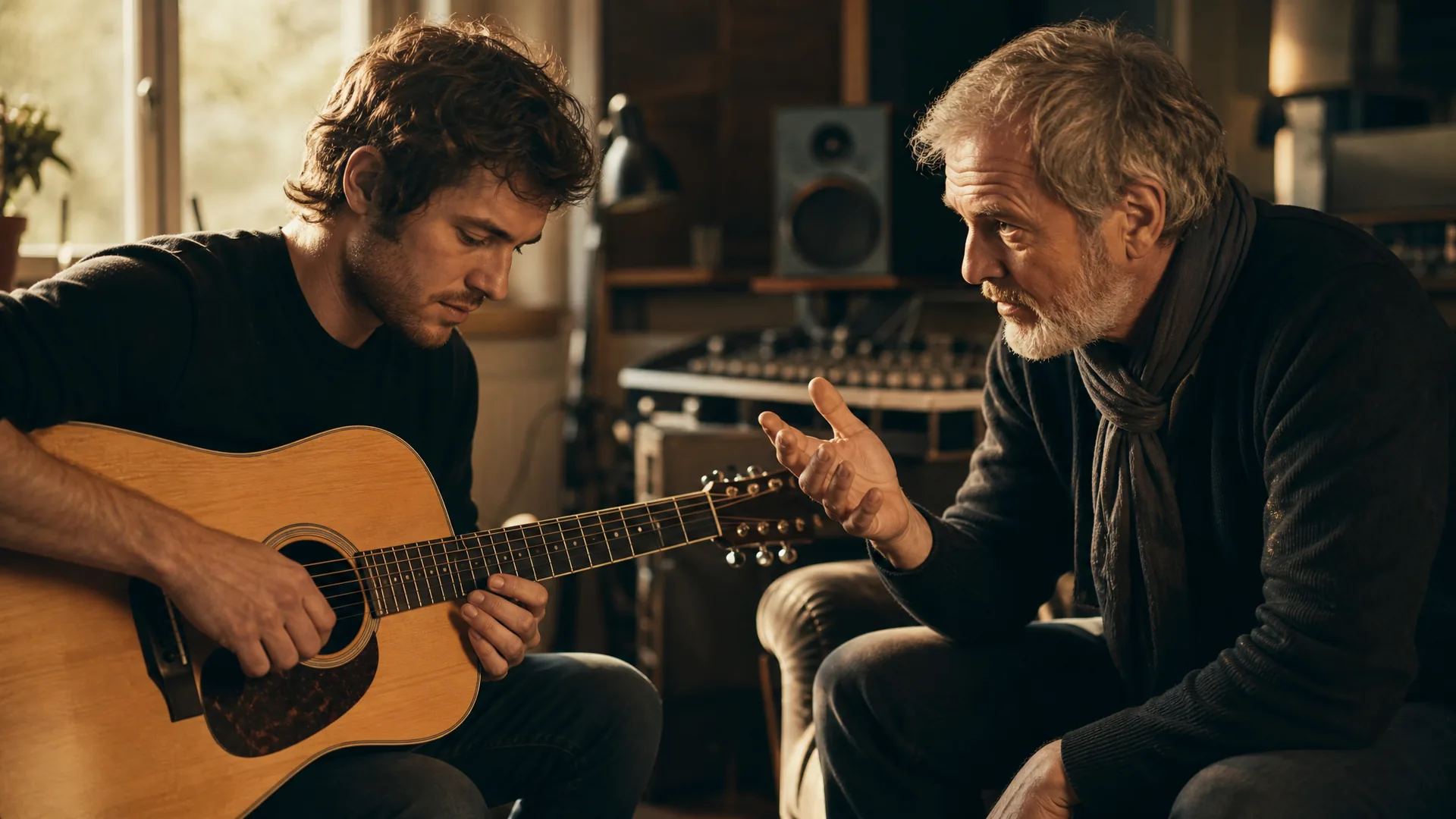
The phrase "what is a music coach for guitar" gets searched regularly, and answered almost nowhere. That gap reflects genuine confusion about what kind of help a guitarist actually needs at different stages of their development. Getting this distinction right changes everything about how you grow.
Guitar Coach Definition: A Term Worth Getting Right
A music coach for guitar works with a player who already has skills and helps them figure out why those skills aren't producing music that sounds like them. Where a teacher delivers content, a coach diagnoses context: your musical identity, your decision-making under pressure, the gap between what your fingers can do and what your playing actually says.
That distinction matters because most guitarists seek help based on what's comfortable, another lesson, another technique video, another scale to add to the pile. A coach refuses that. They ask harder questions, hold you accountable to a musical vision, and force you to confront the real problem. That's a different relationship entirely.
The Difference Between a Guitar Teacher and a Guitar Coach
What a Guitar Teacher Does
A guitar teacher transfers knowledge. They show you where to put your fingers, explain music theory, assign exercises, and move you through a curriculum, chord shapes, scales, arpeggios, sight-reading. A good teacher is invaluable at the start. You need that information. Without it, you're guessing in the dark.
The teacher's model runs on a clear transaction: here is what you don't know, here is how I'll teach it to you. Progress is measurable in new material covered. At the beginner level, that's exactly right. The limitations only surface later, when the student has absorbed the curriculum and still can't play with conviction. A different kind of relationship will fix that.
How well do you really know the fretboard?
Take the free Fretboard Challenge and find out exactly which notes cost you time, then get the note map that fixes them.
One email with the sheet. Unsubscribe whenever. No card, nothing to cancel.
On its way.
Check your inbox in the next minute or two. If it is not there, look in promotions.
What a Guitar Coach Does Differently
A guitar coach starts where a teacher stops. The question shifts from "what can't you play?" to "what aren't you expressing?" The coach's job is to diagnose the gap between technical ability and musical identity, then build a bridge between the two.
That means challenging assumptions. Why do you default to that scale in that key? What are you actually trying to say in this solo? A coach holds you accountable to a musical self you're still in the process of discovering. This is the Playing vs. Being a Musician distinction made real. Playing is executing notes correctly. Being a musician is bridging technical skill and genuine musical feel, and a coach is the person who won't let you hide on the safe side of that line.
The sport analogy is exact: a batting coach diagnoses the flaw in your swing that only shows up under game pressure. A guitar coach does the same for your musical decision-making.
Why Intermediate Guitar Players Need Coaching, Not More Lessons
Here's the profile that shows up again and again: years of playing experience, solid mechanical ability, decent knowledge of shapes and patterns, and an inability to translate any of that into expressive, intentional music. No new technique video is going to close that gap, because the gap is conceptual.
This is why so many guitarists plateau and can't break through. They've accumulated the vocabulary but haven't developed a musical voice. They know the notes; they don't know what to say with them. More instruction piles vocabulary onto a problem that needs a different kind of attention entirely.
Music coaching for adults hits differently than it does for younger students. Adult players carry more weight, years of ingrained habits, self-diagnosed weaknesses, and a frustration born from knowing they're capable of more. A coach addresses that directly. They help the player make real decisions instead of running patterns, deciding what to play based on musical intention instead of whatever the fingers find comfortable.
After 50 years of teaching guitar, from Berklee classrooms to Motown recording sessions, the single biggest obstacle Adam Levine sees in intermediate players is a lack of musical conviction. They know what to play. They don't know what to say. That's a coaching problem. And breaking the intermediate plateau as an adult guitarist requires someone willing to name it plainly and work on it directly.
What Personal Guitar Coaching Actually Looks Like
Personal guitar coaching is concrete and diagnostic from the first session. It starts with an honest assessment of where you're actually stuck.
At Adam Loves Guitar, the coaching methodology begins with a diagnostic question: "what aren't you hearing?" The ear leads; the fingers follow. That means training your ear to lead your playing is built into the process from day one.
From there, coaching shapes how you practice as well as what you practice. Intentional, mindful practice design replaces the default of running through the same material until it feels smoother. A coach builds practice sessions around specific musical decisions, what to listen for, what to respond to, what to cut.
Real-time feedback in a coaching session goes further than "that note was wrong": why did you choose that phrase? What were you hearing before you played it? Was that a decision or a reflex? That line of questioning is uncomfortable at first. It's also exactly what forces a player to grow beyond mechanical execution into genuine musical expression.
Music Mentorship on Guitar: The Long Game
Music mentorship on guitar is the longest arc of the relationship. A mentor fixes what's broken and also teaches you how to hear, how to think, and how to keep growing without needing someone to tell you what to do next.
That's the outcome that matters most. A guitarist who depends on lessons indefinitely hasn't learned to learn. A guitarist shaped by real mentorship develops an internal compass: they hear something and know how to interrogate it, absorb it, and make it their own.
What formal Berklee training brings to guitar mentorship is structure, vocabulary, and a rigorous ear, the analytical tools that let a mentor hear exactly what a student needs and name it precisely. When you combine that with decades of real studio work and performance, the mentor's diagnosis carries weight. It's grounded in evidence.
Adam's students have gone on to perform alongside George Benson, Norah Jones, Celine Dion, and Michael Jackson, because they learned how to make musical decisions under pressure. That's what a mentor produces: a musician who can function at the highest level without a teacher in the room.
How to Know If You're Ready for a Guitar Coach
A few questions settle this quickly. Do you often know the "correct" notes to play but still feel like your solos say nothing? Do you practice regularly but find that creativity never seems to improve? Have you spent more time learning techniques than developing a sound you'd actually call your own?
If those land, what you need is a coach.
The player who is ready for personal guitar coaching has already done the work of a student. They can execute. What they can't do, yet, is decide. They can't walk into a musical moment and know what to say. That's the specific gap coaching addresses, and it's a gap that doesn't close on its own no matter how many hours go in.
If you recognize yourself in that description, the next step is straightforward: find out what the Adam Loves Guitar Academy offers players at exactly this stage: serious adult guitarists who are ready to stop accumulating and start expressing.
