
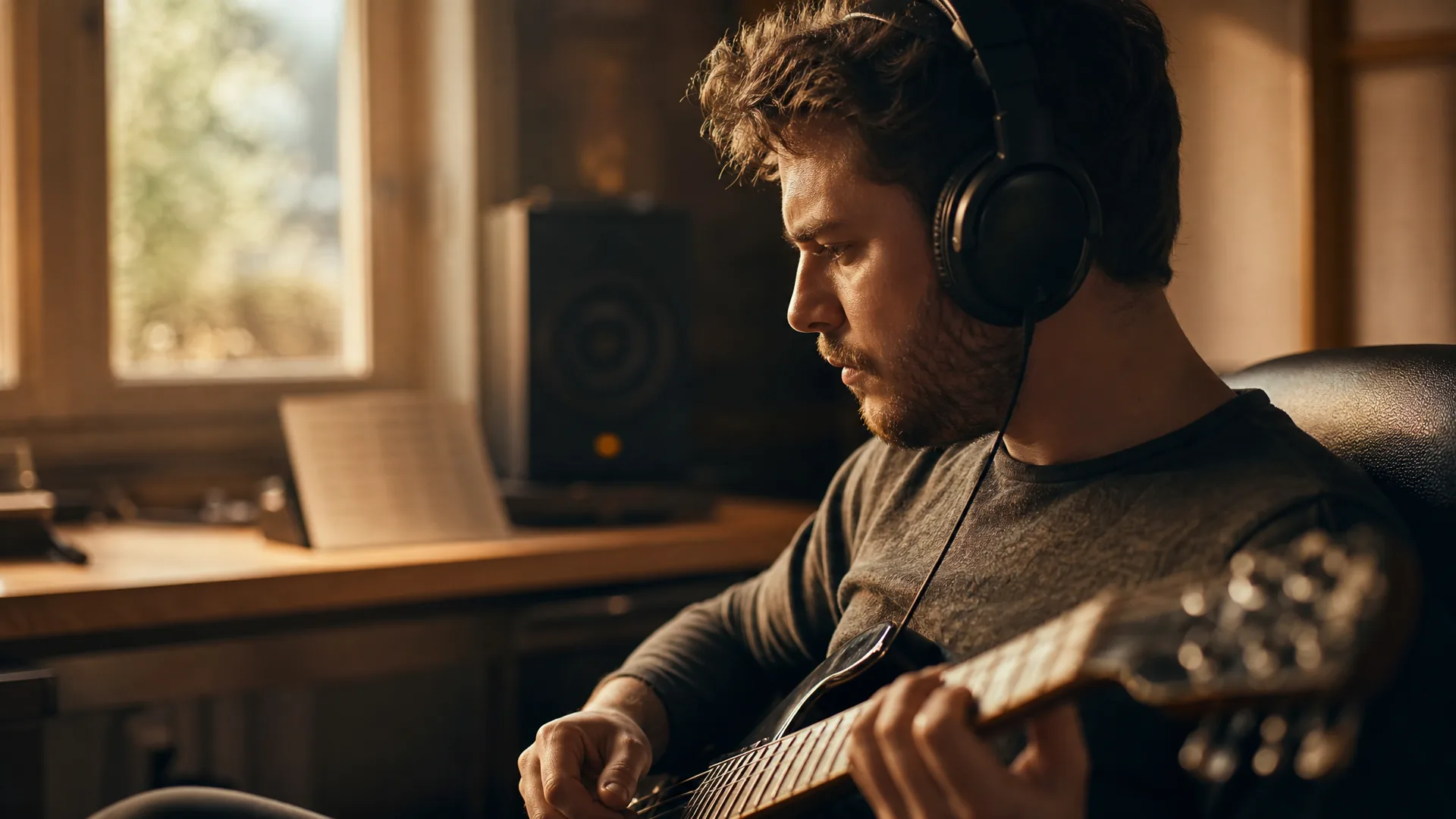
Listening skills for musicians separate the players who grow from the players who stagnate. Technique, theory and hours in the shed all matter less than perception: what you actually extract from a recording when you press play.
Most intermediate guitarists have a hearing problem. And until you solve that, why your plateau is really a perception problem is something you'll keep running into, no matter how many scales you run.
Most Guitarists Listen, But They're Not Really Hearing
Here's the distinction that changes everything: passive listening is what you do for enjoyment. Active listening is what you do for extraction.
Put on a B.B. King solo. A passive listener hears "blues feel", the bends, the emotion, the vibe. That's real, and it matters. But an active listener hears specific choices: where B.B. enters a phrase late, how long he sits on a bent note before releasing it, how many beats of silence he allows before the next statement. Those are craft decisions. You can't replicate them, learn from them, or build on them if you never registered them in the first place.
This is the intermediate plateau in its truest form. You can play the notes. You have not heard them yet. Not really.
Adam Levine spent years as a Motown studio guitarist, where each session demanded analytical listening in real time: isolating your part, the rhythm section, the arrangement, and the producer's intent simultaneously. That professional pressure forged a listening discipline most self-taught players never develop. The good news is you can develop it deliberately, starting with a structured framework.
The Active Listening Framework for Guitarists
Seasoned studio pros isolate elements instead of trying to absorb everything in a single pass. They listen in layers. That's the model here, three focused passes, each one building on the last.
Layer 1, Rhythm and Phrasing First
Before you hear a single pitch, hear the rhythm. When does the phrase start relative to the beat? Does it sit on top of the groove, or does it lay back? How long is the phrase? Where does it end?
On your first pass through any passage, ignore the notes entirely. Listen only to the rhythmic shape, the attack, the duration, the silence after. This forces you to hear phrasing as a rhythmic event, which it is. Most guitarists skip this layer entirely, then wonder why their solos sound like a stream of notes rather than a statement.
Those phrasing choices inside a blues solo you admire? They're rhythmic decisions before they're melodic ones.
Layer 2, Melodic Contour and Space
On your second pass, track only the shape of the melody: the contour, before the intervals. Is the line climbing or descending? Does it peak early and resolve down, or does it build gradually? Where does it pause, and for how long?
Space is a decision. The players you love choose silence as carefully as they choose notes. Hearing that silence as a deliberate choice, rather than a gap, is a critical shift in musical ear development.
This layer pairs directly with an ear-first approach to music theory, because contour is how melody communicates before your brain labels any interval.
Layer 3, Harmonic Context and Intention
Now add the harmony. What chord is underneath the phrase? Is the melody landing on a chord tone or creating tension? Is the player resolving to the root, or leaving things unresolved?
This pass requires the most musical knowledge, which is why it comes last. Without layers one and two, harmonic analysis floats in abstraction. With them, it locks into something you can actually feel and use.
Ear Training vs. Transcription, Know the Difference
These two disciplines are related but not the same, and confusing them is one of the most common mistakes in ear training guitar practice.
Ear training builds your internal library, the bank of sounds, intervals, rhythms, and patterns your brain can recognize and recall without a guitar in hand. Transcription is the application of that library: you hear something, you identify it, you find it on the instrument.
Many players jump straight to transcription and hit a wall. They slow the track down, stare at the fretboard, and hunt note by note, guessing more than hearing. That's because the library isn't built yet. The three-layer framework above is what makes transcription skills on guitar achievable. It trains your ear to hear in structured, isolatable elements so that when you sit down to transcribe, you're recalling something real.
Build the ear first. Then transcribe.
How to Build Your Musical Ear by Learning Directly From Recordings
The most direct path to musical ear development is sustained, disciplined engagement with recordings you care about. Here's how to do it practically.
How well do you really know the fretboard?
Take the free Fretboard Challenge and see exactly which notes cost you time. Then get the note map that fixes them.
One email with the map. Unsubscribe whenever: no card, nothing to cancel.
On its way.
Check your inbox in the next minute or two. If it is not there, look in promotions.
Choosing the Right Recording to Study
Don't start with your favorite song. Start with the right passage for learning. Look for something short, four to eight bars, from a player whose sound you genuinely admire. The melodic line should be clear and relatively uncluttered: a guitar lead or a vocal melody works better than a dense chord-melody arrangement when you're building the habit.
Motown session recordings from the 1960s and 70s are a near-perfect ear-training laboratory: the arrangements are clear, the guitar parts are rhythmically exact, and the interplay between instruments is intentional. Every element was placed there by a professional who was listening to everything else in the room. That clarity makes every choice audible.
Choose something that excites you slightly beyond your current ability to hear. Not so complex you're lost, just enough that there's something new to find on each pass.
The Slow-Down and Sing-It Rule
Slow the passage down, most modern playback tools let you drop to 60 or 70 percent speed without pitch-shifting. Then, before you touch the guitar, sing or hum the line.
Serious musicians do this at every level, and it's consistent with how formal training sharpened the listening ear for players who went on to work at the highest levels. Singing before playing forces genuine internalization. If you can't sing it, you don't really know it yet. You're guessing.
The moment you can sing the phrase accurately, rhythm, contour, and all, finding it on the guitar becomes a confirmation rather than a search. That shift is the difference between learning by ear and hunting by hand.
What the Great Players Were Actually Doing, and How to Hear It
Active listening reveals specific craft decisions.
George Benson's melodic economy is a masterclass in this. Nearly every phrase is shorter than you expect, lands on a strong beat, and leaves deliberate space. A passive listener hears "smooth jazz." An active listener hears a precise decision about where not to play, and why that restraint makes every note land harder.
The Motown session players operated by the same logic, applied to rhythm. The guitar parts from those sessions are locked. They sit in the pocket with a precision that's only possible when the player is listening to the drums, the bass, the horns, and the melody simultaneously and choosing where their part lives in that total picture.
Norah Jones-era session recordings carry the same lesson: restraint is the statement. The guitarists on those records were making real decisions when improvising, choosing to serve the song over serving themselves. You only hear that level of intention when your listening skills are working at full capacity.
Adam's students, players who have gone on to work with Michael Jackson, Celine Dion, and Norah Jones, consistently name active listening as the skill that separated their development from peers who kept practicing scales in isolation. Technique gets you in the room. Listening keeps you in the room.
Make Active Listening a Daily Practice
The minimum effective dose is simple: one focused listening session per day, ten to fifteen minutes, with a single layer of focus.
One passage, one layer, full attention. Run Layer 1 on Monday. Layer 2 on Tuesday. By the end of the week you'll have heard a single eight-bar phrase more deeply than most guitarists hear an entire album.
This is what bringing focused attention to every practice session actually looks like: more presence in the hours you have. It's also what separates playing guitar from being a musician. Players practice. Musicians listen.
The craft of bridging technical skill and genuine feel starts here, at the speaker.
If you're ready to hear music the way professionals do, that's exactly what we build inside the Academy. Take a look at how it works.
