
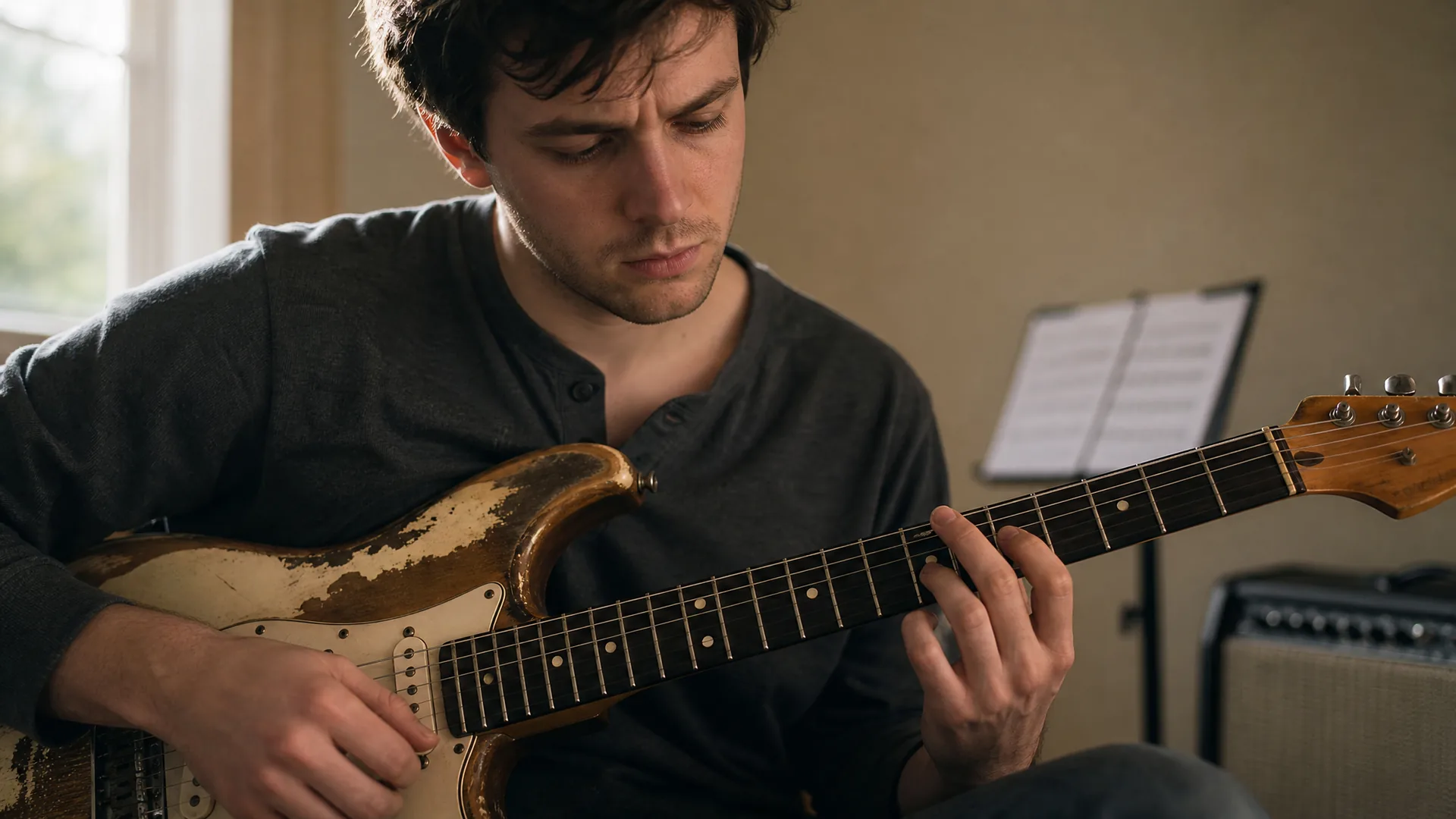
Most intermediate guitar students stuck at a plateau aren't lazy. They practice. They watch lessons. They can play, and yet something refuses to move forward. The frustration is real, and the standard advice ("practice more," "be patient," "try harder") doesn't touch it. That's because the advice is answering the wrong question. The problem is structure.
The Real Reason Intermediate Guitar Students Get Stuck
The Problem Is Structural
When players hit the intermediate wall, the conversation almost always turns to mindset or hours logged. Grind harder. Stay consistent. Push through the plateau. But after 50 years of teaching, one pattern holds: the students who plateau longest are the ones who never learned to listen, to the harmony, to the space, to the other musicians in the room.
That's a structural gap, and structure can be fixed.
Most intermediate players have learned to execute shapes. They can run pentatonic scales, navigate a few chord progressions, and maybe pull off a recognizable lick or two. What they haven't learned is the music underneath those shapes, why those notes matter, where they lead, what they're responding to. The real reason you've plateaued on guitar is almost always a shortage of the musical understanding that gives those patterns meaning.
Fixing that requires a different kind of work.
The Difference Between Playing Guitar and Being a Musician
Technique Without Musicality Is a Dead End
Here's the sharpest distinction in all of guitar education: a player executes patterns, a musician makes decisions.
Knowing five pentatonic boxes is technique. Knowing why you'd choose one particular phrase, in that key, over that chord, at that moment in the song, that's musicality. One is a library of shapes. The other is a language you're actually speaking.
Plenty of intermediate players can demonstrate impressive technical facility. They've drilled their scales, memorized their modes, and can reproduce licks from their favorite players note-for-note. But put them in a room with other musicians, give them an unfamiliar chord change, a moment of silence to fill, a producer asking for something that "feels right", and the technique stops working. There's nothing behind it.
That's the dead end. More technique won't fix it.
What Musical Understanding Actually Looks Like
Musical understanding looks like making musical decisions instead of running patterns. It looks like hearing a chord and knowing which scale fits over it and what emotion that scale is capable of carrying. It looks like choosing silence when silence serves the song better than a note would.
Adam Levine spent decades as a Motown studio guitarist, where the demand was musical restraint, groove, and instant harmonic decision-making under pressure. In that environment, the musician-vs.-player distinction becomes undeniable fast. You either hear the music and respond to it, or you don't get called back.
That's the standard. And it's learnable, but only if you're training the right things.
Overcoming Guitar Frustration: What Intermediate Players Are Actually Missing
The three most common gaps in intermediate-to-advanced guitar development are ear training, intentional practice structure, and musical context for every exercise. Overcoming guitar frustration means addressing all three.
Ear Training as a Foundation, Not an Add-On
Most players treat ear training as a separate subject, something to bolt on once the "real" skills are in place. That's backwards. Training your ear as a foundation is what makes every other skill usable. When your ear is developed, you hear what the music needs before your fingers move. When it isn't, you're always guessing from shape instead of responding to sound.
Ear-first learning means you internalize intervals, chord qualities, and melodic motion as sounds. That's how you stop relying on patterns and start playing music.
How well do you really know the fretboard?
Take the free Fretboard Challenge and find out exactly which notes cost you time, then get the note map that fixes them.
One email with the sheet. Unsubscribe whenever. No card, nothing to cancel.
On its way.
Check your inbox in the next minute or two. If it is not there, look in promotions.
How Mindful Practice Breaks Guitar Progress Stagnation
Guitar progress stagnation almost always traces back to the same habit: repetition without intention. Playing through the same material, the same way, hoping something changes. It doesn't. Repetition reinforces whatever you're already doing, including the errors and the mindlessness.
Intentional practice means every session has a specific target, a way to measure whether you hit it, and a feedback loop that tells you when you're drifting. It means slowing down to hear the music inside the exercise instead of just executing the exercise faster. How to practice guitar mindfully is a different discipline from logging hours, and it's the one that actually moves the needle.
Musical context is the third piece. Every scale, every chord shape, every technical drill needs to exist inside a musical situation, as sound you can hear. If you can't hear where an exercise lives in real music, you won't know how to use it when the moment comes.
What the Path From Intermediate to Advanced Guitar Actually Requires
Fretboard Mastery Is a Language, Not a Map
The difference between intermediate and advanced guitar is a shift in how you relate to the instrument. Advanced players speak through the fretboard.
Think about the difference between memorizing vocabulary words and actually holding a conversation. You can know a thousand words and still have nothing to say. Positional fretboard knowledge, shapes, boxes, patterns, is vocabulary. Knowing what to say with it, and when, is the conversation. Fretboard note recognition as a plateau-breaking tool only works when it's connected to harmonic understanding and real musical intent.
The path to next level guitar playing runs through identity. You're becoming a different kind of player. That means developing your own musical sensibility, your own sense of phrasing, your own voice. Developing your own voice on the guitar is the whole point.
The jazz transcription approach Adam teaches illustrates this directly. Instead of copying a solo note-for-note, students learn to understand why a player chose that phrase, the harmonic context, the rhythmic placement, the emotional logic. That analysis creates transferable musical intelligence. You walk away able to generate your own ideas.
Learning From a World-Class Teacher Changes the Trajectory
There's a reason some guitarists make five years of progress in twelve months under the right teacher: a skilled teacher sees what you don't. They diagnose before they prescribe. They know which gap to close first because they understand how musical development actually sequences.
What a music coach for guitar actually does is structurally different from what a conventional lesson provides. A coach builds a curriculum around your specific deficits. That's only possible when the teacher has seen enough students, across enough years, to recognize the pattern behind the symptoms.
Adam's training at Berklee College of Music shaped how he structures every lesson: ear first, theory as explanation, technique as tool. That sequence matches how music actually works, and how musicians actually develop. His Motown studio experience put that philosophy under real pressure and proved it out in the most demanding professional context a guitarist can face.
Students trained under that method have gone on to perform alongside Michael Jackson, George Benson, Celine Dion, and Norah Jones, as musicians trusted to serve the song at the highest level. That's what developing musicians actually produces.
The Next Step for Serious Adult Guitarists Who Want More
If you're reading this, you already know you're stuck. You don't need that confirmed. What you need is a clear picture of what's actually missing and a structural environment where you can address it properly.
More YouTube lessons won't do it. Another scale book won't do it. What moves the needle is a coherent system that builds ear training, musical context, and intentional practice into every session, guided by someone who can see your specific gaps and sequence your development correctly.
That's what the Adam Loves Guitar Academy is built around: a structured method rooted in 50 years of teaching and professional musicianship at the highest level. It's the environment where the shift from player to musician actually happens, because it's designed specifically for that shift.
You've spent enough time practicing things that aren't working. The next move is a different one.
