
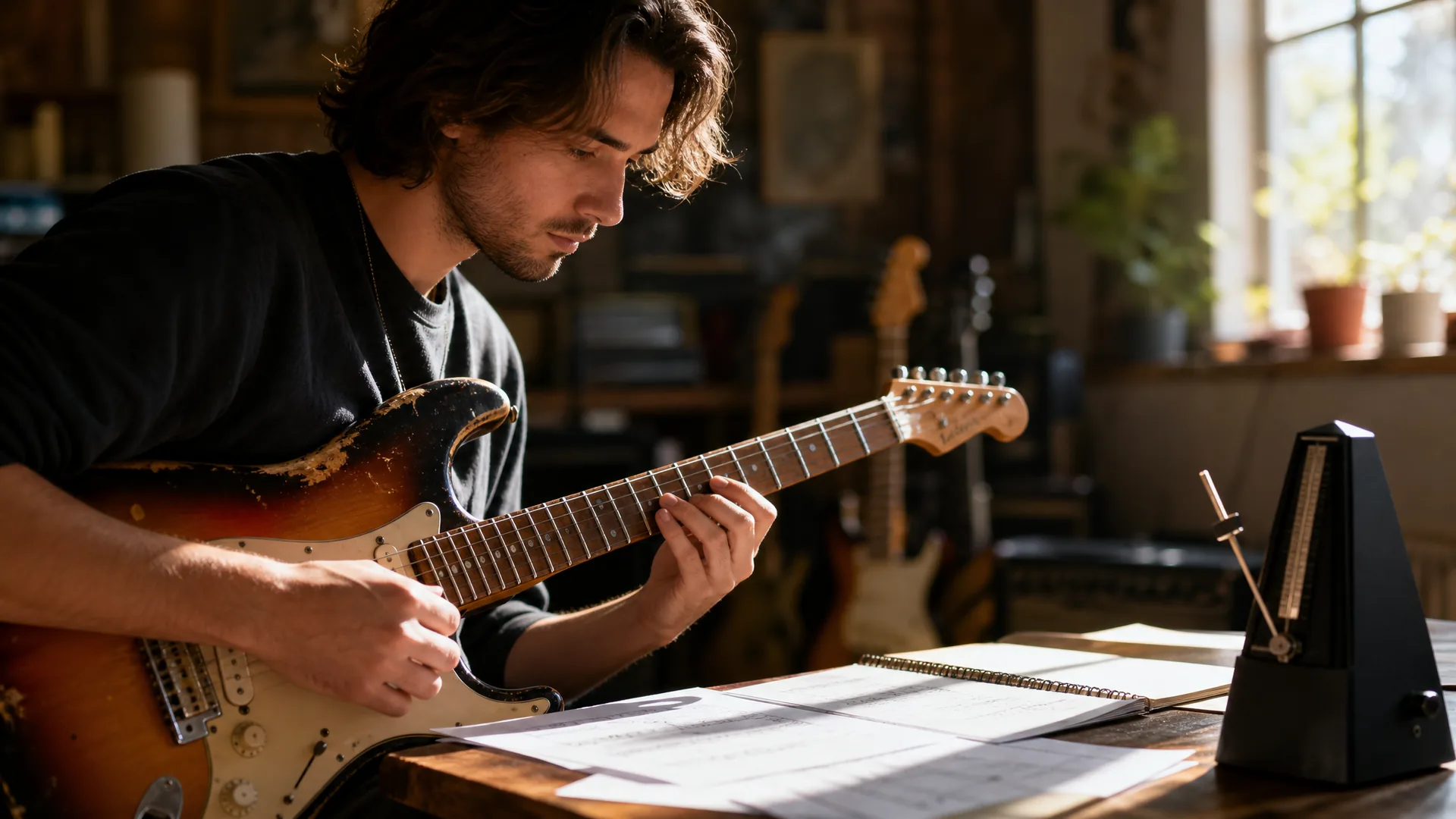
Most guitar players spend years waiting to "find" their style, as if it were buried somewhere in a pentatonic scale, waiting to surface. Knowing how to develop your own style on guitar comes down to deliberate, structured choices made over time. This guide gives you that framework.
Style Is Something You Build
Drop the "finding your style" framing first. It implies passivity, that style emerges on its own if you play long enough. In practice, players who develop a genuine voice make specific decisions: which notes to emphasize, which to leave out, how long to hold a bend, how much silence to let sit.
Style is the sum of those decisions, compounded over thousands of hours of intentional practice. It reflects what you value musically, what you've studied, and how your physical tendencies shape the instrument. None of that happens by accident.
After 50 years of teaching at every level, from beginners to players who went on to perform with Michael Jackson, George Benson, and Norah Jones, Adam has seen one pattern repeat: the players who develop a real voice are the ones who learn to make decisions rather than pile up options.
That's the framework: decision-making.
The First Step: Auditing Your Influences With Intention
Most players absorb influences the way people absorb pop culture, passively, emotionally, without analysis. You love how a player sounds, you try to sound like them, and you end up with a vague imitation that doesn't quite land. The problem is you absorbed a feeling when you needed a device.
How to Listen Like a Musician, Not a Fan
Listening like a fan means responding to the emotional effect. Listening like a musician means asking what created that effect. Those are different questions, and they produce different results.
To train your ear to hear like a musician, start isolating decisions: Where does the player land rhythmically, ahead of the beat, behind it, or dead on? How wide is the vibrato, and how fast does it arrive? Which scale degrees are emphasized? Where does the phrase end, and how much space follows?
This kind of listening is slower and more deliberate than casual enjoyment. It's also what separates guitarists who develop a voice from those who stay technically capable but musically anonymous.
Extracting Specific Devices, Not General Vibes
Vague inspiration ("I love his tone") doesn't transfer to your playing. Specific devices do.
BB King's entire identity lived in a single bent note held at the right moment, a signature sound built from one deliberate device. Wes Montgomery's decision to play with his thumb instead of a pick became the warm, rounded tone that defined his musical identity for a generation of players. These are specific, extractable choices.
When you study an influence, write down the exact devices: the vibrato approach, the rhythmic placement, the harmonic substitutions, the dynamic range. Transcribe the intent behind the notes as well as the notes themselves. That's the raw material you'll work with next.
Internalization: Turning Borrowed Ideas Into Your Own Musical Language
Extracting devices is research. Internalization is where personal guitar expression actually begins.
The Absorption Loop: Copy, Adapt, Combine
Every serious musician across every genre has run some version of this cycle: copy the device exactly, adapt it to your own physical tendencies and musical context, then combine it with other influences until it stops sounding borrowed. This is how musical language develops. Jazz musicians call it "woodshedding." Classical composers studied counterpoint by copying Bach. The process is the same.
In practice: take a specific device you've extracted, say, the way a player uses a half-step bend into a chord tone at the end of a phrase. Play it exactly as they do first. Then shift the timing. Then apply it to a different harmonic context. Then pair it with a rhythmic idea from a different influence. At some point in that process, the device stops belonging to the original player and starts belonging to you.
Blues phrasing techniques that carry real expression are a useful proving ground for this, because the vocabulary is specific enough to copy precisely but flexible enough to recombine in endless ways.
How well do you really know the fretboard?
Take the free Fretboard Challenge and find out exactly which notes cost you time, then get the note map that fixes them.
One email with the sheet. Unsubscribe whenever. No card, nothing to cancel.
On its way.
Check your inbox in the next minute or two. If it is not there, look in promotions.
Musical Identity on Guitar Starts With Constraint
Here's the counterintuitive part: more options produce generic facility, the ability to play anything, which sounds like nothing in particular.
Constraint forces commitment. When you limit yourself to three techniques in a practice session, or one scale in a solo, or a narrow dynamic range for a week, you stop reaching for the comfortable and start making the chosen elements mean something. Jimi Hendrix fused blues phrasing, simultaneous rhythm and lead, and a raw sonic palette into something entirely his own by filtering everything through a singular, uncompromising point of view. The limitation was the source of identity.
Guitar Tone and Style: Why Your Sound Is a Decision
Players spend real money chasing a signature sound through gear. The gear matters less than they think. Your tone, in the sense that defines you as a player, lives in pick attack, vibrato width, note duration, dynamic contrast, and how much space you allow between ideas.
Two guitarists playing through identical equipment can sound completely different, because one attacks the strings with authority and the other plays tentatively. One uses vibrato that arrives fast and stays narrow; the other waits a beat, then widens. One treats silence as part of the phrase; the other fills every gap. These are all technique choices.
Tone and style are inseparable from touch. Berklee's approach to ear training is rooted in the idea that you cannot express what you cannot hear, meaning musical identity begins in the ear, long before it reaches the fingers. What you listen for, you start to control. Pick dynamics, vibrato timing, the physical weight behind each note, these are learnable, repeatable, and deeply personal once you commit to them deliberately.
Playing guitar with real feel is ultimately about these micro-decisions stacking up into something recognizable as yours.
From Fretboard Mastery to Personal Guitar Expression
There's a ceiling on musical identity that fretboard ignorance creates. A player who is guessing where notes live cannot make deliberate musical statements; they react. They land where their fingers are comfortable instead of where the music wants to go.
Knowing the Fretboard Frees You to Make Choices
Fretboard note recognition as a foundation for expression removes the cognitive friction between what you hear in your head and what you play. When you know where every note lives across the entire neck, you stop navigating and start choosing.
This is why why so many experienced players plateau is a vocabulary problem. They've run out of ways to say anything new because they're drawing from the same three positions they've always used. Fretboard fluency expands the sentence structure available to you. It doesn't guarantee you'll have something to say, but it guarantees you won't be muffled when you do.
The goal is instantaneous access, so that when you hear a musical idea, your hand is already moving toward it.
Musical Storytelling on Guitar: Style in Action
All of this, the analytical listening, the absorption loop, the technique decisions, the fretboard command, only becomes real in a musical moment. Style is what you do when the track starts.
A guitarist with developed musical identity makes choices in real time: they build tension across two bars and release it on a note that lands with physical weight. They repeat a motif, vary it, then abandon it at the moment of highest interest. They leave four beats empty and let the rhythm section breathe. They play one note where another player would play eight.
This is the difference between playing guitar and being a musician. Pattern execution is predictable, the same scale runs, the same lick in the same position, regardless of what the music needs. Musical storytelling responds to context. It uses decision-making over pattern execution in improvisation as the organizing principle of every phrase.
You know you're playing with genuine musical identity when your choices surprise you, when you reach for something specific instead of something comfortable, and it serves the moment. That's built capability making itself available.
One line captures the whole framework: audit deliberately, internalize systematically, constrain intentionally, and make every touch count. Practicing with intention rather than repetition is what turns this framework into an actual voice over time.
If you're ready to stop reading about this and start applying it with real guidance, Adam's Academy is where this framework gets put into practice, with a teacher who has built this process across five decades, for players at every level. It's a method you work through, with someone watching how you play and telling you the truth about it.
