
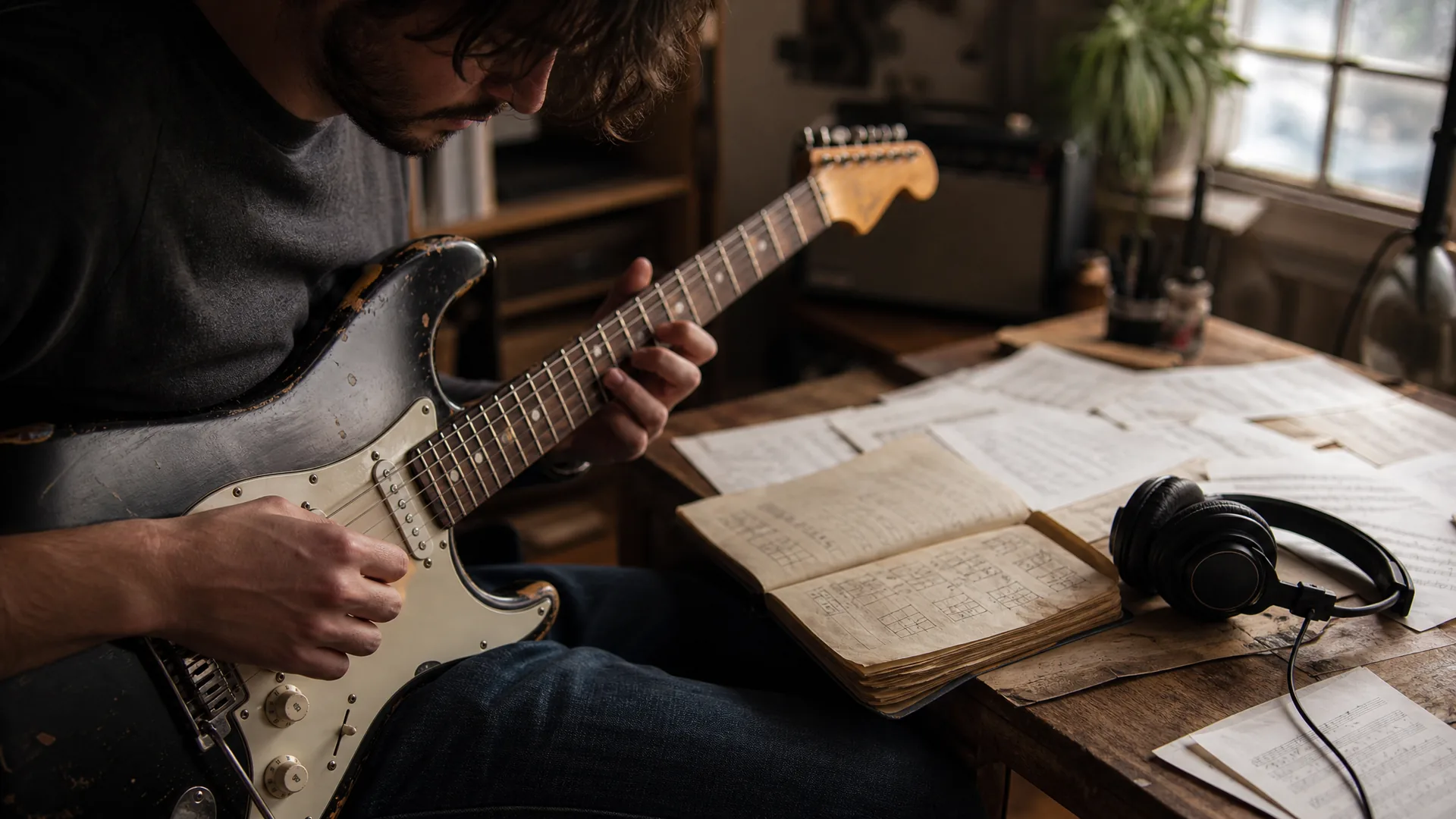
Most guitarists have a folder full of licks they can't use. They've watched the tutorials, saved the tabs, copied the phrases, and when it's time to improvise, they freeze. The problem is process. Building musical vocabulary guitar players can actually deploy requires something more systematic than collecting phrases: it demands listening, transcribing, analyzing, and integrating, in that order, with intention at every step. That's the process most players skip entirely, and it's exactly why so many intermediate guitarists get stuck at the same plateau for years.
Why "Learning Licks" Is Not the Same as Building Guitar Vocabulary
The Difference Between a Lick Collection and a Musical Language
Here's the honest distinction: a lick collection is a pile of words you can't put into a sentence. Real lick vocabulary guitar means having phrases you can place with intent, the right phrase, at the right moment, over the right chord, at will.
Most players learn a lick in the key of A, in one position, from the artist who played it. They can reproduce it in isolation. But ask them to drop it into a G minor context, or start it on beat three instead of one, or vary the rhythm, and it falls apart. That's mimicry.
A musician with real vocabulary generates phrases. The phrase may resemble something they absorbed, from a record, a solo, a great teacher, but it emerges from understanding. The difference between those two states is enormous, and getting from one to the other is deliberate practice. It also applies far beyond jazz: phrasing techniques that make blues guitar feel authentic are built the same way, through internalization.
Step One: Listening as a Discipline, Not a Habit
How to Listen So Your Ear Leads Your Fingers
Passive listening, having records on while you drive, has real value, but it won't build vocabulary on its own. Active, focused listening is a separate discipline. It means sitting with a phrase until you can hear exactly where it starts, where it breathes, where it resolves, and why it lands the way it does.
This is the ignored foundation of music vocabulary training. Jazz vocabulary building has always started here. Miles Davis, Wes Montgomery, and Charlie Parker became themselves by listening with surgical focus to the players who came before them. Wes Montgomery built one of the most recognizable guitar vocabularies in jazz history without reading a note of music, by internalizing Charlie Christian and Charlie Parker so thoroughly that his own voice emerged from that deep listening.
Concrete practice: pick eight bars of a solo you love. Play it five times without your guitar. Track the shape of the line, does it rise and fall? Where does the tension peak? Where does the phrase land? Only then pick up the guitar and try to find what you heard. Training your ear as a musician is the work itself.
When your ear leads, your fingers follow with purpose. When your fingers lead, you get patterns.
Step Two: Transcribing for Understanding, Not for Copying
What to Transcribe
Don't transcribe everything. Transcribe phrases that already live in your ear, ones you've listened to enough that you can sing them before you write them. If you can't sing it, you don't know it well enough to transcribe it. Start short: four bars of a Kenny Burrell line, eight bars of a Wes solo, a single George Benson phrase that resolves in a way you can't explain yet.
Breadth matters too. Pull from different tempos, different feels, different harmonic contexts. A vocabulary built only from ballads will fail you at medium swing. Pull from the full range of music you want to play.
How well do you really know the fretboard?
Take the free Fretboard Challenge and see exactly which notes cost you time. Then get the note map that fixes them.
One email with the map. Unsubscribe whenever: no card, nothing to cancel.
On its way.
Check your inbox in the next minute or two. If it is not there, look in promotions.
How to Analyze What You've Written Down
Transcription without analysis is just notation. You've moved ink from a record to paper and learned almost nothing. The goal, and this is where most players stop short, is to understand why the phrase works.
The full approach to transcribing jazz solos for analysis rather than mimicry goes deep on this process. The core question every time you write something down: what is this phrase actually doing? Which notes carry the weight? How does it relate to the underlying chord? Where in the bar does it begin, and does that placement create tension or release?
At Berklee, Adam Levine encountered a consistent emphasis on whether you could hear a phrase, understand it, and use it. Most guitarists skip the middle step entirely, and the middle step is everything.
Step Three: Analyzing the DNA of Every Phrase
This is where jazz vocabulary building becomes structural. Once you've transcribed a phrase and can play it, take it apart. Ask four questions:
Entry point. Where in the bar does it start? On the beat, ahead of it, behind it? Many of the most musical phrases start on the "and" of two, they borrow time rather than demand it. That rhythmic placement is craft.
Note choice relative to the chord. Is the phrase built around the third and seventh, the guide tones? Does it approach from a half-step below? Does it pass through a chromatic note that creates color before resolving? These are decisions. Understanding music theory through your ear first makes these decisions legible, you stop seeing random notes and start seeing a logic.
Contour. Does the line climb and then resolve downward? Does it sit in a narrow range and then leap? The shape of a phrase is as much of its identity as the notes. George Benson, one of the musicians Adam's students have performed with, demonstrates this in every solo: each phrase has a clear beginning, development, and resolution, the hallmark of a player who has internalized language.
Resolution point. Where does the phrase land, and on what note? Landing on the root feels settled. Landing on the major seventh feels suspended. The destination of a phrase determines what it says emotionally. That's the vocabulary of musical storytelling.
Stop asking "what notes." Start asking "why these notes here." That shift in question is the shift from a student to a musician.
Step Four: Integrating New Vocabulary Across the Fretboard
Practicing in All 12 Keys
This is the gym work of expanding guitar repertoire, and almost no one does it. Take a phrase you've transcribed and analyzed, and move it through all 12 keys. All of them, including the uncomfortable ones.
Why? Because a phrase you can only play in A minor is a phrase you can't actually use. You don't get to choose the key at a jam session or on a gig. You either have the phrase or you don't. Transposing forces your ear and your hands to internalize the shape of the phrase rather than its finger pattern. The pattern belongs to one key. The shape belongs to all of them.
Solid fretboard note recognition across all positions is the infrastructure that makes this possible. Without it, transposing becomes a theory exercise rather than a musical one. Build the map first, then navigate it.
Using Vocabulary in Real Musical Situations
A phrase isn't yours until you've used it under pressure. Play over backing tracks in multiple keys. Bring it into a lesson or a jam. Improvise for ten minutes and see if the phrase emerges naturally, because the music called for it.
Adam Levine spent years as a Motown studio guitarist, where communicating a musical idea instantly, with no room to noodle, was the professional baseline. That experience shapes how he teaches vocabulary: it must be deployable on demand. The studio doesn't wait for you to find the phrase. You either have it or you don't.
Test your vocabulary live. That's where it becomes real.
How Real Musical Storytelling Emerges from Systematic Vocabulary Work
Fifty years of teaching has shown Adam one consistent pattern: the players who break through the intermediate plateau are almost always the ones who started transcribing and analyzing before they started improvising more. They built something to say before they tried to say it.
That's the whole point of building musical vocabulary guitar players can truly command. When you have real vocabulary, phrases internalized through listening, refined through transcription, understood through analysis, and proven through transposition and live use, you stop guessing and start deciding. Every note you play is a choice. Every phrase has a reason. The music has a shape.
That is what separates a musician from someone who plays guitar.
Improvisation, at its best, is storytelling. It has tension and release, question and answer, momentum and rest. None of that is possible without vocabulary, without a reservoir of musical language deep enough to draw from in real time. Making real decisions when you improvise is only possible when the vocabulary is already there.
If you're ready to build that vocabulary systematically, with a teacher who has walked this exact path for decades and taken students to the highest levels of the profession, the Adam Loves Guitar Academy is where that work happens. It's a structured environment where every lesson builds on the last, guided by someone who has seen what actually works.
The process is clear. The only question is whether you're ready to follow it.
