
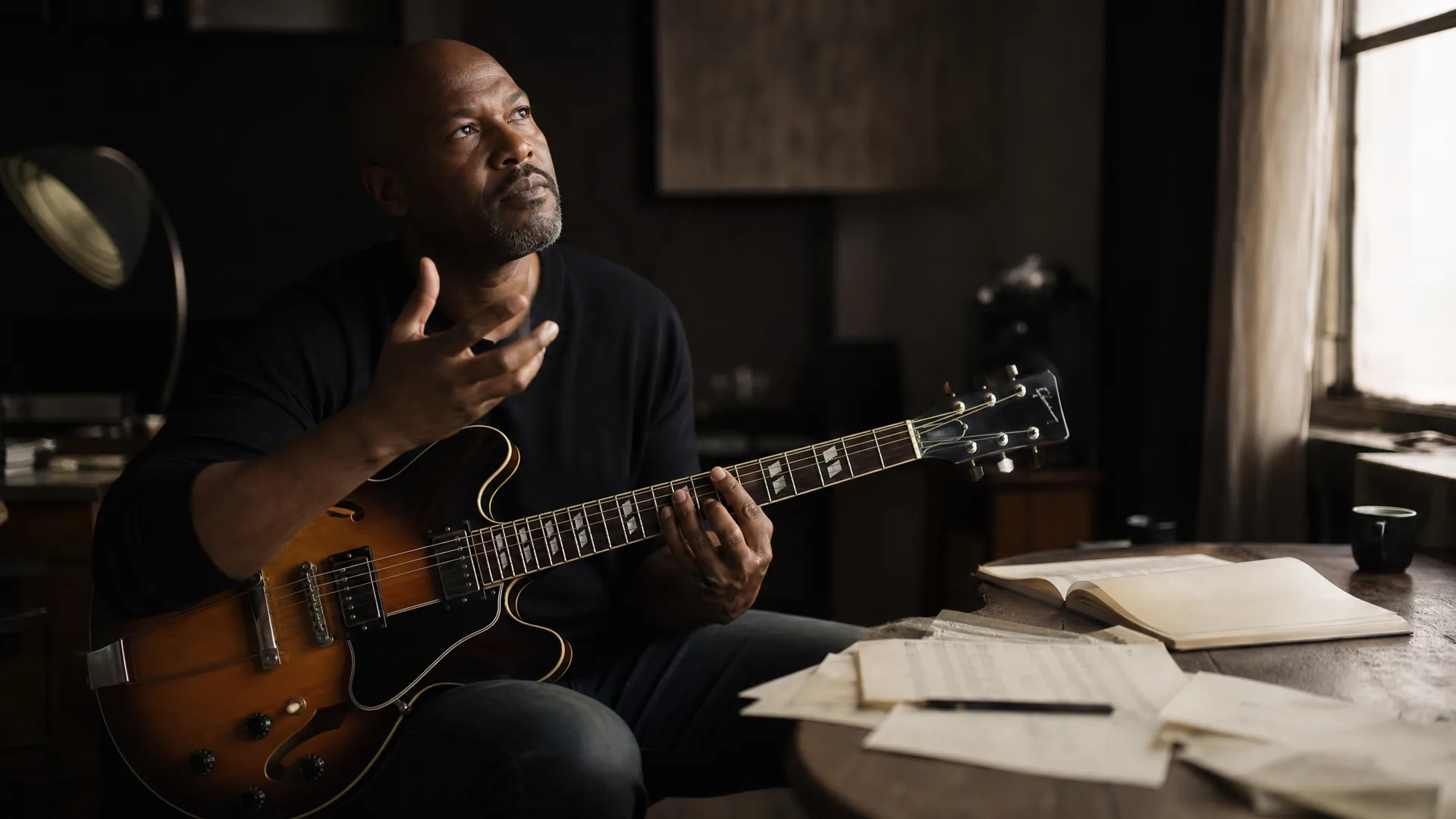
Transcribing jazz solos is one of the oldest and most respected methods of jazz education. But most guitarists are doing it wrong, and the trouble lies in the mindset more than the mechanics. They copy the notes, learn the fingering, and move on. What they miss is everything that made the solo worth transcribing in the first place.
After five decades of teaching, Adam Levine's consistent finding is this: intermediate players who plateau are almost always transcribing by ear without ever analyzing what they hear. The notes go into the hand. They never reach the mind.
That gap is what this guide closes.
Why Most Guitarists Transcribe Wrong
There's a difference between copying a solo and reading it. Serious players treat a transcription like a text, something to be examined, questioned, and understood at depth. Most players treat it like a riff to steal.
Transcription without analysis is mimicry. You might reproduce the pitches, but you won't know why the phrase lands. You won't know what the soloist was hearing, what harmonic problem they were solving, or what rhythmic idea they were developing. So when you try to use that material in your own playing, it sounds borrowed, because it is.
Miles Davis told his sidemen, "Don't play what's there, play what's not there." That's an analytical instruction. It's about understanding space, harmonic implication, and musical choice. Transcription is the tool that builds that understanding, but only if you treat every solo as a document of musical thinking.
What Motown session players understood about musical restraint is the same thing: you read the music beneath the music. Adam Levine spent years as a Motown studio guitarist, where reading a soloist's intent as well as their notes was a professional survival skill. That discipline shapes every transcription method taught at Adam Loves Guitar.
How to Transcribe Guitar Solos: The Mechanics Done Right
Accuracy in the mechanical process matters. A sloppy transcription gives you nothing to analyze. Here's how to do it right.
Use a pitch-preserving slow-down tool. Apps like Amazing Slow Downer or Transcribe! let you drop the tempo 50% or more without shifting pitch. This is how you catch the fast runs, the grace notes, and the micro-timing that defines a player's feel. Loop short phrases, typically two to four bars, and repeat until you can hear every note before you touch the guitar.
Slowing Down Without Losing Pitch
Work in small units. Don't transcribe a chorus at a time. Transcribe a phrase, then stop, sing it back, and verify. Tools like Transcribe! let you loop specific regions, which means you can sit with a single measure until it's clear. The goal is accuracy, because everything downstream depends on it.
Singing Before You Play
This is the step most players skip, and it's the most important one. Before you find a transcribed phrase on the fretboard, sing it. Sing it at tempo. If you can't, you don't own it yet, you're just playing connect-the-dots by memory.
Training your ear to hear what's really happening is what makes singing back a phrase possible. The voice is the first instrument. If the phrase lives in your ear and your voice, it will find the fretboard naturally. If it only lives in your fingers, it's fragile.
Solo Analysis Guitar: What to Look For Once You Have the Notes
Now the real work begins. You have the notes on paper or in a notation app. Most guitarists stop here. Don't.
Phrase Shape and Breath Points
Mark where each phrase starts and ends. A phrase in jazz typically runs two to four bars before it resolves or pauses, these are the breath points, the moments where the soloist "lands." Look at the contour: does the phrase climb, then fall? Does it start low and build to a peak? These shapes are intentional, and they're part of what you're learning to internalize.
Wes Montgomery's solo over "Four on Six" is a textbook example of motivic development. He introduces a simple rhythmic cell in the opening phrase and transforms it across the entire solo, rather than stringing together unrelated licks. Analyzing phrase shape is how you see that, and once you see it, you can't un-see it in any solo.
Connecting the Solo to the Harmony Underneath
Write the chord changes beneath your transcription, bar by bar. Then identify where the soloist targets chord tones, the root, third, fifth, seventh, especially on strong beats or at phrase peaks. This is where transcription practice guitar becomes actual musical education.
Look at scale choices against each chord. Does the soloist use the Dorian mode over a ii chord? A bebop scale to navigate a dominant? Chromatic approach notes before a chord tone? They're a vocabulary of harmonic choices that you're now cataloguing.
Hearing the harmony before you name it is the prerequisite skill here. The theory label comes after the ear recognition, not before. And learning music theory through your ear is exactly how this analysis should feel: you hear the pull toward the chord tone first, then you name what it is.
Learning Jazz Standards by Ear: Building a Real Vocabulary
There's a difference between a jazz lick and a jazz concept. A lick is a fixed sequence of notes. A concept is a device, something you understand well enough to transform and reuse in any context. Learning jazz standards by ear means hunting for concepts.
How well do you really know the fretboard?
Take the free Fretboard Challenge and see exactly which notes cost you time. Then get the note map that fixes them.
One email with the map. Unsubscribe whenever: no card, nothing to cancel.
On its way.
Check your inbox in the next minute or two. If it is not there, look in promotions.
Isolating Devices Worth Keeping
As you analyze, flag the devices that feel generative. Rhythmic displacement, taking a melodic idea and shifting it a beat or a half-beat forward. Chromatic approach notes, sliding into a chord tone from a half-step below or above. Call-and-response arcs, a short statement in one register, answered by a contrasting phrase in another.
These are durable. A lick played in one position is a party trick. A rhythmic displacement idea works over any chord, in any standard, in any key, once you understand what it is.
Transposing and Relocating Ideas Across the Fretboard
Once you've isolated a concept, practice it in all 12 keys. This is where most players bail, it's tedious, and it exposes gaps in fretboard knowledge fast. But it's exactly what separates a player who "knows a Wes lick" from a player who commands the device Wes was using.
Locating transcribed phrases anywhere on the neck is a fretboard fluency skill, and you need it working together with transcription. Start the transposition on a root you're comfortable with, then move it to the five keys that give you trouble. Berklee College of Music has long placed ear training and transcription at the center of its jazz curriculum as the primary method by which students internalize professional-level musical language. The 12-key transposition drill is one reason why.
Jazz Vocabulary Building: Integrating Transcriptions Into Your Own Playing
This is where jazz vocabulary building closes the loop. You've transcribed, analyzed, and transposed. Now you have to test the material under pressure, inside a real standard, with real changes moving underneath you.
Pick one device you extracted. Set a simple rhythm track or play over a backing track for a standard you know well. Your only job is to deploy that one device, once, intentionally, at the right moment, as a musical decision.
When the phrase fits the moment, something shifts. It stops being "a Wes thing" and becomes an option you chose. That shift is the entire point of transcription practice guitar done right. Turning transcribed vocabulary into real-time decisions is how absorbed language becomes musical expression, and how borrowed vocabulary eventually becomes your own voice.
What a Guided Transcription Practice Actually Looks Like
A repeatable weekly system builds skills.
Here's a practical template built around single-phrase depth rather than volume:
Session 1, Transcription: Choose one phrase, two to four bars. Slow it down, loop it, sing it back, then notate it. Verify every note against the recording before moving on.
Session 2, Analysis: Map the phrase against the chord changes. Mark chord tones, approach notes, and phrase contour. Identify one device the soloist used, name it in plain language. "Chromatic approach into the third on beat three." Specific.
Session 3, Transposition Drill: Move the phrase to three new keys. Play each one slowly, singing the phrase as you play. Then play all three in sequence without stopping.
Session 4, Integration: Take that one device (the device itself, rather than the phrase verbatim) into a short improvisation over a standard you know. Record yourself. Listen back and note once where it felt natural and once where it felt forced.
That's one cycle. One phrase. One week. Done consistently, this approach stacks fast, because each phrase you add is analyzed and understood. Practicing with intention is what makes the difference between logging hours and actually improving.
Transcribing jazz solos this way is slower at first. But you accumulate real vocabulary. After a year of this practice, the question becomes "what do I want to say." That's the shift every serious player is working toward.
If you want a structured curriculum where transcription, ear training, and solo analysis are built into a coherent system, the Adam Loves Guitar Academy is where that work happens. It's designed by a Berklee-trained teacher with 50 years of real-world experience, and it holds you to a higher standard than most players ever hold themselves.
