
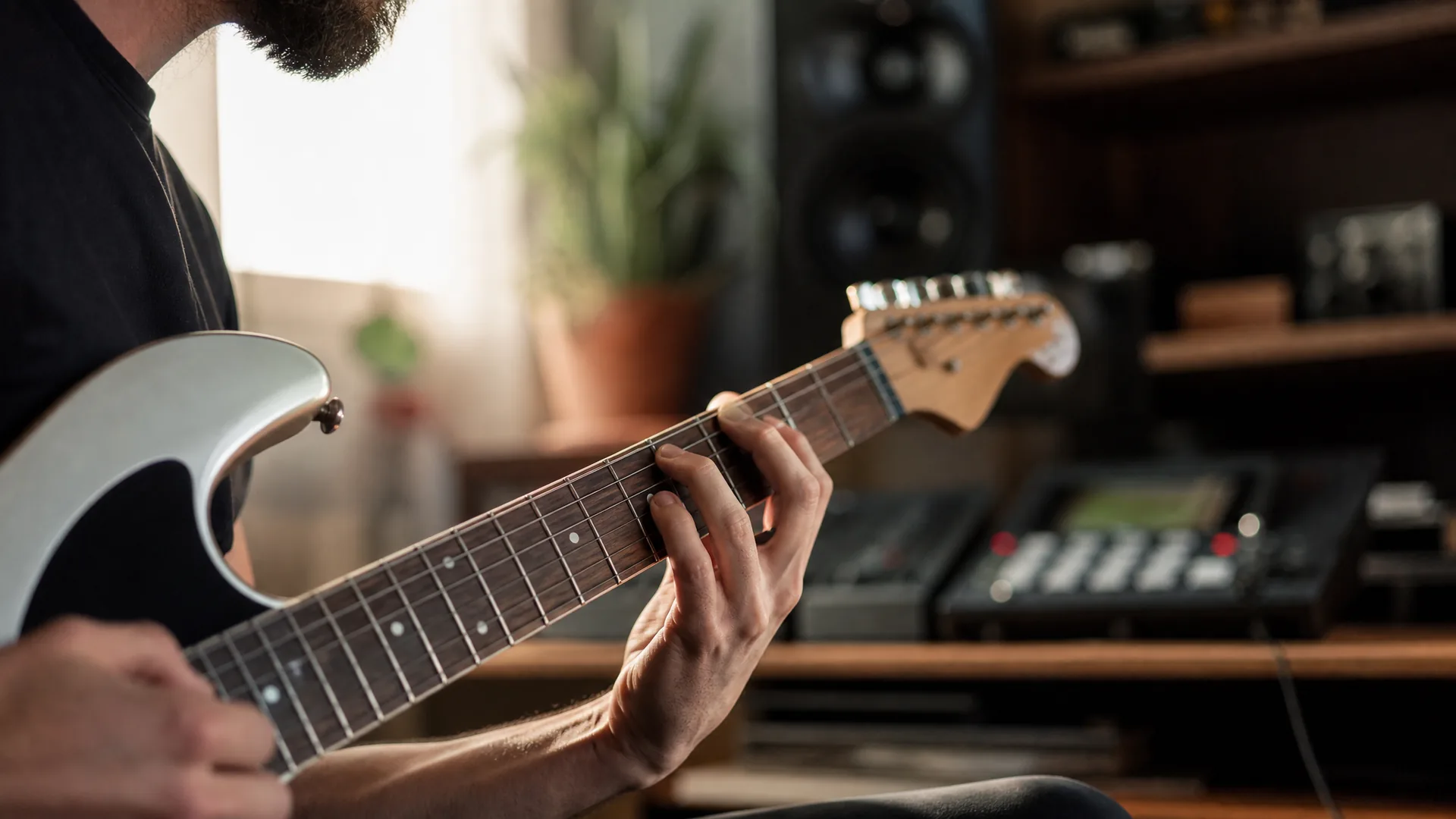
Most guitarists who play off the beat don't know they're doing it. That's the problem. Playing against the beat guitar, deliberate, intentional displacement of a phrase or accent away from the downbeat, is one of the most powerful tools in a rhythm player's hands. But it only works when you're in control. The moment it happens by accident, it's a mistake. Knowing the difference starts here.
The Real Difference Between Sloppy and Intentional Rhythmic Playing
Two guitarists play a note that lands between the beats. One of them is making a musical choice. The other is drifting. From the outside, the notes sound identical. From the inside, and in the recording, everything is different.
Intentional rhythmic displacement is a statement. It says: I know where the beat is, and I'm choosing not to land on it. Sloppy timing says nothing, because the player isn't in command of the relationship between their phrase and the grid.
The distinction lives entirely in awareness and intention. A note landing a fraction behind the beat is expressive in one context and amateurish in another. What separates them is whether the guitarist decided to be there.
Why Most Guitarists Can't Hear Themselves
The hardest thing to develop is the ability to listen to yourself while you play. Most players are so focused on what they're playing that they stop listening to when they're playing it.
This is why recording yourself is non-negotiable. You can't evaluate rhythmic placement in real time if you've never heard yourself from the outside. The gap between how you feel your timing and how it actually sits in the track is often shocking, and that gap is exactly where the work happens.
Guitar Timing and Rhythm: The Foundation You Can't Skip
Guitar timing and rhythm are often treated as one thing, but they are separate. Confusing them makes it impossible to diagnose your own playing, or fix it.
The Pulse, the Grid, and the Groove
Tempo is the clock. It's the metronome, the drummer's kick, the absolute reference point that doesn't move.
The beat is the grid, the subdivisions of that clock into measures, downbeats, upbeats, eighth notes, sixteenth notes. The grid is where most players live because it's where music theory is taught.
Feel is the relationship between your phrase and that grid. Feel is what makes two guitarists playing the same notes sound completely different. One sits right on the grid; the other floats just behind it. Neither is wrong, as long as it's deliberate.
Players who can't distinguish these three concepts can't describe what they're doing rhythmically. And they can't fix it when it goes wrong.
What Playing Against the Beat Actually Means
Playing against the beat guitar means making a conscious choice to place accents, phrases, or notes outside the downbeat grid. It's structured departure, and it takes several distinct forms.
Syncopation on Guitar: Accenting the Spaces
Syncopation on guitar means putting rhythmic weight on the weak beats or the "and" counts, the spaces between the main pulse. Instead of landing on beat 1, you land on the "and" of 1. Instead of hitting beat 3, you accent the "and" of 2.
Funk is built on this. Jimmy Nolen, playing behind James Brown, built entire grooves on a single syncopated scratch-strum pattern, a sixteenth-note ghost strum with a single accented upstroke that landed precisely off the downbeat. The rhythmic intentionality in that one gesture is worth more than a hundred melodic runs.
Syncopation creates tension against the grid. The listener's ear expects the downbeat; you deny it. That denial, when it's controlled, is what makes a groove feel alive.
Pocket Playing and Swing Feel Guitar: Landing Behind or Ahead
Pocket playing means sitting slightly behind the beat, not dragging, but laying back into the groove so that each note feels settled, unhurried. Motown session guitarists mastered this. They locked in so precisely that their parts sounded almost minimalist: every note placed with surgical intent against the rhythm section, not on top of it. The pocket is controlled restraint.
Swing feel guitar is the jazz version of the same principle. Wes Montgomery and Kenny Burrell chose the right notes and also chose where in time to place them. A phrase sitting fractionally behind the beat breathes. A line leaning fractionally ahead of it drives. Both are intentional. Both require knowing exactly where the beat is before you decide to leave it.
Forward-pushed phrasing, landing fractionally ahead of the beat, creates urgency and forward momentum. It's the opposite of pocket lay-back, and it's equally valid when it's chosen deliberately.
These three approaches live along a single axis: your relationship to the beat. Playing guitar with feel is really about owning that axis.
Rhythmic Phrasing Techniques: How to Practice This on Purpose
Owning these concepts takes a practice methodology that builds rhythmic awareness into muscle memory.
How well do you really know the fretboard?
Take the free Fretboard Challenge and see exactly which notes cost you time. Then get the note map that fixes them.
One email with the map. Unsubscribe whenever: no card, nothing to cancel.
On its way.
Check your inbox in the next minute or two. If it is not there, look in promotions.
Listening Before Playing: The Essential First Step
Before you play a single note, train your ear as a musician. Sit with recordings and track where the rhythm sits, not what the notes are. Listen to how a Motown track breathes in the pocket. Listen to how a bebop guitarist pushes a phrase ahead of the band and then resolves it right on the bar.
Berklee's approach to rhythm guitar has long made this explicit: feel is a measurable relationship between where you place a note and where the beat is. Students learn to quantify that relationship before they're expected to own it.
If you can't hear it, you can't do it on purpose.
Exercises to Internalize Rhythmic Phrasing
Transcribe rhythms, not just notes. When you transcribe a solo or rhythm part, notate when each note falls relative to the click, as well as what pitch it is. Transcribing jazz solos for rhythmic analysis is one of the fastest ways to build this awareness. You'll start hearing pocket and push as physical locations in the bar.
Sing the phrase before you play it. If you can sing a syncopated rhythm accurately, placing the accent in the right spot against a metronome, your hands have a target to aim at. Without the vocal rehearsal, you're guessing. With it, you're directing.
Record everything and analyze placement. Set a click, record your part, then zoom in. Where exactly does each downbeat land relative to the click? Are you consistently behind, consistently ahead, or scattered? Consistent placement, even if it's slightly behind or ahead, is a feel. Scattered placement is drift. You need to know which one you have before you can correct it.
What the Masters Knew That Most Guitarists Ignore
The greatest rhythm players were deliberate. They made conscious decisions about where to sit in the pocket, and those decisions came from deep listening and musical context.
Adam Levine spent years as a Motown studio guitarist, a context where rhythmic discipline was a professional requirement. The studio clock never stopped. Every placement decision had to be intentional because there was no room for drift when the track was being cut for release. That environment sharpens something casual practice rarely touches: the ability to place a note exactly where you mean to, every time.
The Motown session culture produced players who understood that restraint is a rhythmic statement. Staying out of the way of the bass and drums, sitting just behind the beat so the groove has room to breathe, requires the same precision as a flashy lead run. It's harder, in some ways, because there's nowhere to hide behind complexity.
In jazz, how Motown guitarists shaped modern playing is an underappreciated through-line. The same pocket discipline that made Motown records undeniable translated directly into the rhythmic vocabulary jazz guitarists used to build expressive phrasing. Wes Montgomery's lay-back phrasing and the Motown rhythm section's locked-in groove come from the same understanding: know where the beat is so completely that departing from it is always a choice.
From Knowing to Doing: Making Rhythmic Intent a Habit
You can understand all of this and still lose it under pressure. When the band is loud, when the changes are fast, when there's an audience, the temptation is to revert to reactive playing. You stop choosing and start surviving.
The gap between knowing and doing is the real challenge. Decision over patterns in guitar improvisation is at the heart of this: you can't make rhythmic choices if you're running on autopilot. Mastery means internalizing the beat so deeply that departure from it is always intentional, never accidental.
This is a long-term project. It happens over time, when you hold yourself accountable to the click, record yourself consistently, and refuse to let rhythmic drift become a habit you tolerate. Why intermediate guitarists get stuck often traces directly back to this: they've plateaued technically but never developed rhythmic sovereignty.
The goal is to choose, on the beat or off it, and to execute that choice so cleanly that the listener feels it as music. That's the standard. It's higher than most players hold themselves to. It's also the one that matters.
If you're ready to build that level of rhythmic intentionality into your playing, as a practiced, embodied skill, that's exactly what the Adam Loves Guitar Academy is designed to develop. The concepts here are the map. The Academy is where you do the miles.
